Overlaid or Overlayed: Which Is Correct?
If you’re choosing between overlaid and overlayed, the answer is one word: overlaid. It is the past tense and past participle of the verb overlay — and it’s irregular, in the lay → laid family — and it’s the form listed by every major dictionary: Cambridge, Oxford, Merriam-Webster, and Collins. Overlayed is a widespread misspelling, born of treating an irregular verb as a regular one. In the four major references checked, it has no entry as an inflection of “overlay” — though, as we’ll see below, that hasn’t stopped it from spreading.
Quick Answer
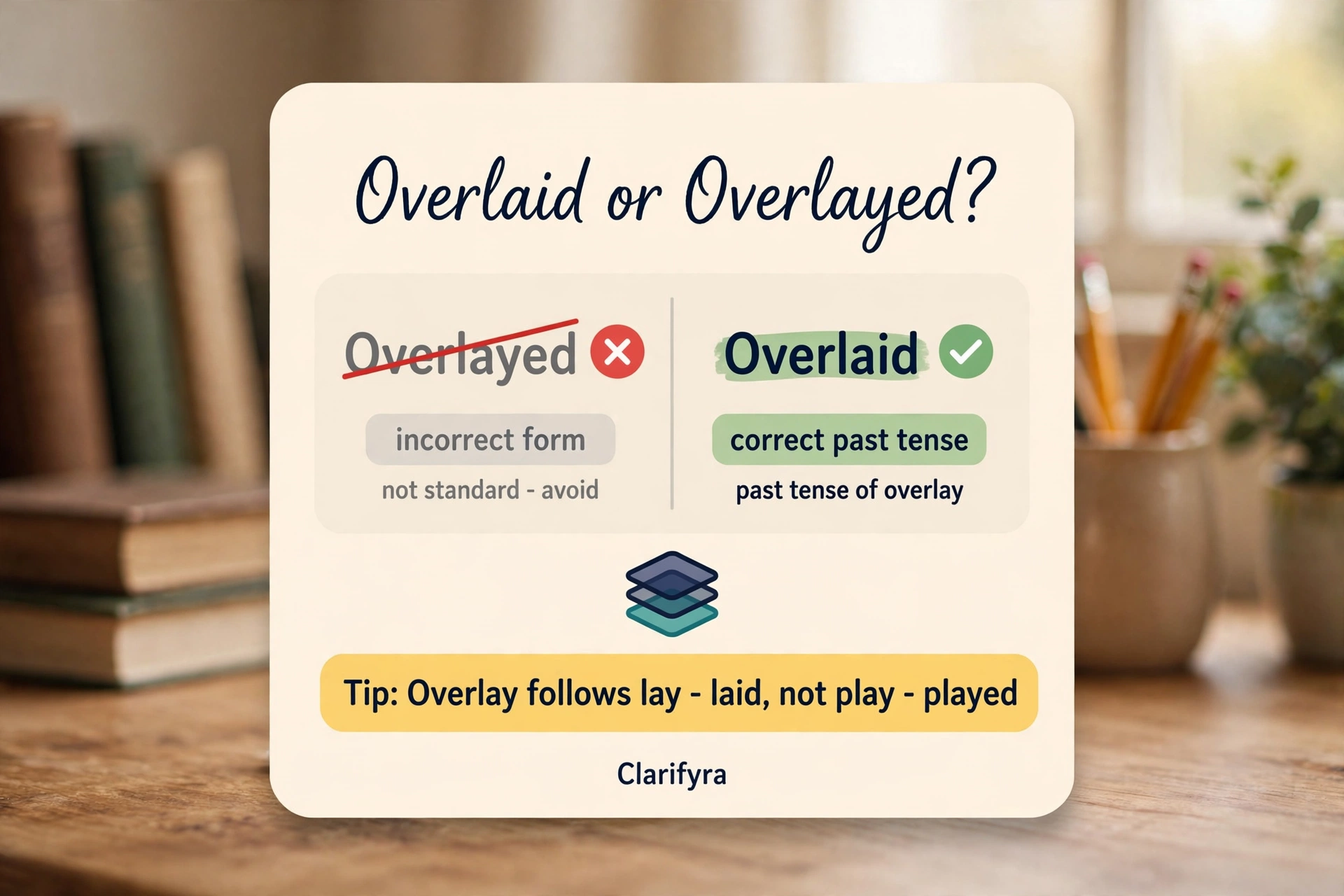
Overlaid is the correct past tense and past participle of overlay: “she overlaid the text on the image.” Overlayed is a common error — an over-regularized -ed form with no entry as an inflection in Cambridge, Oxford, Merriam-Webster, or Collins. Write overlaid in every context, including video editing, maps, and web design.
What the Dictionaries Actually List
This is where precision matters, because the common claim “it’s just a typo” deserves a closer look — and so does the occasional claim that “both are fine.” Here’s exactly what the references record:
| Reference | Past tense | Past participle | Notes |
|---|---|---|---|
| Cambridge | overlaid | overlaid | Full forms listed as: overlaying | overlaid | overlaid |
| Oxford (Advanced Learner’s) | overlaid | overlaid | Verb marked “usually passive”; its own entry confirms “overlaid: past tense, past participle of overlay” |
| Merriam-Webster | overlaid | overlaid | Collegiate entry gives the inflection as “overlaid; overlaying” — and its thesaurus states plainly: “overlaid — past tense of overlay” |
| Collins | overlaid | overlaid | Word forms: plural overlays, present participle overlaying, past tense and past participle overlaid |
| Longman | overlaid | overlaid | “Overlaid: the past tense and past participle of overlay” |
Five references, unanimous: overlaid, no alternative offered. But there’s a footnote worth making honestly. A few crowd-sourced references — notably Wiktionary — do list “overlayed” as an alternative past form. That kind of listing is descriptive: it documents a spelling people actually produce. But it doesn’t make it standard: the major dictionaries are unanimous in listing only ‘overlaid.’ As with inclosed vs enclosed, the lesson is that appearing in some reference is not the same as being recommended — when the major dictionaries are unanimous, follow them.
Why “Overlaid”: It’s a Compound of “Lay”
The irregularity isn’t random. Overlay is a compound: over + lay. And lay is one of English’s classic irregular verbs — lay → laid, in the same family as pay → paid and say → said. Compounds inherit the irregularity of their root: overlay → overlaid, just as “replay” → “replayed” inherits the regular pattern of “play.”
That’s exactly where the error comes from. Nobody parses “overlay” as “over + lay” when they’re writing quickly, so the brain applies the default rule — add -ed — and produces overlayed by analogy with play → played, display → displayed. It’s a perfectly natural mistake, and it’s why the misspelling is so common. But the verb’s DNA is lay, not play: it follows lay → laid, not play → played.
“The designer overlaid the text on the hero image.” (simple past)
“They have overlaid the old street grid with new traffic data.” (past participle)
✗ “She overlayed the video with captions.” → ✓ “She overlaid the video with captions.”
Where This Verb Actually Lives
“Overlay” has found its natural habitat in technical and design contexts — places where layers of one thing get placed on top of another. If you work with any of the following, this verb (and its past tense) is daily vocabulary:
- Maps and GIS: satellite imagery or data layers overlaid on a base map. Cambridge’s own example: “Clicking this button will overlay your map with satellite images of the terrain.”
- Video and photo editing: text, graphics, or effects overlaid on footage — “The subtitles were overlaid automatically.”
- Web and UI design: a modal dialog or dark scrim overlaid on the page behind it.
- Cartography and printing: Collins preserves the older senses — a transparent sheet of details laid over a map, and in printing, material used to adjust pressure on a forme.
Two usage notes from the dictionaries are worth absorbing. Oxford marks the verb as “usually passive” — in practice you meet it far more often as “was overlaid with” than as “she overlaid”. And Collins’ first verb sense is simply “if something is overlaid with something else, it is covered by it” — “The floor was overlaid with rugs of oriental design.” The core meaning is always the same: one layer placed over another.
The Noun “Overlay” — and Its Plural
Overlay is also a noun: the layer itself, or the thing laid on top. Oxford’s definition is the clearest: “a transparent sheet with drawings, figures, etc. on it that can be placed on top of another sheet in order to change it” — “an overlay showing population can be placed on top of the map” — and more broadly, “a thing that is laid on top of or covers something else.”
Two details to get right:
- The plural is “overlays” — not “overlaids.” Collins lists it explicitly: plural overlays.
- The stress shifts. The verb stresses the second syllable — over-LAY — while the noun stresses the first: OVER-lay. Cambridge gives the noun as UK /ˈəʊ.və.leɪ/, US /ˈoʊ.vɚ.leɪ/.
“Toggle the traffic overlay to see congestion data.” (noun)
“The map has three overlays active.” (plural noun)
✗ “The overlaid on the map shows the flood zones.” → ✓ “The overlay on the map shows the flood zones.” — Overlaid is a verb form, never the noun.
Don’t Confuse It with “Overlie”
Here’s the trap lurking behind this whole family. There is a separate verb, overlie — meaning “to lie over something” — and Oxford gives its principal parts as: past simple overlay, past participle overlain. So the word “overlay” is doing double duty: it’s the base form of “overlay” (to lay over, active) and the past simple of “overlie” (to lie over).
“A thick layer of rock overlies the coal seam.” (present of overlie — lies over)
“The mantle overlain by the crust…” (past participle of overlie)
“The engineers overlaid the plans with the survey data.” (past of overlay — laid over)
Keep the families separate: overlay → overlaid (you place something over), overlie → overlay → overlain (something lies over). In everyday writing you’ll almost always want the first one.
Pronunciation: UK and US
The verb is pronounced over-LAY: UK /ˌəʊvəˈleɪ/, US /ˌoʊvərˈleɪ/ (Oxford, Cambridge). The past form simply adds the /d/ of “laid”:
- Overlaid — UK /ˌəʊvəˈleɪd/, US /ˌoʊvərˈleɪd/
Say it as “over-LAID” — one clean syllable at the end, exactly like “laid” itself. There’s no extra syllable (“over-lay-ed” as three beats is a mispronunciation), and the stress stays on the second syllable, unlike the noun’s OVER-lay.
Common Mistakes
1. Writing “overlayed” for the past tense. ✗ “He overlayed the image on the background.” → ✓ “He overlaid the image on the background.” This is the big one — and remember, it will usually earn you a red underline from your spellchecker.
2. Writing “overlayed” for the past participle. ✗ “The subtitles were overlayed automatically.” → ✓ “The subtitles were overlaid automatically.” The participle is identical to the simple past: overlaid in both slots.
3. Using “overlaid” as a noun. ✗ “Click the overlaid to dismiss it.” → ✓ “Click the overlay to dismiss it.” The noun is overlay (plural overlays); overlaid is only ever a verb form.
4. Writing “overlaids” as a plural. ✗ “The map has three overlaids.” → ✓ “The map has three overlays.” The irregularity lives in the verb’s past tense; the noun pluralizes regularly.
5. Mixing up the overlay and overlie families. ✗ “The sediments have overlayed the bedrock.” → If you mean the active verb overlay (to cover): “The sediments have overlaid the bedrock.” If you mean overlie (to lie over): “The sediments have overlain the bedrock.” Pick the family first, then the form.
6. Treating the -ed form as acceptable because it’s “common online.” Frequency of error isn’t evidence of correctness. (Verb forms are a minefield generally — lyed vs lied untangles another past tense that looks almost plausible.)
How to Remember It
Anchor it to the root verb: overlay ends in lay, and lay goes to laid — so overlay goes to overlaid. If you can spell “laid,” you can spell “overlaid”: just bolt “over-” onto the front. The error comes from reaching for the play → played pattern instead; when you’re tempted by “overlayed,” ask which family the verb belongs to — lay → laid, not play → played — and overlaid follows.
Frequently Asked Questions
What is the past tense of “overlay”?
Overlaid — for both the simple past (“she overlaid the text on the photo”) and the past participle (“the text has been overlaid”). Every major dictionary — Cambridge, Oxford, Merriam-Webster, Collins, Longman — lists overlaid as the only form.
Is “overlayed” a real word?
Not in standard English. It has no entry as an inflection of “overlay” in the four major references checked (Cambridge, Oxford, Merriam-Webster, Collins). Some crowd-sourced references list it as an alternative, and it’s an extremely common misspelling, but in edited writing it’s an error.
Do I write “overlaid” or “overlayed” in video editing and design?
Overlaid. Technical contexts don’t change the verb’s spelling: “the captions were overlaid in post-production,” “a heat map overlaid on the base layer.” If anything, the stakes are higher in professional tools and documentation.
What’s the difference between “overlay” and “overlie”?
Overlay (overlaid, overlaid) means to lay something over something else — it’s active: you overlay text on an image. Overlie (overlay, overlain) means to lie over something — one thing rests on top of another: “sediment overlies the bedrock.” Don’t let the shared word “overlay” blur them.
What’s the plural of the noun “overlay”?
Overlays — “the map has three overlays active.” Only the verb’s past tense is irregular; the noun pluralizes with a plain -s.
Is there a British vs American difference?
None. Cambridge, Oxford, Collins, and Merriam-Webster all give overlaid identically, and the pronunciation differs only in the usual accent details (UK /ˌəʊvəˈleɪd/, US /ˌoʊvərˈleɪd/). Overlaid is safe on both sides of the Atlantic.
How do you pronounce “overlaid”?
As “over-LAID”: UK /ˌəʊvəˈleɪd/, US /ˌoʊvərˈleɪd/. Stress the second syllable, and rhyme the ending with “laid” — which is also the memory aid for the spelling.
Why do so many people write “overlayed”?
Because English’s default past-tense rule is “add -ed,” and “overlay” doesn’t visibly advertise that it’s built on the irregular verb lay. Writers reach for the play → played pattern by analogy, especially when typing fast in technical contexts. Natural — but still wrong in standard English.
Final Takeaway
Overlaid is the past tense and past participle of overlay — irregular, inherited from lay → laid, and listed without an alternative by Cambridge, Oxford, Merriam-Webster, Collins, and Longman. Overlayed is the regular -ed form your instincts reach for, and it’s an error in standard English. When the -ed ending tempts you, remember which family the verb belongs to: lay → laid, not play → played — and overlaid follows.