Invoke or Evoke: What’s the Difference?
“Invoke or evoke” look and sound similar, but they are not interchangeable in every sentence. Both can describe something being brought about, which is why phrases such as “invoke emotion” and “evoke emotion” can cause confusion. The easiest distinction is that invoke usually means to call upon, appeal to, or bring something into effect, while evoke usually means to bring a memory, feeling, image, or reaction to mind. Once you understand that difference, choosing the right verb becomes much easier.
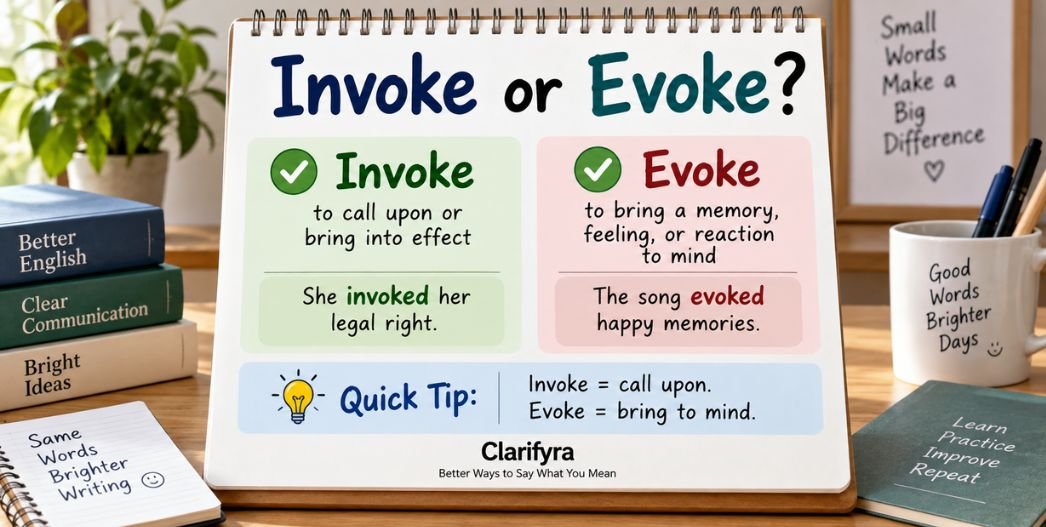
Both “invoke” and “evoke” are correct words. Use invoke when you mean “call upon,” “appeal to,” or “put into effect,” as in “invoke a law.” Use evoke when something brings a memory, feeling, image, or reaction to mind, as in “evoke a memory.”
Invoke vs. Evoke: The Quick Difference
| Feature | Invoke | Evoke |
|---|---|---|
| Basic meaning | Call upon, appeal to, or put into effect | Bring to mind or cause a feeling/reaction |
| Common objects | Law, right, authority, principle, protection | Memory, emotion, feeling, image, response |
| Typical sense | Deliberate or formal | Emotional, mental, or associative |
| Example | She invoked her right to appeal. | The song evoked childhood memories. |
| Correct word for memories? | Sometimes, depending on meaning | Usually |
| Correct word for emotions? | Possible in some contexts | Very common |
A useful shortcut is:
Invoke = call upon.
Evoke = bring to mind.
That distinction covers most everyday situations.
What Does “Invoke” Mean?
Invoke is a verb that generally means to call upon something, appeal to something, rely on something, or cause something to take effect.
It is particularly common when discussing laws, rights, rules, authority, principles, or formal procedures.
For example:
- The lawyer invoked the relevant law.
- She invoked her right to remain silent.
- The manager invoked the company’s policy.
- The speaker invoked the principle of fairness.
- The organization invoked an emergency procedure.
In these examples, something is being deliberately called upon or relied upon.
The word can also be used when calling upon a supernatural or divine power:
The ritual was intended to invoke divine protection.
In computing, invoke can have another technical meaning: to cause a program, function, or procedure to run.
So, although invoke can sometimes relate to feelings or memories, its broader idea is calling upon or bringing something into operation.
What Does “Evoke” Mean?
Evoke means to bring something into someone’s mind or cause a particular feeling, memory, image, or reaction.
It is especially common with emotional and mental experiences.
For example:
- The photograph evoked memories of childhood.
- The music evoked a feeling of nostalgia.
- The painting evokes a sense of calm.
- Her story evoked sympathy from the audience.
- The old house evoked memories of her grandparents.
Notice that the subject does not necessarily deliberately “call upon” the memory or feeling. Instead, it causes the memory or feeling to arise.
That is the central idea behind evoke.
Invoke or Evoke Emotion?
When talking about emotions, evoke is often the more natural choice.
For example:
The film evoked strong emotions in the audience.
This means the film caused people to experience strong emotions.
Other natural examples include:
- The speech evoked feelings of hope.
- The photograph evoked sadness.
- The story evoked compassion.
- The music evoked a powerful emotional response.
Invoke emotion is also possible, particularly in formal writing, but it can carry a slightly different emphasis. It may suggest deliberately calling upon or eliciting an emotional state.
Compare:
The poem evoked a feeling of loneliness.
The poem brought that feeling to the reader’s mind.
The speaker invoked fear to persuade the audience.
Here, invoke can emphasize deliberately calling upon fear as part of an argument or approach.
When your meaning is simply “cause an emotion or feeling to arise,” evoke is usually the clearest choice.
Invoke or Evoke Feelings?
If you are deciding between the two words before feelings, evoke will usually be the natural option.
Examples:
The melody evoked feelings of nostalgia.
The image evoked feelings of happiness.
The novel evoked feelings of unease.
The verb works because the object produces or brings an emotional experience to mind.
By contrast, invoke is more strongly associated with calling upon something:
The speaker invoked religious beliefs during the ceremony.
The distinction becomes clearer when you replace the verb mentally:
- Invoke → “call upon”
- Evoke → “bring out or bring to mind”
If “bring to mind” fits naturally, evoke is likely the right choice.
Invoke or Evoke a Response?
Both verbs can appear with response, but their emphasis can differ.
Evoke a response
Evoke a response means to cause someone to react.
The article evoked a strong response from readers.
Her performance evoked an enthusiastic response from the audience.
The question evoked an emotional response.
Here, something produces a reaction.
Invoke a response
Invoke a response can suggest deliberately calling for, triggering, or bringing about a response, especially in formal contexts.
The announcement invoked an immediate response from the authorities.
However, depending on the sentence, prompt, trigger, elicit, or produce may sound more natural.
For emotional or artistic reactions, evoke is especially useful:
The photograph evoked a powerful response.
For formal procedures or actions being called into operation, invoke may be more appropriate.
What About “Invoke or Evoke Change”?
This is a slightly different case because neither verb is automatically the best choice simply because the object is change.
Consider:
The new policy brought about significant change.
The campaign prompted major changes.
These are often clearer than forcing either invoke or evoke into the sentence.
Invoke change can be used when the sense is that someone deliberately calls for or brings a particular change into effect:
The reform invoked changes to the existing procedure.
But in ordinary English, cause change, bring about change, prompt change, or create change may communicate the idea more directly.
Evoke change is less natural when you simply mean “cause change.”
So if your intended meaning is “make something change,” choose a verb such as prompt, cause, or bring about unless there is a specific reason to use invoke or evoke.
When to Use “Invoke”
Use invoke when the sentence involves calling upon, appealing to, relying on, or activating something.
Laws and rights
The defendant invoked his legal rights.
Rules and policies
The employee invoked the company’s appeal procedure.
Authority or principles
The leader invoked the principle of equal treatment.
Protection or assistance
The villagers prayed to invoke divine protection.
Technical processes
The application invokes the function when the user submits the form.
A useful test is to ask:
Am I calling upon or relying on something?
If yes, invoke may be appropriate.
When to Use “Evoke”
Use evoke when something brings a memory, feeling, image, atmosphere, or reaction into someone’s mind.
Memories
The smell of fresh bread evoked memories of her childhood.
Feelings
The painting evoked a feeling of peace.
Emotions
The story evoked deep sadness.
Images
The description evoked an image of a quiet seaside village.
Reactions
The comedian’s performance evoked laughter from the crowd.
A useful test is:
Does something cause a memory, feeling, image, or reaction to arise?
If yes, evoke is usually a good choice.
Examples: Invoke and Evoke in Sentences
Seeing the words side by side makes the distinction easier.
Invoke
The attorney invoked the client’s constitutional rights.
The committee invoked its emergency powers.
The speaker invoked historical examples to support his argument.
The ceremony invoked traditional beliefs.
Evoke
The old photograph evoked memories of family holidays.
The melody evoked a strong sense of nostalgia.
The painting evokes the atmosphere of a quiet summer evening.
Her words evoked sympathy among the listeners.
The difference is not simply “active versus passive.” It is primarily about what relationship the subject has with the thing that follows.
Why Are These Words Confused?
The confusion comes partly from their similar spelling and pronunciation. More importantly, their meanings overlap around the general idea of bringing something about.
For example, both can sometimes describe causing a feeling or response. This makes it tempting to treat them as synonyms.
But their usual patterns are different.
Invoke tends to be associated with:
- rights
- laws
- rules
- authority
- principles
- powers
- protection
- formal procedures
Evoke tends to be associated with:
- memories
- emotions
- feelings
- images
- nostalgia
- sympathy
- laughter
- reactions
- associations
Learning these common combinations is more useful than trying to memorize a complicated grammatical rule.
A Simple Way to Remember the Difference
Think of invoke as calling something in.
You can:
- invoke a law
- invoke a right
- invoke authority
- invoke a principle
Think of evoke as bringing something out of the mind.
You can:
- evoke a memory
- evoke an emotion
- evoke a feeling
- evoke an image
- evoke nostalgia
So remember:
Invoke = call upon.
Evoke = bring to mind.
This simple distinction will help you choose correctly in most situations.
Common Mistakes to Avoid
1. Using “invoke” for every emotional reaction
Not every emotional reaction needs invoke.
The song evoked memories of school.
is more natural when the song brings those memories to mind.
2. Using “evoke” for a legal right
The defendant invoked his right to remain silent.
Here, invoke is appropriate because the person is formally relying on a right.
3. Treating the words as complete synonyms
Although there is some overlap, their typical uses differ. Replacing one with the other can change the emphasis or make a sentence sound unnatural.
4. Assuming “evoke” only refers to positive feelings
Evoke can describe any kind of emotional or mental response:
The photograph evoked sadness.
The story evoked fear.
The joke evoked laughter.
The memory evoked happiness.
The feeling can be positive, negative, or neutral.
Do You Invoke or Evoke a Memory?
Usually, evoke a memory is the natural expression when something causes a memory to come to mind.
The familiar song evoked a memory of her first concert.
Invoke a memory is possible in some contexts, particularly formal or literary writing, but evoke is generally the more direct choice when you mean “bring a memory to mind.”
The same principle applies to many related expressions:
- evoke memories
- evoke nostalgia
- evoke feelings
- evoke emotions
- evoke an image
These combinations describe something prompting an internal mental or emotional experience.
FAQ
Is “invoke” or “evoke” correct?
Both are correct words, but they have different typical meanings. Invoke generally means to call upon, appeal to, or bring something into effect. Evoke generally means to bring a memory, feeling, image, or reaction to mind.
Is it “invoke emotion” or “evoke emotion”?
Evoke emotion is usually the more natural choice when you mean that something causes an emotional reaction. For example, “The film evoked strong emotions.” Invoke emotion can also occur, particularly when the idea is deliberately calling upon an emotion.
Do you invoke or evoke feelings?
You will usually evoke feelings. For example, “The song evoked feelings of nostalgia.” Use invoke when the meaning is closer to calling upon or appealing to something.
Do you invoke or evoke a response?
Both can be correct, depending on context. Evoke a response emphasizes causing a reaction, while invoke a response can emphasize triggering or calling for a response in a more formal context.
Is “invoke change” or “evoke change” correct?
Neither expression is universally required. If you mean “cause change,” phrases such as prompt change, bring about change, or cause change are often clearer. Invoke may work when the sense is deliberately bringing something into effect.
What is the easiest way to remember the difference?
Remember invoke = call upon and evoke = bring to mind. Invoke a law, right, authority, or principle; evoke a memory, feeling, emotion, image, or atmosphere.
The Bottom Line
Choose invoke when you are talking about calling upon, relying on, appealing to, or activating something. Choose evoke when something brings a memory, emotion, feeling, image, or reaction to mind. In particular, evoke is usually the natural choice for memories and emotional responses, while invoke is strongly associated with rights, laws, authority, principles, and formal actions. For more clear explanations of easily confused English words, Clarifyra helps you find better ways to say what you mean.