Memorise or Memorize: UK & US, Which Spelling Is Correct?
If you are unsure whether to write memorise or memorize, the good news is that both spellings are correct. They are two regional forms of the same verb, meaning to learn something so thoroughly that you can remember it accurately. The main difference is spelling preference: memorize is standard in American English, while memorise is commonly preferred in British English. Other varieties, including Australian and Canadian English, require a little more context because their spelling conventions do not always follow exactly the same pattern.
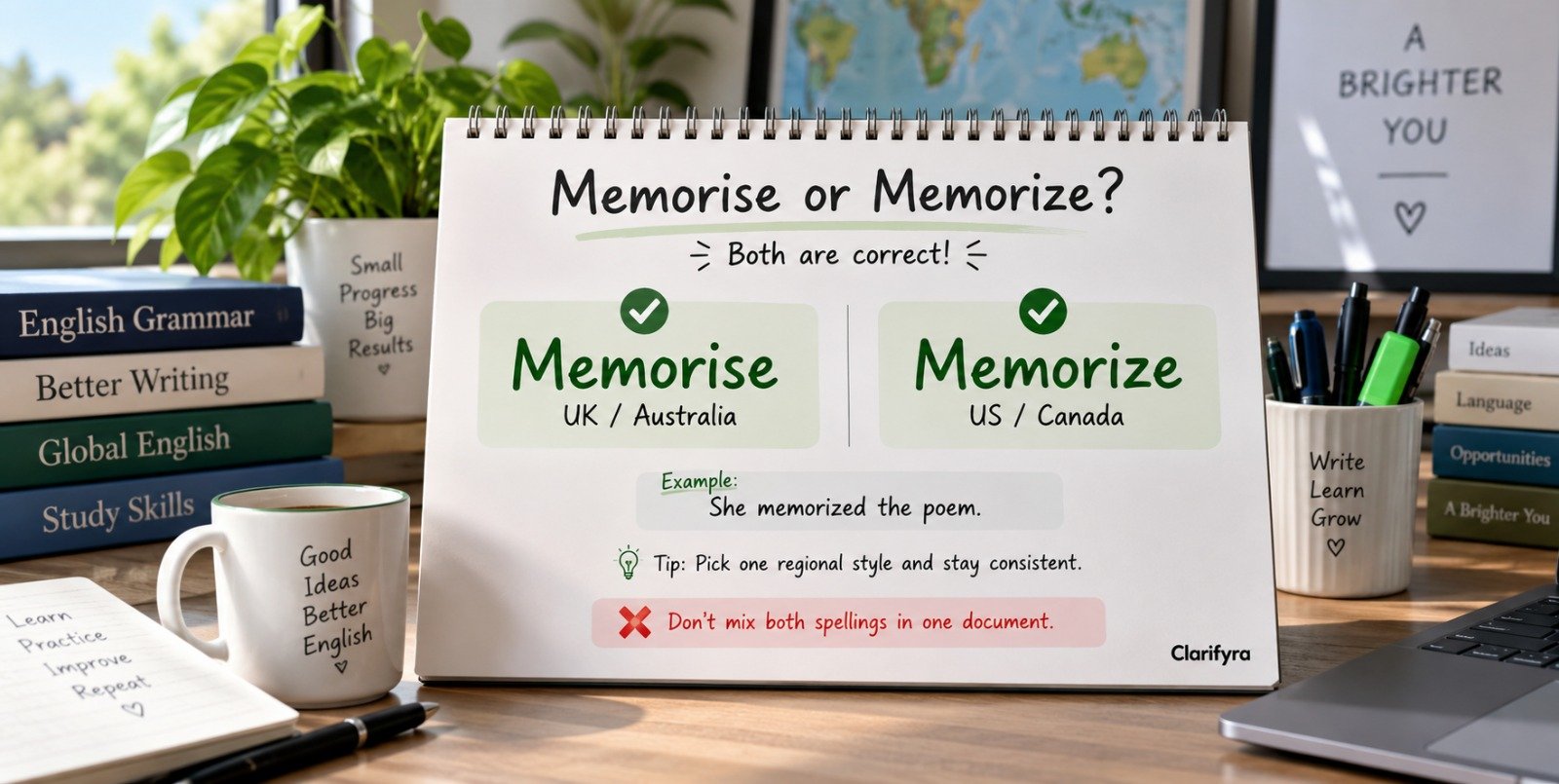
Memorise and memorize are both correct. Memorize is the standard American spelling, while memorise is commonly used in British English. They have exactly the same meaning: to learn something so that you can remember it accurately.
Memorise or Memorize: What Is the Difference?
There is no difference in meaning between these two forms. The distinction is mainly regional.
| Feature | Memorise | Memorize |
|---|---|---|
| Correct spelling? | Yes | Yes |
| Meaning | Learn something so you can remember it exactly | Learn something so you can remember it exactly |
| Word type | Verb | Verb |
| Common in | British English | American English |
| Example | I need to memorise this speech. | I need to memorize this speech. |
Cambridge describes memorize as a verb meaning to learn something so that you remember it exactly and notes that memorise is the usual UK alternative. Oxford similarly lists memorize while identifying memorise as a British English form.
The choice therefore depends mostly on the spelling system you are following.
Many English learners mix up similar-looking words such as Wandering or Wondering: What’s the Difference?
What Is Memorise?
Memorise is a verb meaning to learn information deliberately until you can recall it accurately without needing to look at the original source.
It is especially common in British-style spelling.
For example:
- The students had to memorise a short poem.
- I am trying to memorise her phone number.
- She memorised every line before the performance.
- You do not need to memorise the entire chapter.
The spelling changes normally when the verb changes form:
- memorise
- memorises
- memorised
- memorising
The meaning remains the same in every case.
What Is Memorize?
Memorize has exactly the same meaning, but it uses the -ize ending.
It is the standard spelling in American English and is also accepted in some other English varieties and style systems. Cambridge defines it as learning something so that it can be remembered exactly.
Examples include:
- Please memorize your password.
- He memorized the directions before leaving.
- We are memorizing vocabulary for tomorrow’s test.
- She can memorize long passages quickly.
Its common forms are:
- memorize
- memorizes
- memorized
- memorizing
So if you are writing primarily for an American audience, memorize is the natural choice.
Memorise or Memorize in UK English
In modern British English, memorise is a common and familiar spelling.
Cambridge specifically labels memorise as the usual UK form, while Oxford recognizes both forms and notes memorise as British English.
For example:
British style:
She had to memorise the poem before Friday.
That said, memorize is not inherently incorrect in Britain. Some British publishing traditions and dictionaries also allow -ize spellings in words of this type. The safest approach is to follow the style guide, dictionary, school requirements, or publication standards you are expected to use.
For everyday British writing, however, memorise will usually look more familiar.
Memorise or Memorize in American English
American English strongly favors memorize.
For example:
American style:
You should memorize the formula before the exam.
Related forms normally follow the same pattern:
- memorized
- memorizing
- memorization
Cambridge’s American dictionary entry uses memorize, and Oxford also lists the verb with the -ize form.
If your audience is in the United States, memorize is therefore the clearest choice.
Memorise or Memorize in Australia
Australian English generally follows many British spelling conventions, but Australian spelling is not simply identical to British English.
The Australian Government Style Manual recommends using an Australian dictionary and notes that Australian spelling usually follows British patterns while still having exceptions.
For this reason, you may encounter memorise in Australian writing, especially where -ise conventions are followed.
A natural Australian-style example would be:
Students were asked to memorise the safety instructions.
However, for formal Australian writing, it is better to follow the preferred dictionary or house style of the organization rather than assuming every British spelling rule automatically applies.
The most important rule is consistency. If your document uses organise, recognise, and similar -ise forms, memorise fits naturally with that style.
Memorise or Memorize in Canada
Canadian English combines features of both British and American spelling, so the answer is slightly different.
The Government of Canada’s Language Portal recommends -ize for many verbs, specifically including memorize. Its guidance says to use -ize in words such as civilize, criticize, memorize, and organize.
Canadian government guidance also explains that Canadian spelling has historically been influenced by both British and American English and recommends using a reliable Canadian dictionary consistently.
Therefore, for standard Canadian writing:
Preferred Canadian form: memorize
Example:
Try to memorize the emergency contact number.
This is a useful reminder that Canadian spelling does not always match British -ise conventions, even though Canada uses British-style forms in many other words.
What Does “Memorise by Heart” Mean?
The expression learn by heart means to learn something so well that you can repeat it from memory.
For example:
She learned the entire poem by heart.
You may also hear someone say they have memorised something by heart, although that wording can feel slightly repetitive because memorise already contains the idea of learning something so that you can recall it.
More natural choices are often:
- memorise the poem
- learn the poem by heart
- know the poem by heart
For example:
Natural: I memorised the speech before the ceremony.
Natural: I learned the speech by heart before the ceremony.
Both communicate nearly the same idea.
Useful Synonyms for Memorise and Memorize
The best memorise synonym depends on the sentence.
Possible alternatives include:
- learn
- learn by heart
- commit to memory
- remember
- retain
- master
They are not always perfectly interchangeable.
For example:
Memorize the formula means deliberately learning it until you can recall it.
Remember the formula may simply mean that the information remains in your memory.
Commit the formula to memory has a meaning very close to memorize, but it sounds more formal.
So although remember and learn are related, memorise/memorize usually emphasizes the deliberate process of fixing information in your memory.
Correct Usage Examples
Because both spellings have the same meaning, the examples differ mainly by regional style.
British-style examples
- I need to memorise these vocabulary words tonight.
- She memorised the route before starting her journey.
- Actors often have to memorise long sections of dialogue.
- He is memorising the names of all the new employees.
American-style examples
- I need to memorize these vocabulary words tonight.
- She memorized the route before starting her journey.
- Actors often have to memorize long sections of dialogue.
- He is memorizing the names of all the new employees.
The sentences mean exactly the same thing.
Common Mistakes to Avoid
The biggest mistake is not choosing one spelling over the other. Both are legitimate. The real problem is usually inconsistency.
For example, this may look untidy:
I memorised the first chapter and then memorized the second.
Unless you are quoting different sources or intentionally changing regional styles, choose one spelling system and stay with it.
Another mistake is assuming that every country follows either purely British or purely American spelling. Canadian English, for example, prefers memorize in official Canadian guidance even though many other Canadian spellings resemble British forms.
Writers should also keep related forms consistent. If you choose memorise, use memorised and memorising. If you choose memorize, use memorized and memorizing.
An Easy Way to Remember Which One to Use
A simple rule is:
US → memorize with Z
For British English, think:
UK → memorise with S
For Canada, remember that official Canadian writing guidance favors memorize.
For Australia, follow Australian English conventions and the dictionary or house style required for your writing.
The most important principle is not to switch randomly between the two forms in the same piece of writing.
Final Verdict: Memorise or Memorize?
Both spellings are correct and mean the same thing. Use memorise when following common British-style spelling and memorize for American English. Canadian government guidance also favors memorize, while Australian writers should follow an Australian dictionary or their required house style. Whichever version you choose, use it consistently throughout your writing. That kind of practical spelling clarity is exactly what Clarifyra aims to make easier.
Frequently Asked Questions
Is it memorise or memorize?
Both are correct. Memorise is commonly associated with British English, while memorize is standard in American English. Your audience and chosen spelling style determine which form you should use.
What is the meaning of memorise or memorize?
Both verbs mean to learn something deliberately so that you can remember or repeat it accurately later, such as memorising a poem, password, formula, speech, or set of facts.
Is “memorise” the UK spelling?
Yes, memorise is a common British spelling. However, memorize also appears in British dictionary and publishing traditions, so it should not automatically be treated as incorrect in every UK context.
Which spelling is used in Australia?
Australian English often follows British-style spelling, so memorise may be used. However, the Australian Government Style Manual recommends consulting an Australian dictionary because Australian spelling has its own conventions and exceptions.
Is it memorise or memorize in Canada?
Canadian government language guidance recommends memorize with a z for this word. Canadian English combines British and American spelling conventions, so not every Canadian word follows the same pattern.
Is “memorise by heart” correct?
It is understandable, but learn by heart or simply memorise is often more natural. For example, “She learned the poem by heart” and “She memorised the poem” communicate essentially the same idea.
You May Also Read | Liter or Litre: Which Spelling Is Correct?