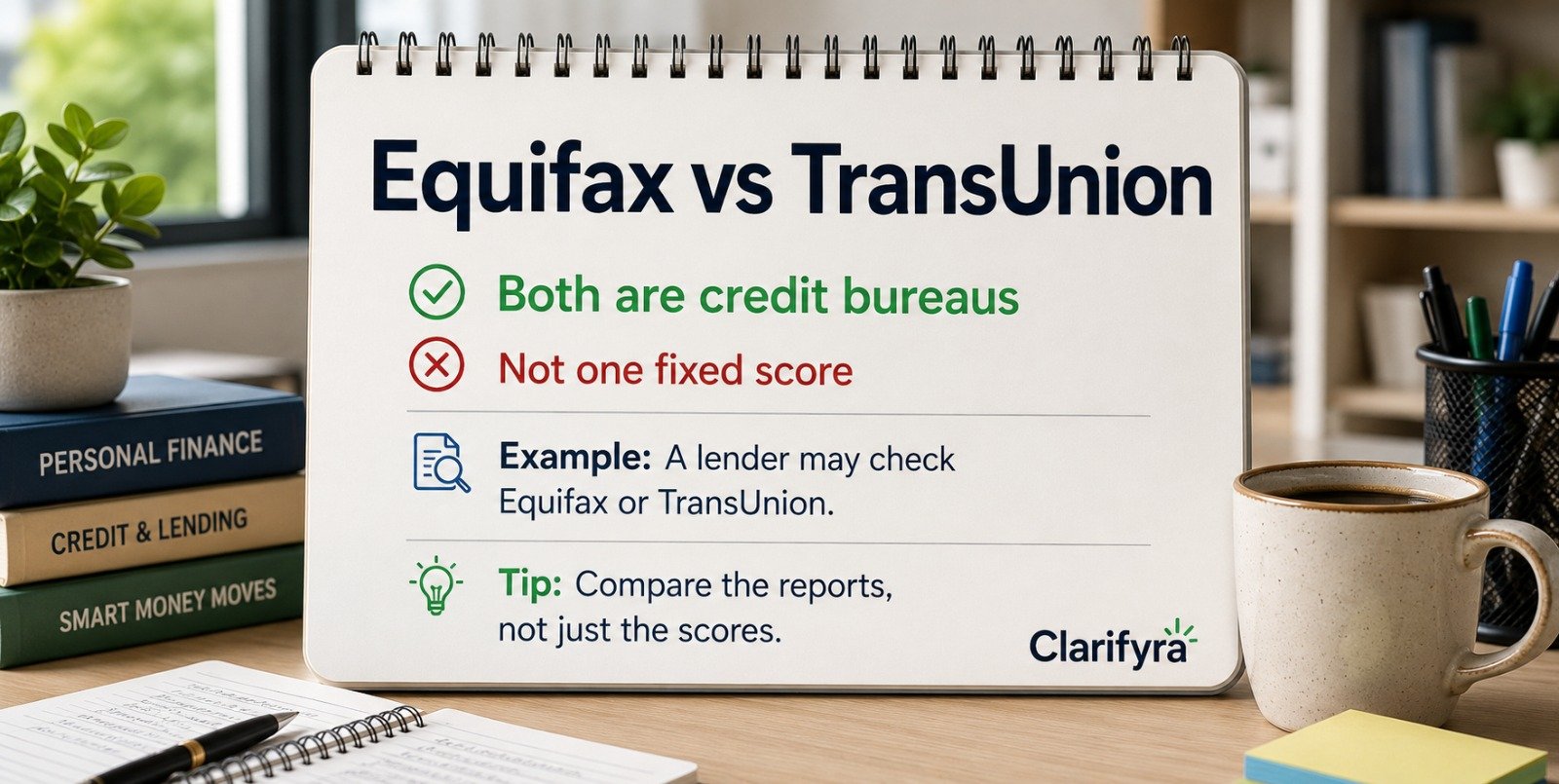
Equifax vs TransUnion: Which Credit Score Matters More?
Equifax and TransUnion are both major credit bureaus, so seeing different information or different credit scores from them can be confusing. Neither company is automatically more accurate or more important than the other. They independently collect information about your borrowing and payment history, and a lender may use data from either bureau when reviewing an application. The real difference often comes down to which accounts are reported to each bureau, when that information is updated, and which credit-scoring model is being used.
Equifax and TransUnion are both legitimate credit bureaus, and neither is universally better. Your reports and scores can differ because they may receive different information or updates, while lenders can choose which bureau and scoring model they use.
Equifax vs TransUnion: What’s the Difference?
The basic purpose of Equifax and TransUnion is very similar. Both maintain consumer credit reports containing information that can help lenders assess how a person has handled credit.
In the United States, Equifax and TransUnion are two of the three nationwide credit bureaus, with Experian being the third. Creditors, banks, credit-card companies, and other lenders may provide account information to these agencies. Lenders can then request reports or credit scores based on those reports when making credit decisions.
Here is the comparison at a glance:
| Feature | Equifax | TransUnion |
|---|---|---|
| Credit bureau? | Yes | Yes |
| One of the three major US bureaus? | Yes | Yes |
| Maintains credit reports? | Yes | Yes |
| Used by lenders? | Yes | Yes |
| Information can differ from other bureaus? | Yes | Yes |
| Can be used to calculate credit scores? | Yes | Yes |
| Automatically more important? | No | No |
| Used in Canada? | Yes | Yes |
| Major UK credit reference agency? | Yes | Yes |
The most important distinction is therefore not that one company performs a completely different job. It is that the information held in their files may differ.
You May Also Read | Columbia vs Colombia: Which Spelling Is Correct?
What Is Equifax?
Equifax is a credit reporting agency that collects and maintains information about consumers’ credit histories.
An Equifax credit report can contain details such as credit accounts, payment history, balances, inquiries, and certain public-record information. When permitted, lenders and other organizations can access this information to help assess creditworthiness.
Equifax does not make every lending decision itself. A bank or other lender establishes its own approval standards and decides how much importance to give the information contained in a credit report.
For example:
- A lender might request an Equifax report when you apply for a credit card.
- A loan account may appear on your Equifax file after the lender reports it.
- A score calculated using Equifax data may differ from a score calculated using another bureau’s data.
In the United States, Equifax operates alongside TransUnion and Experian as one of the three national credit bureaus.
What Is TransUnion?
TransUnion is also a major credit reporting agency. It gathers financial and credit information from permitted sources and maintains credit reports that lenders and other authorized organizations can use.
Like Equifax, TransUnion may hold information about your payment history, open and closed accounts, balances, credit inquiries, and other elements of your credit history.
This does not mean your TransUnion file will always be identical to your Equifax file.
A creditor may report an account to one bureau before another, or information may be updated at different times. In some cases, a particular account or inquiry may appear on one report but not another.
This difference in underlying information is one reason consumers can receive different credit scores even when their overall financial situation has not changed dramatically.
Why Are Equifax and TransUnion Credit Scores Different?
An Equifax vs TransUnion credit score difference is not automatically a sign that something is wrong.
Several factors can cause the numbers to differ.
Different Information May Be Reported
Creditors are not guaranteed to provide identical information to every credit bureau.
If one account appears on your TransUnion file but has not been reported to Equifax, the data used to calculate scores from those reports will be different.
FICO explains that the three major US bureaus can have differences in the information they collect and maintain.
Updates May Arrive at Different Times
Your account information is continually changing.
Suppose you have a credit-card balance of $2,000 and pay $1,500 of it off. One bureau may receive the lower balance before another does.
During that period, scores generated from the two reports could be different even though both bureaus eventually receive updated information.
You May Be Comparing Different Scoring Models
A credit bureau and a credit score are not the same thing.
The bureau provides the underlying credit-report data. A scoring model analyzes that data and produces a number.
Different services may display different types or versions of credit scores. A lender might also use a FICO Score version that is different from the score displayed in a consumer credit-monitoring app.
Because of this, comparing two credit scores is most meaningful when you know both:
- Which credit bureau supplied the data.
- Which scoring model and version produced the score.
There Could Be an Error
A large unexplained difference is worth investigating.
For example, one report might incorrectly show:
- a payment as late,
- an account you do not recognize,
- an incorrect balance,
- a duplicate debt,
- or information that should have been updated.
When scores differ significantly, compare the underlying reports instead of focusing only on the numbers.
Which Credit Score Matters More: TransUnion or Equifax?
Neither credit bureau universally matters more.
The score that matters for a particular application depends largely on the lender reviewing it. Lenders determine which reports and scores they want to use when evaluating applicants.
For example, one credit-card issuer might use a FICO Score calculated from TransUnion information, while another may use Equifax or Experian.
That means having a higher TransUnion score does not necessarily give you an advantage if the lender checks Equifax instead.
For most consumers, the better approach is to maintain accurate and healthy credit information across all applicable bureaus rather than trying to concentrate on only one.
Equifax vs TransUnion: Which Is Better?
There is no universal winner in an Equifax vs TransUnion: which is better comparison.
If you are checking your own credit, both can be valuable.
Equifax may contain information you have not yet noticed on TransUnion, while TransUnion may show accounts, balances, or inquiries differently. Reviewing both can therefore give you a more complete understanding of your credit history.
A better question is:
Which bureau will my lender use?
Unfortunately, the answer can vary from one lender and credit product to another.
For that reason, a higher score with one bureau should not be treated as your single “real” credit score.
Experian vs Equifax vs TransUnion
When discussing US credit reporting, the full comparison is often Experian vs Equifax vs TransUnion.
All three are national credit bureaus that maintain credit-report information.
They perform broadly similar functions, but their reports do not have to be identical.
| Bureau | Major US Credit Bureau | Maintains Credit Reports | May Be Used by Lenders |
|---|---|---|---|
| Equifax | Yes | Yes | Yes |
| Experian | Yes | Yes | Yes |
| TransUnion | Yes | Yes | Yes |
One creditor might report an account to all three, while another might not. Reporting dates may also vary.
As a result, a person could have three different scores even when the same general scoring system is involved.
FICO notes that differences in bureau data can lead to differences among FICO Scores generated from Equifax, Experian, and TransUnion information.
This is why the TransUnion vs Equifax vs Experian question should not be reduced to finding the “best” bureau. Each can provide a different view of your credit file.
FICO vs TransUnion vs Equifax
The phrase FICO vs TransUnion vs Equifax compares two different types of things.
Equifax and TransUnion are credit bureaus. FICO is a credit-scoring system.
FICO uses information contained in credit reports to calculate FICO Scores.
For example, you could have:
- a FICO Score based on Equifax data,
- a FICO Score based on TransUnion data,
- and a FICO Score based on Experian data.
Those scores do not necessarily have to match.
FICO also has different scoring versions designed for different types of lending. Auto lenders may use industry-specific FICO Auto Scores, while credit-card issuers may use FICO Bankcard Scores or other FICO versions.
So when someone says, “My FICO score is different from my TransUnion score,” the first step is to check what scoring model the TransUnion number actually represents.
Do Banks Use TransUnion or Equifax?
Banks can use TransUnion, Equifax, Experian, or more than one bureau, depending on the lender and type of application.
There is no general rule saying banks must choose Equifax over TransUnion or vice versa.
For many ordinary credit applications, lenders may use one FICO Score from one of the three major bureaus rather than pulling all three. The exact process varies according to the credit product and lender.
That is another reason it is risky to assume that only your highest credit score matters.
If you are preparing to apply for important credit, check each relevant report for inaccurate information before applying.
Equifax vs TransUnion in the UK
The Equifax vs TransUnion UK comparison works somewhat differently from the US system.
Equifax, Experian, and TransUnion are major credit reference agencies in the UK. They collect financial and public-record information and provide credit-related data that lenders can use in their decision-making.
However, the consumer scores displayed by different agencies should not be directly compared as though they are measurements on one universal scale.
TransUnion currently uses a UK consumer score range of 0 to 999, while Equifax uses a different scoring system with a maximum of 1,000. The agencies can also hold slightly different information and use their own scoring methods.
For example, a TransUnion score of 750 and an Equifax score of 750 do not necessarily represent exactly the same credit profile.
More importantly, UK lenders apply their own rules and lending criteria rather than simply accepting or rejecting an applicant based on the consumer-facing score shown by one credit reference agency.
Equifax vs TransUnion in Canada
In Canada, Equifax and TransUnion are the two main credit bureaus. Canada’s Financial Consumer Agency identifies both organizations as the country’s principal credit bureaus responsible for tracking credit histories and creating credit reports and scores.
Canadian consumers can obtain credit reports from both agencies, and checking your own report does not damage your credit rating.
The two reports can still contain differences. That makes checking both especially useful before applying for a mortgage, car loan, credit card, or other important form of credit.
Canadian government guidance specifically recommends reviewing reports from both Equifax and TransUnion when looking for errors or possible fraud.
So for Equifax vs TransUnion Canada, there is again no simple “better” bureau. Both matter.
How to Compare Your Equifax and TransUnion Reports
If you notice different scores, do not immediately assume the lower one is incorrect.
Instead, compare the reports themselves.
Look for differences in:
- credit-card balances,
- loan balances,
- payment status,
- open and closed accounts,
- credit inquiries,
- collection accounts,
- dates of updates,
- and accounts you do not recognize.
Pay particular attention to negative information appearing on only one report.
If the difference simply comes from an account being updated at a different time, it may resolve when new information is reported.
If the information itself is inaccurate, use the relevant bureau’s dispute process to request an investigation.
The underlying report matters because a credit score is ultimately calculated from information in that report.
Common Mistakes When Comparing Credit Scores
One common mistake is assuming you have only one official credit score. You can actually have multiple scores because different bureaus, scoring models, and score versions may be involved.
Another mistake is comparing two numbers without checking the scoring system. A FICO Score and another consumer score are not automatically equivalent simply because both are expressed as three-digit numbers.
It is also easy to assume that the highest bureau score is the one a bank will see. The lender chooses which report and scoring model it uses, so that may not be the case.
Finally, do not ignore a large unexplained difference. While moderate differences can occur naturally, unexpected accounts or incorrect negative information should be investigated.
The Bottom Line
Equifax and TransUnion perform similar roles, but their reports and the credit scores based on them can differ. Neither bureau is automatically more accurate, better, or more important. What matters most is that the information across your relevant reports is correct and that your overall credit habits remain strong. Understanding that distinction makes the Equifax vs TransUnion comparison much simpler—and fits Clarifyra’s goal of making easily confused terms and comparisons easier to understand.
Frequently Asked Questions
Is Equifax or TransUnion more accurate?
Neither is automatically more accurate. Both receive information from lenders and other permitted sources, but the data they hold may not be identical or updated at exactly the same time. If you find conflicting information, check the account details and dispute anything that is genuinely incorrect.
Why is my TransUnion score higher than my Equifax score?
Your TransUnion score may be higher because the reports contain different information, account updates arrived at different times, or the scores were produced using different scoring models. A difference by itself does not prove that either score is wrong.
Which credit score matters more, TransUnion or Equifax?
There is no universally more important bureau. The lender decides which credit bureau and scoring model it uses for a particular application. Maintaining accurate information across all relevant credit reports is therefore more useful than concentrating on only one score.
Do banks use TransUnion or Equifax?
Banks may use either bureau. In the United States, they may also use Experian. Some lending decisions rely on information from one bureau, while others may involve multiple reports or scores depending on the lender and type of credit.
Is FICO the same as TransUnion or Equifax?
No. FICO creates credit-scoring models, while Equifax and TransUnion are credit bureaus that maintain credit-report information. A FICO Score can be calculated using data from an Equifax, TransUnion, or Experian credit report.
Should I check both Equifax and TransUnion?
Yes, especially before applying for major credit. Comparing reports can help you find inaccurate balances, missing accounts, unfamiliar inquiries, or other inconsistencies. In the United States, it is also useful to review Experian because it is the third nationwide credit bureau.
You May Also Read | Upon vs Apon: Which Spelling Is Correct?