25 Formal Ways to Say “Apply” in Professional and Academic Writing
“Apply” is already a correct and professional English word, but it isn’t always the most precise choice. In a cover letter, you might submit an application or express your interest. In academic writing, you might implement a method. When discussing a rule, you may say that it is applicable to a particular situation.
So, the best formal way to say apply depends on what “apply” means in your sentence. Below, you’ll find natural alternatives for job applications, professional emails, academic work, requests, policies, and other formal situations.
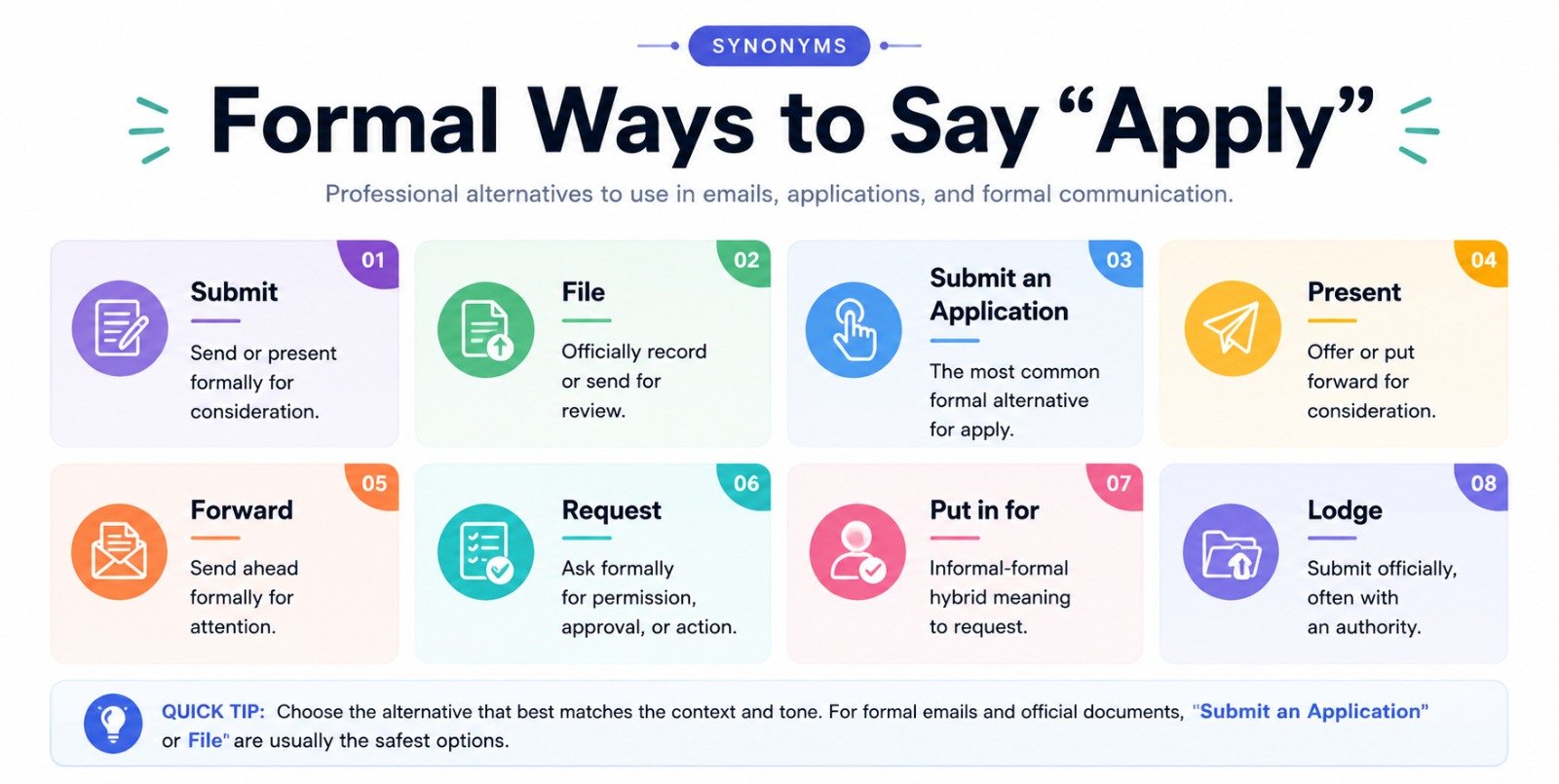
Formal Alternatives to “Apply” at a Glance
| Alternative | Best Used For | Example |
|---|---|---|
| Submit an application | Jobs, universities, programs | Please submit an application by Friday. |
| Express interest | Jobs and opportunities | I am writing to express my interest in the position. |
| Seek consideration | Formal applications | I wish to seek consideration for the role. |
| Request consideration | Formal requests | I respectfully request consideration for the scholarship. |
| Pursue an opportunity | Career situations | She hopes to pursue the opportunity. |
| Seek admission | Universities and programs | He plans to seek admission to the program. |
| Submit a request | Permissions and services | Employees may submit a request for leave. |
| Implement | Policies, methods, strategies | The company will implement the new policy. |
| Employ | Methods and techniques | Researchers employed a different approach. |
| Put into practice | Knowledge and principles | Students can put the theory into practice. |
| Utilize | Resources or tools | The team utilized the available resources. |
| Be applicable to | Rules and conditions | The policy is applicable to all employees. |
| Pertain to | Rules, topics, issues | These requirements pertain to new applicants. |
| Be relevant to | Ideas and circumstances | The findings are relevant to this case. |
What Does “Formal Way to Say Apply” Mean?
A formal way to say apply is a more context-specific expression that communicates the same general idea while fitting professional, academic, legal, administrative, or polite communication.
However, “apply” has several different meanings.
Consider these sentences:
- “I want to apply for the job.”
- “We will apply the new policy.”
- “This rule applies to everyone.”
- “Please apply the cream carefully.”
The same synonym cannot replace “apply” naturally in all four examples.
For instance, submit an application works for a job but not a policy. Implement works for a policy but would sound wrong when talking about submitting a job application.
That distinction matters more than simply choosing a word that sounds sophisticated.
Formal Ways to Say “Apply” for a Job
When “apply” refers to seeking employment, the most professional alternatives describe either submitting your application or expressing your interest in the role.
Other Ways to Say “Apply for a Job”
1. Submit an Application
This is one of the clearest formal alternatives.
Example:
“I would like to submit my application for the Marketing Coordinator position.”
It works well when you are actually sending application materials.
2. Express My Interest
This sounds polished and natural in emails and cover letters.
Example:
“I am writing to express my interest in the Project Manager position.”
It doesn’t literally mean that you have completed an application, so avoid using it when the submission itself is important.
3. Seek Consideration
“Seek consideration” has a more formal and slightly traditional tone.
Example:
“I am writing to seek consideration for the available position.”
It is appropriate in formal letters but can sound unnecessarily stiff in an ordinary workplace email.
4. Request Consideration
This emphasizes your request to be considered rather than the act of completing an application.
Example:
“I respectfully request consideration for the position of Senior Analyst.”
5. Put Forward My Candidacy
This is a highly formal expression that suits leadership positions, committees, elections, appointments, and some senior professional roles.
Example:
“I would like to put forward my candidacy for the role of committee chair.”
For an ordinary retail or office job, “apply” or “submit my application” would normally sound more natural.
6. Pursue the Opportunity
This expression focuses on your interest in moving forward with an opportunity.
Example:
“I would be pleased to pursue this opportunity further.”
It is useful in networking and recruitment conversations, but it doesn’t necessarily mean a formal application has been submitted.
Professional Ways to Say “I Want to Apply”
“I want to apply” is grammatically correct, but want can sometimes sound too direct in formal correspondence.
You can soften it with:
- I would like to apply.
- I wish to be considered.
- I would like to submit my application.
- I am interested in pursuing this opportunity.
- I would like to express my interest in the position.
- I am writing to request consideration for the role.
Compare:
Direct:
“I want to apply for your internship.”
More professional:
“I would like to submit my application for your internship program.”
Or:
“I am writing to express my interest in your internship program.”
The first version focuses on submitting an application; the second focuses on interest. They aren’t completely interchangeable.
Formal Ways to Say “Apply” for University or a Program
Academic admissions have their own useful alternatives.
Other Ways to Say “Apply for Admission”
7. Seek Admission
“Seek admission” is formal and especially suitable for universities, schools, training programs, and professional institutions.
Example:
“She intends to seek admission to the graduate program next year.”
8. Submit an Application for Admission
This is clearer when you mean the actual administrative process.
Example:
“Candidates must submit an application for admission before the deadline.”
9. Request Consideration for Admission
This is more formal and works well in correspondence with admissions departments.
Example:
“I respectfully request consideration for admission to the program.”
10. Seek Enrollment
“Seek enrollment” may work when the focus is joining or enrolling in a course or institution, although it isn’t a direct replacement in every context.
Example:
“International students seeking enrollment must provide additional documentation.”
Formal Ways to Say “Apply” When Making a Request
Sometimes “apply” means formally asking for a benefit, permit, grant, leave period, or service.
Other Ways to Say “Apply for Something”
11. Submit a Request
Useful for workplace and administrative communication.
Example:
“Employees may submit a request for annual leave through the online portal.”
12. File a Request
“File” has a more administrative or procedural tone.
Example:
“Residents may file a request for reconsideration within 30 days.”
13. Request Approval
Use this when the purpose of applying is specifically to obtain permission.
Example:
“The department must request approval before making the purchase.”
14. Seek Authorization
This is formal and useful in legal, corporate, and administrative settings.
Example:
“The contractor must seek authorization before beginning additional work.”
Again, these aren’t general synonyms for “apply.” They work only when the application itself is a request for permission or approval.
Formal Ways to Say “Apply” in Academic and Professional Writing
“Apply” can also mean putting a method, theory, strategy, or principle into use.
In this sense, job-related alternatives such as “submit an application” clearly don’t work.
Other Ways to Say “Apply a Method or Strategy”
15. Implement
Implement means to put a plan, policy, system, or strategy into effect.
Example:
“The organization will implement the revised procedure in September.”
It is especially natural with:
- policies
- strategies
- procedures
- systems
- plans
- reforms
16. Employ
“Employ” can mean to use a method, technique, strategy, or approach.
Example:
“The researchers employed a qualitative approach to examine the responses.”
This wording is particularly common in academic and technical contexts.
17. Put Into Practice
This phrase works when something moves from theory or knowledge into actual use.
Example:
“Participants will have an opportunity to put these principles into practice.”
It sounds less technical than “implement” and is especially useful when discussing skills, knowledge, or ideas.
18. Use
Don’t overlook the simplest option. Use is often clearer than a supposedly more formal synonym.
Example:
“The researchers used three methods to evaluate the results.”
Formal writing does not require unnecessarily complicated vocabulary.
19. Utilize
“Utilize” means to make practical use of something.
Example:
“The organization will utilize existing resources wherever possible.”
However, don’t replace every occurrence of “use” or “apply” with “utilize.” In many sentences, plain “use” is clearer.
20. Adopt
“Adopt” works when choosing and beginning to use a method, policy, approach, or practice.
Example:
“The department adopted a more flexible approach.”
It suggests accepting or taking up an approach rather than merely using it once.
When “Apply” Means “Be Relevant”
Consider this sentence:
“The new rule applies to all employees.”
Here, “apply” means that the rule concerns or is relevant to the employees.
Other Ways to Say “Applies To”
21. Be Applicable To
This is one of the closest formal alternatives.
Example:
“These conditions are applicable to all applicants.”
“Applicable” is particularly common in formal, administrative, and legal writing.
22. Pertain To
“Pertain to” means to relate directly to something.
Example:
“These requirements pertain to international applicants only.”
It can sound more formal than “apply to,” so it works well in regulations or official documents.
23. Be Relevant To
This is clearer and less bureaucratic.
Example:
“The findings are relevant to several areas of workplace policy.”
“Relevant to” and “applicable to” are related, but they aren’t identical. Something can be relevant to a discussion without being a rule that formally applies to it.
24. Relate To
This is a neutral option when “apply to” means “concern.”
Example:
“The following instructions relate to online submissions.”
25. Govern
“Govern” can work when a rule, policy, or law controls a particular activity.
Example:
“These regulations govern the handling of confidential information.”
It is stronger than “apply to” because it suggests authority or control.
Not Every Alternative Is Interchangeable
This is one of the most important distinctions to remember.
Submit an application ≠ express interest
Expressing interest doesn’t necessarily mean you’ve formally applied.
Implement ≠ employ
You might implement a policy but employ a research method.
Applicable to ≠ relevant to
“Applicable” often means something actually governs or fits a case, while “relevant” simply means it has a meaningful connection.
Seek admission ≠ enroll
Seeking admission happens before acceptance; enrollment generally happens after you’ve been admitted or otherwise become eligible to join.
Put forward my candidacy ≠ apply in every situation
The former is much more formal and often suits elections, appointments, or senior positions.
Choosing according to meaning will make your writing sound more natural than simply replacing “apply” with whichever synonym sounds most impressive.
Formal Wording for Related Everyday Expressions
Formality isn’t only about replacing “apply.” In professional communication, several everyday expressions can also be adjusted depending on your audience.
Other Ways to Say “Thank You” Formally
You can use:
- I sincerely appreciate your assistance.
- I greatly appreciate your support.
- Please accept my sincere thanks.
- I am grateful for your assistance.
- Thank you for your consideration.
“Thank you” itself is perfectly professional. More elaborate wording is useful when you want to emphasize gratitude, not simply to make every email sound formal.
Other Ways to Say “Hello” Formally
Natural formal greetings include:
- Good morning.
- Good afternoon.
- Good evening.
- Dear Mr./Ms. [Surname],
- Dear Hiring Manager,
- Dear Members of the Committee,
“Greetings” can also work, although it may sound less natural in some ordinary business emails than “Hello” or a time-based greeting.
Other Ways to Say “Stop” Formally
Depending on the situation:
- Please discontinue this practice.
- Please cease the activity.
- Kindly refrain from doing so.
- Please suspend further action.
- Please refrain from further contact.
“Cease” is considerably stronger and more official than “stop,” while “refrain from” often works as a polite instruction.
Other Ways to Say “Heads Up” Formally
“Heads up” is conversational. In professional writing, alternatives include:
- Please be advised that…
- Please note that…
- For your awareness…
- I wanted to inform you in advance that…
- I would like to bring this to your attention.
For example:
Casual:
“Just a heads up, tomorrow’s meeting has moved.”
Formal:
“Please note that tomorrow’s meeting has been rescheduled.”
Other Ways to Say “FYI” Formally
“FYI” means “for your information,” but a full phrase can sound smoother in formal communication.
Try:
- For your information…
- For your reference…
- Please note…
- For your awareness…
- By way of an update…
- I would like to bring this to your attention.
Choose according to purpose. “For your reference” is useful when supplying material that someone may consult later, while “please note” draws attention to an important point.
Other Ways to Say “Goodbye” Formally
In written correspondence, suitable closings include:
- Kind regards
- Best regards
- Sincerely
- With appreciation
- Thank you for your time
- I look forward to speaking with you again
“Goodbye” itself isn’t usually necessary at the end of a professional email.
A Note on Formal Expressions in Other Languages
Formality works differently across languages, so English rules shouldn’t simply be transferred word for word.
In Spanish, usted is the formal singular “you,” while tú is generally informal. Usage can vary by region and social context.
In French, Comment allez-vous ? is a standard formal way to ask “How are you?” The use of vous distinguishes it from more informal forms using tu.
These distinctions show why formal language involves more than choosing a longer synonym: audience, culture, relationship, and context all matter.
What About a Formal Way to Say “Dupe”?
“Dupe” has two notably different meanings, so the formal alternative depends on which one you intend.
If dupe means a similar, usually less expensive product:
- alternative
- substitute
- comparable product
- equivalent
- similar option
- lower-cost alternative
Example:
“This product is a more affordable alternative to the premium version.”
If dupe means to trick a person:
- deceive
- mislead
- defraud
- trick
- manipulate
Example:
“The fraudulent advertisement was designed to mislead consumers.”
Calling a product an “alternative” and saying someone was “deceived” are therefore completely different uses of the word.
How to Choose the Right Formal Alternative
Before replacing “apply,” look at what the verb is doing in your sentence.
If you’re seeking employment, submit an application or express interest usually sounds natural.
If you’re asking an organization for something, consider submit a request, seek authorization, or request approval.
If you’re talking about a policy or strategy, implement may be the better verb.
For research methods and techniques, employ or simply use often works well.
If a rule concerns a particular group, be applicable to or pertain to can express the meaning formally.
The goal isn’t to make your sentence sound complicated. It’s to choose a phrase that communicates the exact relationship you mean.
Frequently Asked Questions
What is the best formal way to say “apply”?
There isn’t one universal replacement. For jobs, submit an application is one of the clearest alternatives. For methods or policies, implement or employ may be appropriate. When “apply” means “be relevant,” be applicable to can work.
Is “apply” considered formal English?
Yes. “Apply” is completely acceptable in professional, academic, and formal English. You don’t need to replace it unless another phrase communicates your meaning more accurately or helps you avoid awkward repetition.
How do I professionally say “I want to apply for this position”?
Natural options include:
“I would like to apply for this position.”
“I would like to submit my application for this position.”
“I am writing to express my interest in this position.”
“I wish to be considered for this opportunity.”
The first sentence is already professional and is often the most straightforward choice.
What can I say instead of “apply this method”?
Depending on what you mean, you can say use this method, employ this method, implement this method, or put this method into practice. “Employ” is especially suitable in academic writing, while “implement” often suits organized procedures or strategies.
What is another formal way to say “this applies to you”?
Possible alternatives include:
“This is applicable to you.”
“This requirement pertains to you.”
“This policy covers your situation.”
The best option depends on whether you’re discussing a rule, requirement, policy, or general idea.
Can I say “express interest” instead of “apply”?
Sometimes, but they don’t mean exactly the same thing. Expressing interest tells someone that you are interested in an opportunity. Applying usually involves formally submitting the required information or documents.
Is “utilize” a better formal word than “apply”?
Not automatically. “Utilize” can mean to make practical use of something, but it doesn’t replace “apply” in every context. Simple words such as use are often clearer and just as appropriate in professional writing.
What is a formal way to say “apply for permission”?
Depending on the process, you might say request permission, seek authorization, request approval, or submit a request for approval.
Final Thoughts
A strong formal alternative to “apply” should make the sentence more precise, not simply more complicated. Submit an application works for official applications, express interest suits introductory professional communication, implement works for plans and policies, and be applicable to fits rules and conditions.
Pay attention to what you’re applying for or what you’re applying to, then choose wording that matches your audience and level of formality. That context-first approach is exactly what Clarifyra is designed to make easier: finding better ways to say what you mean without sacrificing natural English.
You May Also Read | Another Way to Say “Because of This”: 25 Better Alternatives