Another Way of Saying Old: 40+ Polite, Positive and Natural Alternatives
Sometimes old is exactly the right word. Other times, it can sound too blunt, vague, or even unintentionally disrespectful. Finding another way of saying old depends on what you’re describing: a person, an object, a tradition, a relationship, or something that belongs to the past.
For people, words such as older, senior, mature, and elderly may fit certain situations. For objects, you might need vintage, antique, historic, dated, or worn. And when “old” simply means something from an earlier time, former, previous, or long-standing can often be more accurate.
What Does “Old” Mean?
The word old has several meanings, which is why there isn’t one synonym that works everywhere.
You can use “old” to describe:
- someone who has lived for many years
- something that has existed for a long time
- something belonging to the past
- something you previously had or used
- something worn through age
- a familiar or long-standing relationship
Consider these sentences:
- “My old teacher called me yesterday.”
- “They live in an old house.”
- “That’s an old tradition.”
- “My phone is getting old.”
- “We’re old friends.”
Replacing “old” with the same word in all five sentences wouldn’t work. “Former teacher,” “historic house,” “long-standing tradition,” “aging phone,” and “long-time friends” all communicate different ideas more precisely.
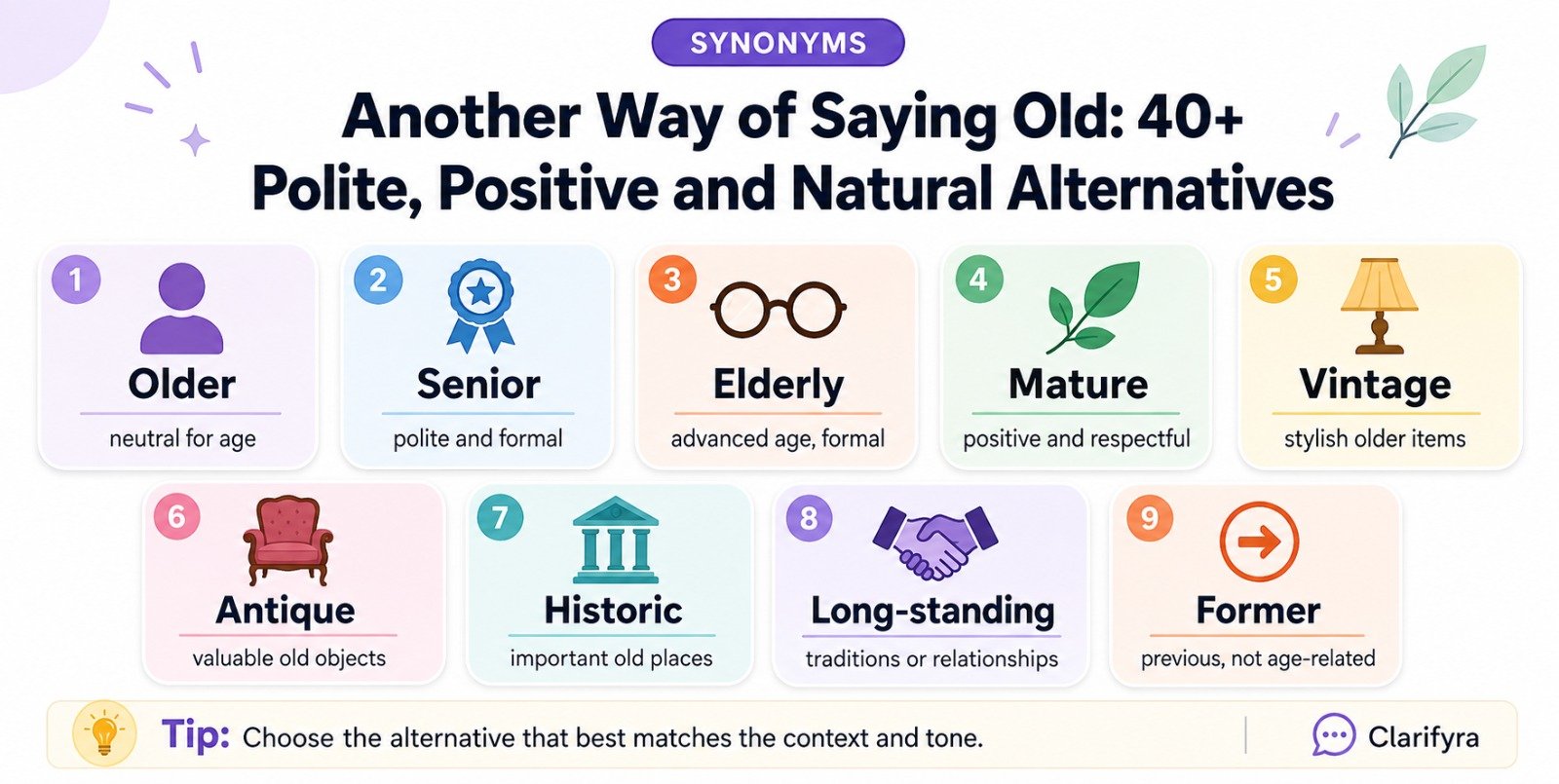
Quick Comparison: Alternatives to “Old”
| Alternative | Tone/Meaning | Best Used For |
|---|---|---|
| Older | Neutral | People and comparisons |
| Senior | Polite/formal | People, roles, age groups |
| Elderly | Formal, age-focused | People of advanced age |
| Mature | Positive/neutral | People, development |
| Aged | Formal/descriptive | People, food, materials |
| Vintage | Positive/stylish | Clothing, cars, décor |
| Antique | Historical/valuable | Furniture and collectible objects |
| Ancient | Very old | History, ruins, civilizations |
| Historic | Historically important | Buildings, places, events |
| Timeworn | Literary/descriptive | Objects and appearances |
| Long-standing | Established over time | Relationships, traditions, agreements |
| Established | Positive/professional | Businesses, institutions, practices |
| Former | Previous, not age-related | Jobs, positions, relationships |
| Previous | Earlier | Versions, systems, situations |
| Outdated | No longer current | Technology, ideas, information |
These alternatives aren’t interchangeable. Vintage can make age sound desirable, while outdated suggests that something is no longer suitable or current. Former refers to something previous and says nothing about physical age.
Polite Ways to Talk About an Older Person
Age-related language deserves a little more care because tone can change how a description feels.
In ordinary respectful communication, older person and older adult are often natural choices. “Senior” can also work, especially in phrases such as “senior discount,” “senior community,” or “senior services.”
Other Ways to Say “Old Person”
Useful alternatives include:
- older person
- older adult
- senior
- senior citizen
- elderly person
- mature adult
- person in later life
- older member of the community
Older person is probably the simplest neutral alternative.
“The center offers activities for older adults.”
This sounds more considerate than:
“The center offers activities for old people.”
Senior citizen is widely understood, but it can sound more institutional than conversational.
“Senior citizens may qualify for discounted fares.”
Elderly generally refers to people of advanced age, but it can feel more age-focused than “older adult.” It therefore works better in some formal contexts than in direct personal descriptions.
Other Ways to Say “Old People” Nicely
When referring to a group, natural choices include:
- older people
- older adults
- seniors
- senior citizens
- the older generation
- people in later life
For most everyday writing, older people or older adults is clear and respectful.
Instead of:
“The program helps old people stay connected.”
Write:
“The program helps older adults stay connected.”
“The older generation” can also work when you’re discussing generations rather than individuals.
“The tradition remains especially popular among the older generation.”
Positive Ways to Say Someone Is Old
Sometimes age is associated with experience, knowledge, or maturity rather than decline. In those situations, choosing positive language can change the tone considerably.
Other Ways to Say “Old” in a Positive Way
Depending on the sentence, try:
Seasoned
Usually describes someone with considerable experience.
“She’s a seasoned journalist who has covered major events for decades.”
Experienced
Focuses on knowledge gained over time rather than age.
“We need an experienced professional to lead the project.”
Mature
Can refer to age, behavior, or emotional development.
“He has a mature perspective on the issue.”
Distinguished
Suggests respect, accomplishment, or prominence.
“A distinguished professor delivered the opening lecture.”
Veteran
Often describes someone with long experience in a particular profession or activity.
“She’s a veteran broadcaster with decades of experience.”
Be careful with these substitutions. Calling someone experienced isn’t literally the same as calling them old. It shifts attention from age to what they’ve learned or accomplished.
Another Way of Saying Getting Old
“Getting old” is common and perfectly natural, but different expressions can make the idea sound neutral, humorous, gentle, or reflective.
Other Ways to Say “Getting Old”
Neutral options include:
- getting older
- growing older
- aging
- advancing in age
- entering later life
More conversational expressions include:
- getting on in years
- not getting any younger
- adding another year
- growing older and wiser
Examples:
“We’re all getting older.”
“He’s getting on in years, but he’s still incredibly active.”
“I’m not getting any younger, so I finally booked the trip.”
Not getting any younger is usually humorous or mildly self-deprecating. It wouldn’t be appropriate in every serious discussion about aging.
Growing older often feels softer and more reflective:
“Growing older has changed the way she thinks about success.”
Another Way of Saying Old and Grey
The phrase old and grey usually creates an image of someone reaching later life, often alongside a partner.
Possible alternatives include:
- growing old together
- older and gray-haired
- together in our later years
- growing older side by side
- spending our golden years together
- together for a lifetime
- growing older together
For romantic writing, growing old together is especially natural.
“I hope we grow old together.”
“Golden years” has a warmer, more optimistic tone:
“They dreamed of spending their golden years by the sea.”
If you’re simply describing appearance, gray-haired is more literal:
“A gray-haired gentleman opened the door.”
Another Way of Saying Old Enough
Old enough usually means someone has reached a sufficient or required age to do something.
However, the right replacement depends on what the age requirement represents.
Other Ways to Say “Old Enough”
- of age
- of legal age
- mature enough
- at the required age
- having reached the required age
- eligible by age
- of sufficient age
Examples:
“She’s old enough to drive.”
Could become:
“She has reached the legal driving age.”
But consider:
“He’s old enough to know better.”
Here, mature enough is closer to the intended meaning:
“He’s mature enough to know better.”
This shows why these phrases aren’t always direct substitutes. Of legal age relates to laws or formal age requirements, while mature enough concerns judgment or development.
Alternatives to “Old” for Objects and Things
When you’re describing things rather than people, “old” becomes even broader.
An old chair may be antique, vintage, worn, or simply used depending on its age and condition.
Other Ways to Say “Old” for Objects
Vintage
Used for older items that have style, character, or appeal associated with an earlier period.
“She found a vintage leather jacket at the market.”
Antique
Usually refers to an old collectible item valued partly because of its age.
“The room was furnished with antique tables and cabinets.”
Worn
Describes something damaged or changed through repeated use.
“He replaced his worn work boots.”
Aging
Describes something becoming older, often with signs of decline.
“The company is replacing its aging equipment.”
Outdated
Means something is no longer current or suitable.
“The website uses outdated software.”
Obsolete
Stronger than outdated. It means something has largely been replaced and is no longer useful or used.
“The old storage format is now obsolete.”
A vintage computer may be interesting to a collector, while an outdated computer may simply be frustrating to use. The emotional meaning matters.
Better Words for Old Buildings, Places, and Traditions
For buildings and traditions, age can be historically meaningful rather than negative.
Other Ways to Say “Old” for Buildings and Places
Consider:
- historic
- ancient
- centuries-old
- heritage
- traditional
- timeworn
- long-standing
- well-preserved
“They restored a historic house near the town center.”
“Visitors walked through the ancient ruins.”
“The village is known for its centuries-old architecture.”
Historic should generally be used when something has historical importance, not simply because it is old.
A thirty-year-old building may be old compared with nearby buildings, but that doesn’t automatically make it historic.
Other Ways to Say “Old Tradition”
Useful alternatives include:
- long-standing tradition
- time-honored tradition
- age-old tradition
- centuries-old tradition
- established custom
- traditional practice
“The festival follows a long-standing local tradition.”
Time-honored has a positive tone and suggests that a tradition is respected because it has lasted for many years.
When “Former” Is Better Than “Old”
One of the most common problems with “old” is ambiguity.
Consider:
“I spoke to my old boss.”
Does “old” mean the boss is elderly, or that the person used to be your boss?
If you mean the second, say:
“I spoke to my former boss.”
The same applies to:
- old job → former job / previous job
- old house → former home / previous home
- old company → former company
- old version → previous version
- old system → previous system / legacy system
Former and previous often make writing much clearer because they refer to sequence rather than age.
Another Way of Saying “Love Story as Old as Time”
The expression “as old as time” describes something that feels ancient, universal, or endlessly recurring.
If you want to describe a familiar or enduring romance without using that wording, several alternatives can work.
Other Ways to Say “A Love Story as Old as Time”
Try:
- a timeless love story
- an age-old romance
- an enduring tale of love
- a classic love story
- a romance through the ages
- a timeless tale of romance
- a story of enduring love
- a love that transcends generations
For example:
“Their story feels like a timeless romance.”
Or:
“It’s an enduring tale of love, sacrifice, and reunion.”
Timeless love story usually emphasizes lasting emotional appeal, while age-old romance highlights how familiar or ancient the theme is.
“Old” Isn’t Always Negative
It’s tempting to replace “old” whenever possible, but that isn’t necessary.
Sometimes “old” is the clearest and most natural word:
“How old are you?”
“My dog is twelve years old.”
“We found an old photograph.”
“She’s an old friend.”
Trying to replace “old” in every sentence can actually make writing less natural.
For instance:
“She’s a mature friend.”
doesn’t mean the same thing as:
“She’s an old friend.”
In old friend, the adjective usually refers to the length of the friendship, not the person’s age. Long-time friend would therefore be a more accurate alternative.
How to Choose the Right Alternative
Before replacing “old,” ask what you actually want to communicate.
If you’re discussing a person’s age, “older” is usually neutral. If you want to emphasize experience, words such as “seasoned” or “experienced” may work better.
For an object, consider whether you’re describing its age, condition, historical importance, or style. “Antique,” “worn,” “historic,” and “outdated” all tell the reader something different.
For something belonging to your past, words such as former and previous are generally clearer than “old.”
The goal isn’t to avoid the word “old.” It’s to choose a word that expresses your intended meaning more precisely.
Frequently Asked Questions
What is another way of saying old?
Depending on the context, you can use older, aged, mature, senior, elderly, vintage, antique, historic, long-standing, former, previous, or outdated. There is no single synonym that works in every sentence.
What is a nice way of saying an old person?
Older person or older adult are generally neutral and respectful choices. Senior also works in many contexts. “Elderly” is understood but can sound more formal and more focused on advanced age.
What is a nice way of saying old people?
You can say older people, older adults, seniors, senior citizens, people in later life, or the older generation. “Older adults” works especially well in neutral and professional writing.
What is another way of saying getting old?
Natural alternatives include getting older, growing older, aging, advancing in age, and getting on in years. For a humorous tone, you might say not getting any younger.
Is “mature” another word for old?
Sometimes, but not always. Mature can refer to someone who is fully developed or behaves sensibly, so it doesn’t automatically mean “old.” It can be useful when you want to emphasize development or experience instead of age.
What is another way of saying old and grey?
Depending on the tone, you can say growing old together, growing older side by side, together in our later years, or spending our golden years together. For romantic writing, “grow old together” is especially natural.
What can I say instead of old enough?
Options include of age, of legal age, mature enough, at the required age, and having reached the required age. Use “mature enough” for ability or judgment and “of legal age” when the issue involves a legal age requirement.
What’s a positive word for something old?
For objects or traditions, positive alternatives include vintage, classic, historic, heritage, time-honored, established, and well-preserved. The correct choice depends on why the item’s age matters.
Final Thoughts
Finding another way to say old is less about avoiding the word and more about choosing language that matches your meaning. Use older when talking neutrally about age, seasoned when experience matters, vintage or antique for certain valued objects, former for something from your past, and historic only when historical importance is part of the meaning.
Small wording choices can completely change how a sentence feels. That’s the idea behind Clarifyra: helping you find clearer, more natural ways to say exactly what you mean.
You May Also Read | Other Ways to Say Structural Inequalities: 30 Clear Alternatives