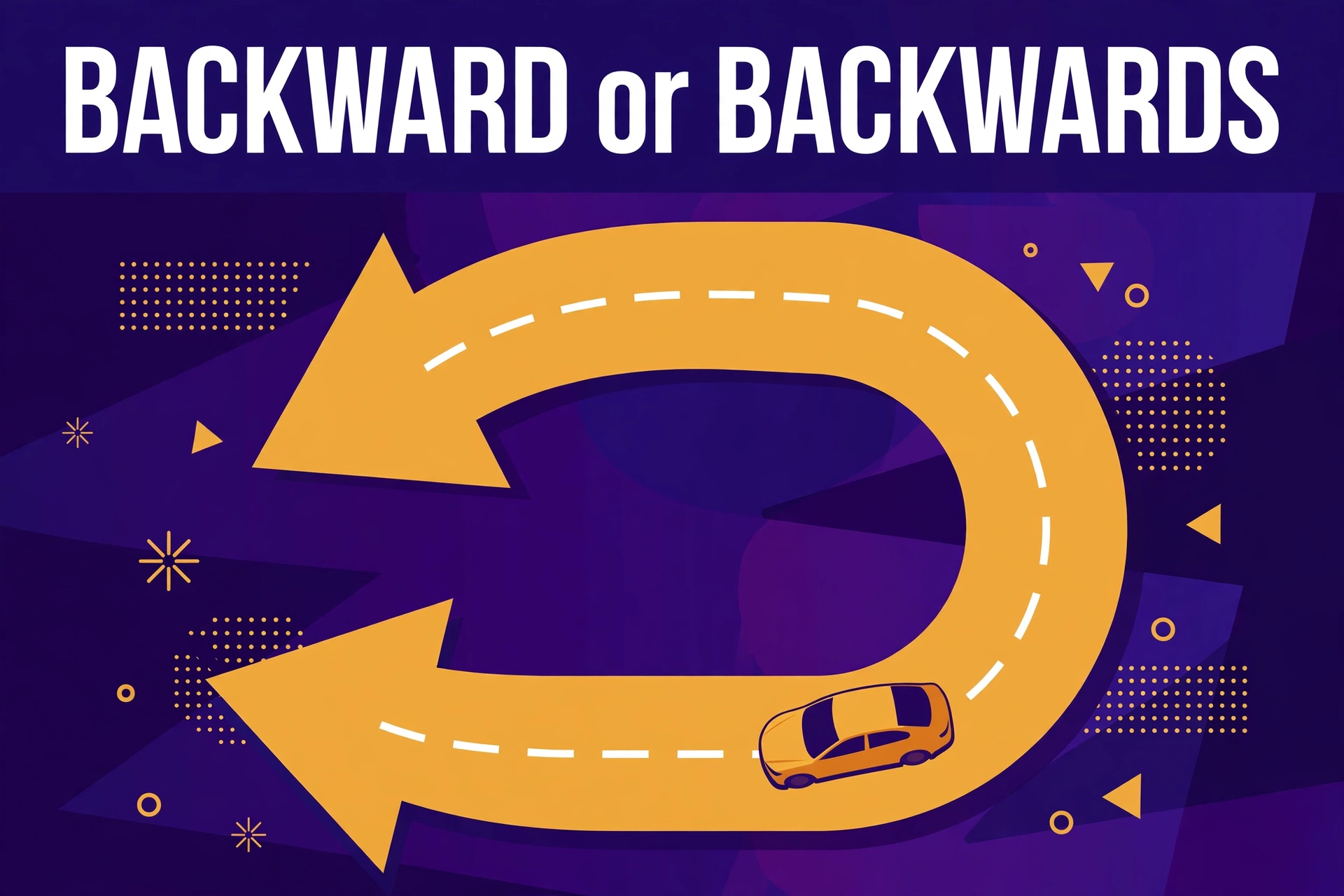
Backward or Backwards: Which Is Correct?
Backward and backwards are both correct words, and the difference between them is smaller than most people think. As adverbs, they mean the same thing — towards the back, in reverse, or towards a less advanced state — and the choice between them is mostly a matter of where you are writing. American English prefers backward; British English prefers backwards. As an adjective, though, there is only one correct form: backward. “A backwards step” is not standard English, and “a backward step” is the form every dictionary and style guide prescribes. The rule, in short, is this: use backward before a noun, and choose between backward and backwards as an adverb according to your audience.
Quick Answer: As an adjective, always use backward — “a backward step,” “a backward glance.” As an adverb, both forms are correct: American English prefers backward (“He stepped backward”) and British English prefers backwards (“He stepped backwards”). Both are pronounced with the stress on the first syllable: backward /ˈbæk.wəd/ (UK) or /ˈbæk.wərd/ (US), backwards /ˈbæk.wədz/ (UK) or /ˈbæk.wərdz/ (US). Never use backwards as an adjective in formal writing.
What the Dictionaries Say
Cambridge Dictionary lists backward as an adjective, marked “always before noun,” meaning not following the development of the times, or behind in progress — “a backward town” — and as an adverb, /ˈbækwərd/, with the note “also backwards,” meaning towards the back or in the direction behind you. The same entry records the idiom “backward and forward,” meaning to and fro: “The cat ran backward and forward near the door.” The adjective sense of being behind in time or progress is the one that gives the word its figurative uses: a backward policy, a backward economy, a backward-looking attitude.
Thesaurus.com states the position plainly: “Backward and backwards are used interchangeably as adverbs, with backward being more common in American English and backwards being more common in British English. Only backward is considered standard when used as an adjective.” Grammarly gives the same account, defining backward as an adjective meaning “directed towards the back or in the reverse direction; not advanced in civilization; dull in understanding; reluctant or not willing,” and backwards as an adverb meaning “towards the back or in the direction that is behind you; returning to a former or less advanced state.” Both sources agree that the adverb is a matter of regional preference and the adjective is not.
Merriam-Webster and the Oxford Learner’s Dictionaries follow the same line. Backward is listed as both adjective and adverb; backwards is listed as an adverb only. That asymmetry is the whole story. The -s is an adverb ending, and it does not belong on an adjective. If you remember that one fact, you will never get the pair wrong in formal writing.
Backward as an Adjective
As an adjective, backward has two groups of meanings. The first is directional: turned towards the back, or moving in reverse. A backward step is a step taken towards the rear. A backward glance is a look over your shoulder. A backward somersault is a somersault performed backwards. In these uses the word comes before the noun it describes, and it cannot be replaced by backwards without breaking the rules of standard English. “A backwards glance” is heard in casual speech, and it will be understood, but it is not the standard form, and it should not appear in careful writing.
The second group of meanings is figurative, and it is the group that gives the word its force. A backward place, policy, or attitude is one that is behind the times, undeveloped, or resistant to change: “a backward economy,” “backward policies,” “a backward-looking government.” In this sense the word is a judgement, and it is a strong one — it says that something has failed to keep up. The adjective backward-looking, written with a hyphen, means concerned with the past rather than the future, and its opposite is forward-looking. The noun is backwardness: the state of being behind in development.
Backward and Backwards as Adverbs
As adverbs, the two forms are interchangeable in meaning, and the choice is regional. In American English, the preferred adverb is backward: “He fell backward,” “She glanced backward,” “The car rolled backward down the hill.” In British English, the preferred adverb is backwards: “He fell backwards,” “She glanced backwards,” “The car rolled backwards down the hill.” Both are correct in both varieties — an American writer will not be marked wrong for “backwards,” and a British writer will not be marked wrong for “backward” — but each variety has a clear preference, and following it makes your writing sound natural to your readers.
The adverb has three main senses, and they cover most uses. The first is direction: towards the back, or in the direction behind you. “Step backward,” “Look backwards,” “He walked backwards out of the room.” The second is reversal: in the opposite order, or in the reverse of the usual way. “Count backwards from ten,” “Play the tape backwards,” “Read the sentence backwards.” The third is regression: towards a former or less advanced state. “The country is moving backwards,” “His health went backwards after the operation,” “The reforms took us ten years backwards.” In all three senses, the two spellings are available, and the regional preference is the only thing that separates them.
There is a reason for the difference, and it is a general one. British English adds an -s to a whole family of directional adverbs: towards, upwards, downwards, forwards, backwards, afterwards. American English uses the same words without the -s: toward, upward, downward, forward, backward, afterward. The pattern is consistent, and once you see it, the whole family becomes easy to manage. If you write towards, write backwards; if you write toward, write backward. The two choices belong together.
Fixed Phrases and Idioms
Several fixed phrases use these words, and they are worth learning as units. Backwards and forwards means to and fro, or in both directions: “She paced backwards and forwards across the room.” In American English the same phrase is backward and forward, and both are correct in their own variety. To know something backwards means to know it thoroughly, so well that you could recite it in reverse: “She knows the route backwards.” To bend over backwards means to try very hard to help someone or to do something: “They bent over backwards to make us welcome.” To go backwards means to regress or deteriorate: “Since the new manager arrived, the whole department has gone backwards.”
In computing, the phrase is backward compatible in American English and backwards compatible in British English, meaning that new software or hardware can work with older versions. The adjective in that phrase is compatible, and backward or backwards is the adverb modifying it, so both forms are acceptable — but the regional preference still applies, and a British manual that says “backwards compatible” is following the same rule as a British novel that says “he stepped backwards.”
Correct vs Incorrect
| Incorrect | Correct | Why |
|---|---|---|
| It was a backwards step for the company. | It was a backward step for the company. | Before a noun, only backward is standard; backwards is an adverb. |
| She gave a backwards glance over her shoulder. | She gave a backward glance over her shoulder. | Glance is a noun, so the adjective backward is required. |
| He stepped backwards. (American English) | He stepped backward. | American English prefers backward as the adverb. |
| He stepped backward. (British English) | He stepped backwards. | British English prefers backwards as the adverb. |
| The country is moving backward in time. (British English) | The country is moving backwards in time. | In British English the adverb takes the -s, matching towards and forwards. |
| Count backward from ten. (British English) | Count backwards from ten. | British English prefers backwards for the adverb, including in instructions. |
Common Mistakes to Avoid
1. Using “backwards” as an adjective
The most common mistake is using backwards before a noun: “a backwards step,” “a backwards glance,” “backwards policies.” In standard English, the adjective is always backward. The error is common in speech, and it is spreading in informal writing, but style guides and dictionaries still prescribe backward as the adjective, and formal writing should follow them.
2. Mixing the regional preferences
The second mistake is inconsistency: writing towards and backwards in one paragraph and toward and backward in the next, or using backwards in an American document and backward in a British one. Neither choice is wrong on its own, but mixing them looks careless. Pick the variety you are writing in and use its forms throughout — towards, forwards, backwards for British English; toward, forward, backward for American English.
3. Confusing “backward” with “backwards” in fixed phrases
The third mistake is getting the fixed phrases wrong: “bend over backward” instead of “bend over backwards,” or “know it backward” instead of “know it backwards.” The idioms use the adverb form, and in British English that form is backwards. In American English, “bend over backward” is the standard idiom, with the American adverb. Learn each idiom in the variety you write in, and do not swap the forms.
Frequently Asked Questions
Is it “backward” or “backwards”?
Both are correct as adverbs. American English prefers backward and British English prefers backwards, but both forms are understood everywhere. As an adjective, only backward is standard: “a backward step,” never “a backwards step.”
How do you pronounce “backward” and “backwards”?
Backward is pronounced /ˈbæk.wəd/ in British English and /ˈbæk.wərd/ in American English, with the stress on the first syllable. Backwards adds a /z/ sound at the end: /ˈbæk.wədz/ in British English and /ˈbæk.wərdz/ in American English.
What does “bend over backwards” mean?
It means to try very hard to help someone or to do something, often more than is reasonable: “The hotel bent over backwards to make our stay comfortable.” In American English the idiom is usually “bend over backward,” following the American preference for the adverb without -s.
What is the difference between “backward” and “backwards compatible”?
There is no difference in meaning. Backward compatible is the American spelling and backwards compatible is the British spelling, and both mean that new software or hardware works with older versions. The choice follows the same regional rule as the adverb in general.
The Takeaway
The rule fits in one sentence: backward is the only adjective, and as an adverb the choice is regional — backward in American English, backwards in British English. The -s belongs to the same family as towards, forwards, and upwards, so if you write British English, use it; if you write American English, leave it off. Keep the adjective and the adverb apart, and the pair will never cause trouble again.
Sources: Cambridge Dictionary (backward, adjective and adverb, UK /ˈbækwərd/, “also backwards”); Thesaurus.com (backward or backwards, adverb interchangeable, “only backward is considered standard when used as an adjective”); Grammarly (backward vs backwards, adjective and adverb definitions, regional preferences); Writing Explained (backward or backwards, British -s adverbs, American preference for backward).