Occurred or Occured: Which Is Correct?
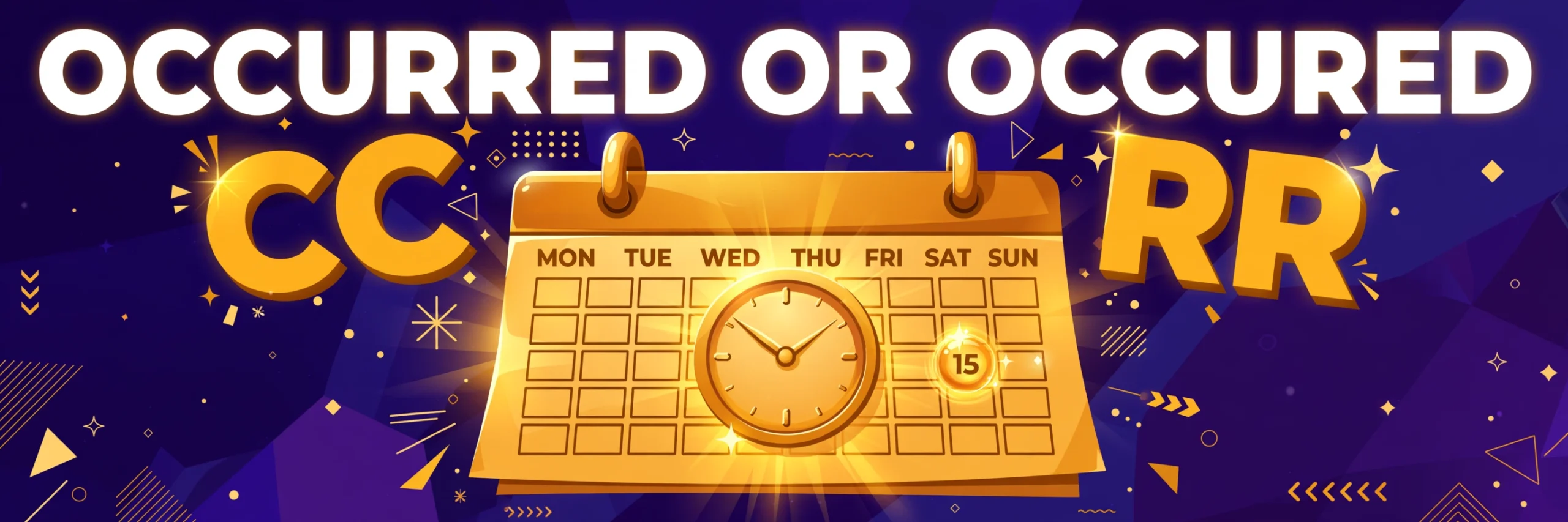
Occurred is the correct spelling of the past tense of occur, and it has two cs and two rs: o-c-c-u-r-r-e-d. Occured, with a single r, is a misspelling — it does not appear in any dictionary, and spellcheckers flag it every time. The double r is not a quirk of this one word. It follows a regular English spelling rule: when a verb ends in one vowel followed by one consonant, and the stress falls on the last syllable, the final consonant doubles before a suffix that begins with a vowel. Occur fits the rule exactly, so the r doubles in occurred, occurring, and occurrence.
Quick Answer: Write occurred — double c, double r. Occured (single r) is always a misspelling. The rule: occur is stressed on its last syllable (oc-CUR), so the final r doubles before -ed, -ing, and -ence: occurred, occurring, occurrence. The double c is already in the base word occur — the rule only adds the second r.
What the Dictionaries Say
Merriam-Webster lists occur as an intransitive verb with three meanings: to be found or met with (“This bird occurs in New England in the spring”), to come into existence or happen (“The accident occurred at 5 p.m.”), and to come to mind (“An idea that has occurred to me”). Its inflections are given as occurred and occurring — both with the double r. The dictionary’s own note on the spelling is worth quoting: “It’s an unusual-looking word, being so small but with two c’s up against each other, and then just a simple r at the end. The r is doubled, though, for the past tense: occurred. And the double r continues in the present participle: occurring.”
Cambridge Dictionary’s grammar guide states the rule as a correction, which is how most learners meet it: “The past simple and past participle of ‘occur’ have ‘rr’. Don’t write ‘occured’, write occurred. The -ing form is occurring.” The same guide groups occur with the other verbs that follow the rule: prefer to preferred and preferring, refer to referred and referring, and transfer to transferred and transferring. If you can spell one of those, you can spell them all, because the rule is the same for each.
Oxford Learner’s Dictionaries gives occur as a verb, formal in the sense of “happen,” and records the same forms: occurs, occurring, occurred. Collins gives the same inflections and the same three senses. There is no disagreement between the dictionaries on this word: the spelling is settled, and occured is not a variant in any of them. It is a misspelling, and the only question is why it is so common.
Occur: To Happen, to Appear, to Come to Mind
Occur is a formal word for “happen.” In everyday speech people usually say “happened” — “What happened?” is far more common than “What occurred?” — but in academic writing, reports, and formal prose, occur is the usual choice. “A significant change occurred in the third quarter” sounds like a report; “Something happened in the third quarter” sounds like a story. The two are largely interchangeable in meaning, but occur carries a more formal register, and it is the word you will meet in scientific papers, legal documents, and official records.
The verb has three senses, and they are worth separating because they take different constructions. The first is “to happen or take place”: “The accident occurred at 5 p.m.” “The meeting will occur tomorrow at noon.” The second is “to be found or to appear”: “This species occurs only in the highlands.” “Errors occur when the data is entered by hand.” The third, and the most idiomatic, is “to come to mind”: “It occurred to me that I had forgotten the keys.” “It never occurred to her to ask.” This third sense always takes the construction “it occurred to [someone] that…” or “it occurred to [someone] to…”, and it is the sense in which the word is most often used in everyday writing.
Occur is an intransitive verb, which means it does not take a direct object: you cannot “occur something.” The related noun is occurrence — “a rare occurrence,” “a daily occurrence” — which keeps the double c and the double r and ends in -ence, not -ance. That ending is itself a common source of error: occurence with a single r and occurrance with an a are both misspellings. The adjective is occurring only in the participial sense; there is no common adjective occurrent in modern English, though the word exists in specialist use.
The Doubling Rule, Step by Step
The rule behind occurred is one of the most useful spelling rules in English, because it explains dozens of words at once. It has three conditions, and all three must be true before you double the final consonant. First, the suffix you are adding must begin with a vowel: -ed, -ing, -er, -est, -y, or -ence. Second, the base word must end in one vowel followed by one consonant — a consonant-vowel-consonant pattern — and that consonant must not be w, x, or y. Third, the last syllable of the base word must be stressed.
Occur passes all three tests. The suffix -ed begins with a vowel. The word ends in u followed by r — one vowel, one consonant. And the stress falls on the last syllable: oc-CUR. So the r doubles: occurred. The same test gives occurring and occurrence, because -ing and -ence also begin with vowels.
Pronunciation: The Stress That Decides the Spelling
Occur is pronounced /əˈkɜːr/ in British English and /əˈkɝː/ in American English: “uh-KUR,” with the stress on the second syllable. Occurred is /əˈkɜːd/ and /əˈkɝːd/; occurring is /əˈkɜː.rɪŋ/ and /əˈkɝː.ɪŋ/; occurrence is /əˈkʌr.əns/ in British English and /əˈkɝː.əns/ in American English. The difference between the British and American forms is the r sound itself — British English is non-rhotic in this position, American English pronounces the r — but the stress is the same in both varieties, and it is the stress that decides the spelling.
Correct vs Incorrect
| Incorrect | Correct | Why |
|---|---|---|
| The accident occured at 5 p.m. | The accident occurred at 5 p.m. | The past tense of occur has a double r. |
| It occured to me that I was wrong. | It occurred to me that I was wrong. | “It occurred to me” always takes the double-r form. |
| The problem is occuring again. | The problem is occurring again. | The -ing form also doubles the r. |
| It was a rare occurence. | It was a rare occurrence. | The noun is occurrence: double c, double r, -ence. |
| The event will occured tomorrow. | The event will occur tomorrow. | After “will,” use the base form occur, not the past tense. |
| Errors occured when the data was entered by hand. | Errors occurred when the data was entered by hand. | Past-tense occur is always occurred, in any sense. |
Common Mistakes to Avoid
1. Writing “occured” with a single “r”
This is the central mistake, and it is one of the most common spelling errors in English. It happens because the writer knows the word has a double letter somewhere and puts it in the wrong place, or because they remember the double c and forget the double r. The fix is the symmetry mnemonic: occurred has two pairs of doubled letters, cc and rr. If your spelling has only one pair, it is wrong. The same test catches ocurred, with a single c and a double r, which is the other common misspelling.
2. Writing “occurence” or “occurrance”
The noun occurrence causes almost as much trouble as the verb. It has the double c and the double r of occurred, and it ends in -ence, not -ance. The -ence ending follows the Latin root -entia, and it is the same ending as in existence, dependence, and reference. If you can spell occurred, you can spell occurrence: take occurred, drop the -ed, and add -ence.
3. Using “occur” where “happen” would be clearer
Occur is a formal word, and in casual writing it can sound stiff. “What occurred at the party?” is correct, but “What happened at the party?” is the natural way to ask the question in conversation. Reserve occur for formal contexts — reports, academic writing, official records — and use happen in everyday prose. The exception is the idiom “it occurred to me,” which is natural in any register and has no equally compact alternative.
4. Doubling the consonant in words that do not need it
Once writers learn the doubling rule, some of them apply it too widely. Visit becomes visitted, offer becomes offerred, benefit becomes benefitted — though the last of these is actually an accepted variant in British English, which makes it a poor example to learn from. The rule has three conditions, and the stress condition is the one most often forgotten. Say the word out loud: if the strong beat is not on the last syllable, do not double. Visit, offer, open, happen — none of them doubles, and none of them should.
Frequently Asked Questions
Is “occured” ever correct?
No. Occured with a single r is a misspelling in both British and American English, and no dictionary lists it as a variant. The correct spelling is always occurred, with two cs and two rs. The same applies to occuring and occurence: the correct forms are occurring and occurrence.
Why does “occurred” have two double letters?
For two different reasons. The double c is inherited from the Latin root occurrere and is already in the base word occur. The double r is added by the English doubling rule: occur ends in one vowel followed by one consonant, and the stress falls on the last syllable, so the r doubles before a vowel suffix. The result is a word with two pairs of doubled letters, which is also the best way to remember it.
How do you remember the spelling?
Two ways. First, the symmetry: occurred has two pairs of doubled letters, cc and rr. Second, the stress: say “oc-CUR” out loud, and remember that a stressed final syllable doubles the final consonant. The same rule gives preferred, referred, committed, and beginning, so learning it once fixes a whole family of words.
The Takeaway
Occurred is spelled with two cs and two rs, and occured is a misspelling. The double c comes from the Latin root, and the double r comes from the English doubling rule: occur is stressed on its last syllable, so the final consonant doubles before -ed, -ing, and -ence. The same rule gives occurring and occurrence, and it works for the whole family — prefer to preferred, refer to referred, commit to committed. Remember the shape of the word, two pairs of doubles, and remember the sound, oc-CUR, with the beat on the second syllable. If the beat is at the end, the letter doubles, and occurred will never catch you out again.
Sources: Cambridge Dictionary (occur; Spelling: Common verb ending mistakes); Oxford Learner’s Dictionaries (occur); Merriam-Webster (occur); Collins English Dictionary (occur); Grammarly (Occurred, Occured, or Ocurred).