Border or Boarder: Which Is Correct?
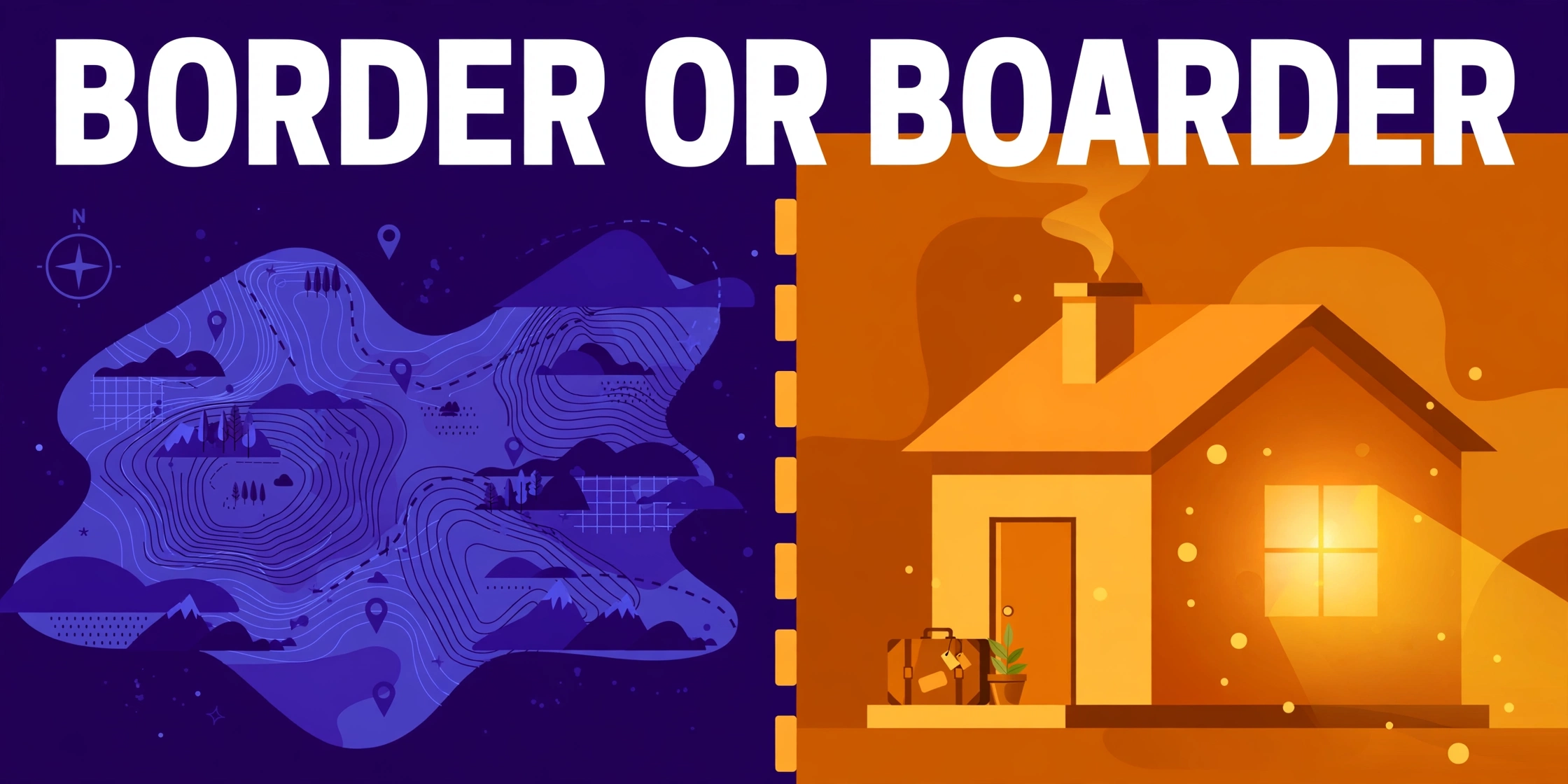
Border is the line that divides one place from another — the edge of a country, a garden, or a picture frame. Boarder is a person — someone who pays to live in a room in somebody else’s house, usually with meals included, or a pupil who lives at school during term time. The two words are pronounced the same in most accents and differ by a single letter, which is why they are mixed up so often. But they are not two spellings of one word. They are two different words with different histories, and the extra a in boarder is doing real work: it marks the word as a person, built on board in the old sense of meals and lodging.
Quick Answer: Use border for a boundary, edge, or dividing line — the border between two countries, the border of a page. Use boarder for a person who pays for a room and meals in someone else’s house, or a pupil who lives at a boarding school. Both are correct English words; they are homophones, so the spelling is the only thing that tells them apart in writing.
What the Dictionaries Say
Cambridge Dictionary lists border as a B1 noun: “a line that has been agreed to divide one country from another” — “Were you stopped at the border?” Its learner’s dictionary adds the wider senses: the line that separates two countries or states, the edge of something, and, as a verb, to form a line around the edge of something (“The fields are bordered by tall trees”) and to have a border with another country (“Spain is bordered by France and Portugal”). The pronunciation is UK /ˈbɔː.dər/ and US /ˈbɔːr.dɚ/.
Boarder carries the same pronunciation — UK /ˈbɔː.dər/, US /ˈbɔːr.dɚ/ — and Cambridge lists it as a countable noun in two senses: a child who lives at school and goes home for the holidays, and a person who pays for a place to sleep and meals in someone else’s house. Oxford Learner’s Dictionaries gives the same two senses, calling the second “a person who pays money to live in a room in somebody else’s house,” with the synonym lodger, and marks it as especially British English in the school sense. Merriam-Webster’s thesaurus defines a boarder as “one who rents a room or apartment in another’s house,” with the example “a boarder who paid $100 per week for a room and meals.”
The shared pronunciation matters. In most accents, border and boarder are exact homophones: there is no sound difference to lean on, only spelling. Wiktionary notes the pair as homophones in accents with the horse–hoarse merger, which covers most English speakers today. A small minority of speakers still distinguish the vowel sounds, but for practical purposes the words sound identical, and the choice between them is a spelling decision.
Border: The Line and the Edge
Border is the older and far more common of the two words — about ninety-five times as common in modern English, by one count — and it covers a family of related senses that all come back to the idea of an edge. The most familiar is the political one: the line dividing two countries, states, or regions. “They crossed the border from Canada into the US.” “The river forms the border between the two states.” The word also names the district along that line — “a border town” — and, in Britain, the Borders is the region straddling the line between England and Scotland.
The second sense is the physical edge of a thing: the strip that goes around or along the edge of something. A picture has a border, a garden has a flower border, a tablecloth has a patterned border. Cambridge gives the example “The card has a pretty design around the border.” Here the word is about decoration as much as division: a border frames what it surrounds, and it can be purely ornamental.
As a verb, border takes both of those senses with it. A country borders another country when the two share a frontier, and a field is bordered by trees when the trees form a line around its edge. And the phrasal verb border on moves the word into figurative territory: something that borders on rude, or borders on the absurd, is almost rude, almost absurd. “His behaviour bordered on contempt” means it came very close to contempt. That figurative sense belongs to border alone: there is no equivalent use of boarder.
The word’s history explains its shape. Border comes from Middle English bordure, from Old French, built on bord — “ship’s side, edge” — from Germanic. The edge is in the word from the beginning, and every sense of border still carries it.
Boarder: The Person Who Pays to Stay
Boarder is built differently. It is board plus -er — a person who boards — and board here is the old word for meals and lodging. “Room and board” is the phrase that preserves the meaning: the room is where you sleep, and the board is the food, named for the table — the board — at which meals were served. A boarder is someone who pays for both. That is the difference between a boarder and a tenant or a lodger in the narrow sense: a lodger rents a room, while a boarder rents a room and takes meals with it. In practice the words overlap, and Oxford gives lodger as a synonym, but the meals are the heart of the original distinction, and they are the reason the word is spelled with an a.
The two main uses follow from that meaning. The first is the paying guest in a private house: “After her father’s death, her mother took in boarders to bring in extra money.” The second is the boarding-school pupil: a child who lives at school during term time and goes home for the holidays, as opposed to a day pupil who goes home every evening. Both are people who live somewhere that is not their own home, and both pay — in money or in school fees — for the privilege. There is also an informal sporting sense: a boarder can be someone who rides a board, a snowboarder or a surfer. It rarely causes mistakes, because the context is always obvious, but it is a reminder that boarder is always a person, never a line.
Why the Two Get Mixed Up
Three things conspire to confuse them. The first is the pronunciation: in most accents the two words sound exactly alike, so a writer working from sound alone has nothing to guide them. The second is the spelling: the words differ by a single letter, the a after the o, and a single letter is easy to drop or add by accident — especially since border is the more familiar word and the hand reaches for it first. The third is that the two words share a root: both come from the old Germanic word for an edge or a plank, and board itself once meant both a plank and a table.
The memory trick that works best is the one built into the spelling. Boarder contains board, and board is what a boarder pays for: room and board. If the sentence is about a person who eats at somebody’s table, the a belongs there. Border, by contrast, has no a and no person in it at all: it is a line, and a line has no appetite. Another way to hold the pair apart is the boarding school: a boarder is a pupil who lives at school, and the word boarding in boarding school is spelled the same way.
Correct vs Incorrect
| Incorrect | Correct | Why |
|---|---|---|
| We waited at the boarder for an hour. | We waited at the border for an hour. | A border is the line between two countries; a boarder is a person. |
| Our new border pays £400 a month for the spare room. | Our new boarder pays £400 a month for the spare room. | The person paying for the room is a boarder. |
| She was a border at a school in Kent. | She was a boarder at a school in Kent. | A pupil who lives at school is a boarder. |
| The boarder between France and Spain runs through the Pyrenees. | The border between France and Spain runs through the Pyrenees. | A dividing line between countries is a border. |
| The picture needs a boarder to finish it. | The picture needs a border to finish it. | The decorative edge of a picture is a border. |
| His comments bordered on the offensive. | His comments bordered on the offensive. | Correct as written — border on means “almost,” and only border works here. |
Common Mistakes to Avoid
1. Writing “boarder” for a country line
This is the most frequent error, and it usually happens in the phrase “the boarder between two countries.” The line between countries is always a border. The error is easy to make because boarder is a real word and a spellchecker will not flag it. Read the sentence back and ask whether it is about a line or a person: if it is a line, the a has to go.
2. Writing “border” for the paying guest
The mirror-image error: “We took on a border to help with the rent.” A person who pays for a room and meals is a boarder, with the a that marks the word as a person who boards. Remember “room and board”: if the person is paying for board, the word is boarder.
3. Confusing “boarder” with “lodger”
The two words are synonyms in Oxford’s entry, but they are not identical. A lodger rents a room; a boarder rents a room and takes meals. In everyday speech the distinction has softened, and calling a boarder a lodger will never be misunderstood. But in formal writing — a tenancy agreement, a school’s admissions page — the precise term matters. If meals are included, boarder is the exact word.
4. Forgetting that “border” is also a verb
Boarder, by contrast, is only ever a noun. If the sentence needs a verb, the word is border.
Frequently Asked Questions
What is a boarder in a boarding school?
A pupil who lives at the school during term time and goes home for the holidays, as opposed to a day pupil who goes home each evening. Oxford marks this as the first sense of the word and notes it as especially British English, though American boarding schools use the word the same way.
Can “border” be used as a verb?
Yes. As a verb it means to form a line around the edge of something — “Tall trees border the fields” — or to share a frontier with another country — “Spain is bordered by France and Portugal.” The phrasal verb border on means to come close to a quality: “His remarks bordered on rudeness.”
The Takeaway
Border is a line — the edge of a country, a garden, or a page — and it can also be a verb, to form that edge or to come close to something. Boarder is a person — someone who pays for a room and meals in another person’s house, or a pupil who lives at a boarding school. The two sound identical in most accents and differ by one letter, but that letter is the whole story: boarder contains board, and a boarder is someone who pays for room and board. If the sentence is about a person who eats at somebody’s table, keep the a; if it is about a line, leave it out.
Sources: Cambridge Dictionary (border; boarder); Oxford Learner’s Dictionaries (boarder; border); Merriam-Webster (boarder, thesaurus); Collins Dictionary (border; boarder); Dictionary.com (border, etymology).