Paranoia Meaning: Definition, Uses, and Examples
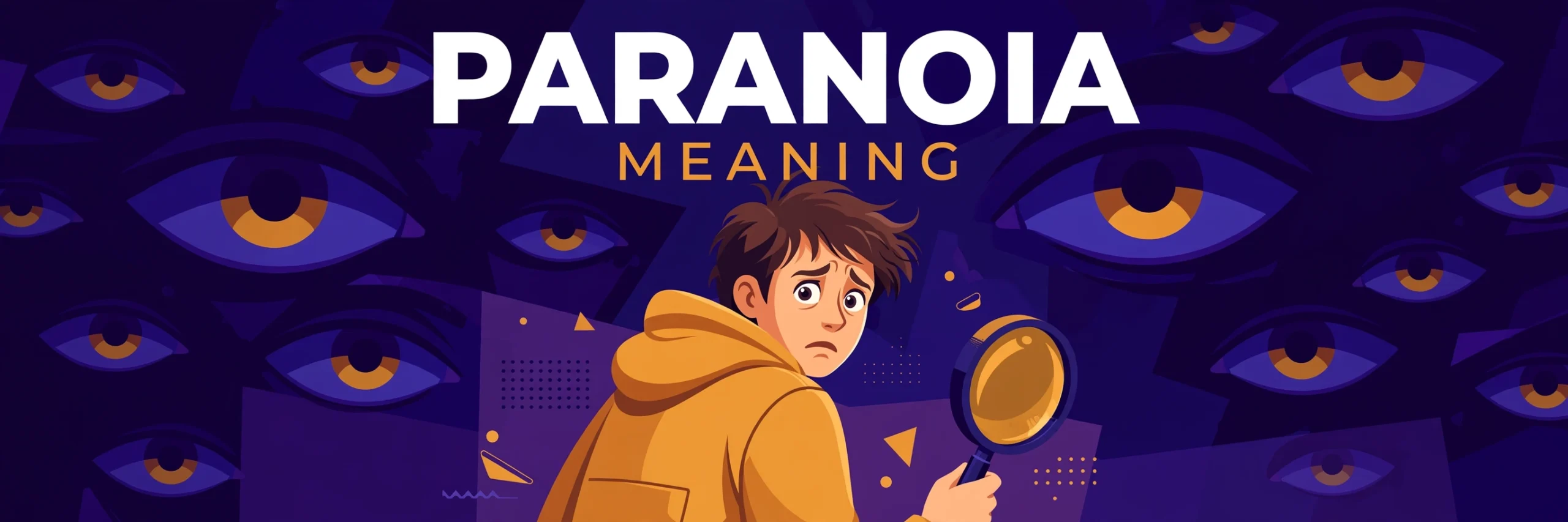
Paranoia is unreasonable suspicion — the feeling that other people dislike you, are talking about you, or are planning to harm you, when there is no evidence for it. In everyday speech it usually means that exaggerated, groundless distrust. In psychology it means something more specific and more serious: false beliefs that form part of a mental health condition.
The two uses live side by side in every dictionary, and keeping them apart matters. Calling a cautious colleague “paranoid” is a figure of speech; the clinical sense describes a symptom, not a personality quirk.
What Does “Paranoia” Mean? The Dictionary Definitions
Cambridge gives the everyday sense first: “an extreme and unreasonable feeling that other people do not like you or are going to harm or criticize you”, and then the specialised psychology sense: unreasonable false beliefs as part of another mental illness, for example schizophrenia. Oxford Learner’s draws the same line, and Merriam-Webster puts the clinical sense first — “mental illness characterized by systematized delusions of persecution or grandeur usually without hallucinations” — and then the general tendency towards “excessive or irrational suspiciousness and distrustfulness of others”.
| Dictionary | Definition of paranoia |
|---|---|
| Cambridge | An extreme and unreasonable feeling that other people do not like you or are going to harm or criticise you. (Psychology, specialised) Unreasonable false beliefs as part of another mental illness, e.g. schizophrenia. |
| Oxford Learner’s | The belief that other people dislike or want to harm you, when there is no evidence or reason for this. (Psychology) False beliefs that are part of a mental health condition. |
| Merriam-Webster | Mental illness characterized by systematized delusions of persecution or grandeur, usually without hallucinations. Also: a tendency towards excessive or irrational suspiciousness and distrustfulness of others. |
| Collins (via Dictionary.com) | Informal: intense fear or suspicion, especially when unfounded. Psychiatry: a mental disorder characterized by delusions, in which the personality otherwise remains relatively intact. |
The word that does the most work in every one of those definitions is unreasonable. Paranoia is not suspicion itself — suspicion can be sensible, even life-saving. It is suspicion without evidence, or suspicion wildly out of proportion to the evidence. Locking your doors at night is not paranoia; believing your neighbours are plotting against you because they whispered on the stairs is the kind of feeling the word describes.
How to Pronounce “Paranoia”: UK and US
- UK: /ˌpær.əˈnɔɪ.ə/ — pa-ruh-NOY-uh, with the short “a” of cat and the stress on the third syllable, NOY.
- US: /ˌper.əˈnɔɪ.ə/ — peh-ruh-NOY-uh, with the first vowel softened towards “eh”.
The stress is always on NOY: pa-ruh-NOY-uh. The adjective paranoid shifts the stress to the first syllable: /ˈpær.ə.nɔɪd/, PA-ruh-noyd, in both British and American English. That shift catches people out — “paranoia” stresses the third syllable, “paranoid” the first — so it is worth learning the pair together. The plural of the noun is paranoias, though it is usually uncountable and rarely needs a plural at all.
The Two Senses: Everyday Feeling and Clinical Condition
1. Everyday paranoia: groundless suspicion
This is the sense you meet in conversation, newspapers, and novels. “There’s a lot of paranoia about crime at the moment,” says Cambridge — a whole neighbourhood, or a whole country, feeling watched and threatened beyond what the facts support. The feeling is real even when the threat is not, and the word is often used lightly, even humorously: “my paranoia about being late”, “a touch of paranoia about the new neighbours”. In this sense the word is countable or uncountable — “a paranoia about crime”, “a lot of paranoia” — and it usually takes about for its topic: paranoia about surveillance, about gossip, about break-ins.
Used this way, paranoia is a matter of degree. Everyone has felt a version of it: the conviction that a room went quiet because people were talking about you, or that a delayed reply means someone is angry. The word applies when the feeling is extreme and unreasonable — when the suspicion has outrun the evidence.
2. Clinical paranoia: false beliefs as part of a mental illness
The psychology sense is different in kind, not just in degree. Here paranoia means systematised delusions — fixed false beliefs, typically of persecution (others are plotting against you) or of grandeur (you are someone of great importance), held without hallucinations and often as part of another condition. Cambridge names schizophrenia as the example; Merriam-Webster’s definition adds the detail “usually without hallucinations”. The older phrase “paranoid schizophrenia” is still heard, though psychiatry has moved away from it as a formal label — the current diagnostic manuals no longer divide schizophrenia into subtypes, and describe paranoia as a feature or symptom rather than a separate illness of its own.
This article is about the word, not about medicine, and it is not the place for diagnosis. Two points of usage follow from the clinical sense, though. First, do not use paranoia or paranoid as a casual label for a real person’s mental health: it can sound dismissive, and it claims a knowledge no casual observer has. Second, if you or someone you know is experiencing persistent, distressing false beliefs, that is a matter for a clinician, not a dictionary.
Paranoia, Paranoid, Paranoiac: The Word Family
| Form | Part of speech | Meaning and use |
|---|---|---|
| paranoia | Noun | The feeling or condition itself. “Her paranoia grew with every unanswered message.” |
| paranoid | Adjective (also noun) | Showing paranoia: “He was paranoid about break-ins.” As a noun, a person with paranoia — clinical, and best avoided casually. |
| paranoiac | Adjective or noun | The less frequent alternative to paranoid, recorded by Merriam-Webster and Oxford. Formal and uncommon; paranoid is the normal choice. |
| paranoically | Adverb | In a paranoid way. Rare; most writers would rephrase. |
The commonest pattern is paranoid about + a topic (“paranoid about what other people say about her”, in Oxford’s example) or paranoid that + a feared situation. Note the grammar: paranoid is usually a predicate adjective after be, feel, or get — “you’re just being paranoid” — though it also works before a noun: “paranoid delusions”, “a paranoid fear”.
Where “Paranoia” Comes From
The word entered English in the early nineteenth century — first recorded 1805–15 — from New Latin paranoia, borrowed from Greek paránoia, “madness”. The Greek breaks down into para-, “beside, irregular”, and nous, “mind”: literally, a mind gone beside itself. Oxford traces it the same way, from Greek paranoos, “distracted”, from para, “irregular”, + noos, “mind”. The older variant spelling paranoea is recorded by Dictionary.com as archaic; the standard spelling today is paranoia.
Paranoia vs Suspicion, Caution, and Anxiety
| Word | How it differs from paranoia |
|---|---|
| Suspicion | Neutral: a feeling that something may be wrong. Suspicion can be reasonable and evidence-based; paranoia, by definition, is not. |
| Caution | Positive: carefulness to avoid danger. Locking doors is caution. Believing the neighbours are plotting against you is paranoia. |
| Anxiety | A broader feeling of worry or unease, often without a specific suspected enemy. Paranoia always has a target: someone is against you. |
| Distrust | A lack of trust, which may be earned. Paranoia is distrust without a reason, or far beyond the reason. |
The test the dictionaries imply is evidence. Ask whether the suspicion fits the facts, and whether it would survive being checked. Caution and scepticism invite checking; paranoia resists it, because the suspicion itself feels like proof.
Paranoia in Sentences: Examples
- “There’s a lot of paranoia about crime at the moment.” (Cambridge)
- “I had to admit that my fears were just paranoia.” (Merriam-Webster)
- “Their whispering just increased her paranoia.” (Cambridge)
- “She was diagnosed with delusional paranoia.” (Merriam-Webster — clinical use)
- “He’s getting really paranoid about what other people say about him.” (Oxford — adjective use)
- “Locking my doors at night isn’t a sign of paranoia — it just means I’m being cautious.” (Dictionary.com)
- “You’re just being paranoid — nobody is talking about you.”
Common Mistakes and Confusions
Mixing up “paranoia” and “paranoid”
The most basic error is a part-of-speech one. Paranoia is the noun: “his paranoia grew”. Paranoid is the adjective: “he grew paranoid”. Saying “he has paranoid” or “she is paranoia” is ungrammatical, and it is a mistake even careful speakers make when they are thinking faster than they are speaking.
Using “paranoid” to diagnose someone
The adjective is used so casually — “you’re being paranoid”, “don’t be so paranoid” — that it is easy to forget it is also a clinical term. As a joke between friends it is usually harmless. As a label for a colleague, a family member, or a stranger, it can sound dismissive: it tells the person their fear is unreasonable without engaging with it.
Treating all suspicion as paranoia
The opposite error is overuse in the other direction: calling any suspicion paranoia. Suspicion is sometimes right. A person who suspects a colleague of taking credit for their work may have evidence; a community worried about a rise in break-ins may be reading the statistics correctly. The word only fits when the suspicion is extreme and unreasonable — when it has outrun the evidence or ignored it.
Spelling: “paranoia”, not “paranoea”
The standard spelling is p-a-r-a-n-o-i-a. The variant paranoea is archaic and should not be used. The confusion is understandable — the word sounds as if it might end in “-oea” — but every modern dictionary spells it with an i.
Frequently Asked Questions
What does paranoia mean in simple words?
An extreme, unreasonable feeling that other people dislike you or are planning to harm or criticise you, when there is no evidence for it. In psychology, it means false beliefs of that kind as part of a mental health condition.
Is paranoia a mental illness?
Not on its own, in the way the word is usually used. The everyday sense is a feeling — groundless suspicion — and it is not a diagnosis. In the clinical sense, paranoia is a symptom or feature of a mental health condition, such as schizophrenia, rather than an illness by itself.
What is the difference between paranoia and being paranoid?
They are the noun and the adjective for the same thing. Paranoia is the feeling or condition: “her paranoia grew”. Paranoid describes a person, thought, or action that shows it: “he was paranoid about break-ins”. The stress moves too: pa-ruh-NOY-uh, but PA-ruh-noyd.
Can paranoia ever be a good thing?
Not under that name. What people sometimes mean is healthy caution or scepticism — checking a claim, locking a door, reading the fine print. Those are sensible, and they are evidence-based. The moment the suspicion becomes extreme and unreasonable, the dictionaries stop calling it caution and start calling it paranoia.
What does “paranoia about” mean?
It names the topic of the suspicion: “paranoia about crime”, “paranoia about surveillance”, “paranoia about what people think of you”. The pattern is the standard one — paranoia about + a noun phrase — and it is the most common way the word takes an object.
Takeaway
Paranoia means suspicion without a reason — the feeling that others are against you, held in spite of the evidence rather than because of it. Pronounce it pa-ruh-NOY-uh, keep the noun paranoia and the adjective paranoid straight, and keep the two senses apart: the everyday feeling, which is common and usually harmless, and the clinical condition, which is a matter for professionals.
Sources: Cambridge Dictionary (paranoia); Oxford Advanced Learner’s Dictionary (paranoia; paranoid); Merriam-Webster (paranoia; paranoid); Collins English Dictionary via Dictionary.com (paranoia). This article explains the meaning of the word and is not medical advice; anyone concerned about persistent, distressing beliefs should speak to a clinician.