Dyed in the Wool Meaning: What Does It Mean?
Call someone dyed in the wool and you are saying their beliefs go all the way through them — not painted on the surface, but soaked into the fibre, like colour in wool that was dyed before it was ever spun into yarn. A dyed-in-the-wool traditionalist does not merely prefer the old ways; the old ways are part of who they are, and no argument is going to wash them out. The phrase is an idiom, not a single dictionary word, but it behaves like an adjective: it describes people, opinions, and loyalties that are fixed, thoroughgoing, and unlikely to change.
Quick Answer: Dyed in the wool (adjective phrase, pronounced /ˌdaɪ.dɪn.ðəˈwʊl/ — dye-din-thuh-WUUL, the same in British and American English) means holding beliefs or opinions strongly and unwilling to change them — “a dyed-in-the-wool traditionalist,” “dyed-in-the-wool opinions.” It comes from the textile trade: wool dyed before spinning takes the colour right through, so the colour cannot fade or wash out. Use hyphens before a noun (dyed-in-the-wool); after a verb the hyphens are often dropped. Do not write “died in the wool” — died is the past tense of die.
What the Dictionaries Say
Contrary to what you might expect of an idiom, Cambridge Dictionary does list this phrase as a headword — as the adjective dyed-in-the-wool, pronounced /ˌdaɪ.dɪn.ðəˈwʊl/ in both British and American English. Its definition is: “If someone is dyed-in-the-wool, or has dyed-in-the-wool opinions, they hold those opinions strongly and will not change them.” The example is “He’s a dyed-in-the-wool traditionalist where cooking is concerned — he doesn’t allow any modern gadgets in the kitchen.” Merriam-Webster gives the shorter definition “thoroughgoing, uncompromising,” and Oxford Languages gives “unchanging in a particular belief or opinion; inveterate” — “dyed-in-the-wool opera fans.”
Three things are worth noticing. First, the phrase describes people and their opinions, not objects: you would not normally call a policy dyed in the wool, though you could call the politician who holds it that. Second, it is a matter of degree — thoroughgoing means the belief runs through the whole person. Third, none of the dictionaries calls it old-fashioned or rare: it is a living idiom, as common in American English as in British English.
| Dictionary | Definition | Notes |
|---|---|---|
| Cambridge | Someone who holds opinions strongly and will not change them | Adjective; /ˌdaɪ.dɪn.ðəˈwʊl/ UK and US |
| Merriam-Webster | Thoroughgoing, uncompromising | Adjective |
| Oxford Languages | Unchanging in a particular belief or opinion; inveterate | “Dyed-in-the-wool opera fans” |
Where the Phrase Comes From
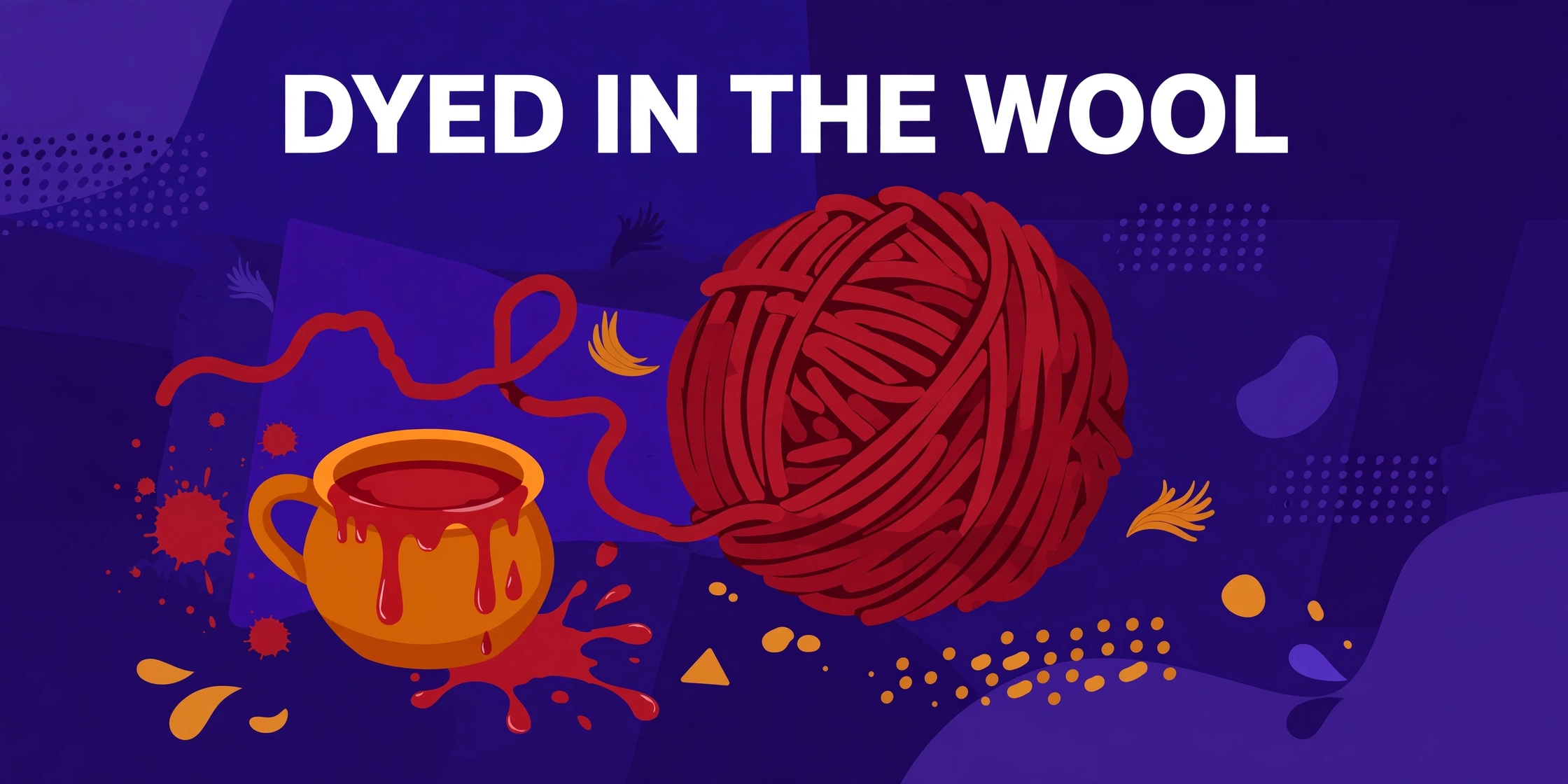
The phrase comes from the textile trade. Wool can be dyed at two stages: before it is spun into yarn, or after it has been woven into cloth. Wool dyed before spinning — dyed “in the wool,” while it is still loose fibre — takes the colour right through, evenly and permanently, because the dye reaches every strand before spinning compresses it. Wool dyed after weaving, “in the piece,” takes the colour only on the surface, and the colour fades and wears unevenly. A dyed-in-the-wool cloth was therefore the better, more honest product, and its colour could not be washed out.
That difference became a metaphor for character. Merriam-Webster’s word-history account traces the figurative use to 16th-century England, where writers compared the dyeing of wool with the way children, if taught early, could be influenced in ways that would stay with them for life — the same idea as the proverb “as the twig is bent, so the tree is inclined.” In the 19th-century United States, the orator Daniel Webster used the phrase for a type of Democrat whose attitudes were as unyielding as dye in unspun wool, and the phrase soon crossed party lines until it became a general term for anyone unlikely to change. That history is Merriam-Webster’s account, as quoted in secondary sources.
One earlier sighting is often quoted: a sentence from Richard Hooker’s Of the Lawes of Ecclesiasticall Politie, published in 1597 — “that which is once dyed in the wooll, will ever have a tincture and relish thereof.” This quotation is reported by an idiom reference site, not checked here against Hooker’s text, so treat the 1597 date as a secondary-source claim. What is certain is that the phrase was already figurative by the 1500s, and the textile practice behind it was older still.
How It Is Used Today
In modern use, the phrase attaches itself to three kinds of things: people, opinions, and loyalties. A dyed-in-the-wool conservative or liberal is someone whose politics are settled and will not shift with the news. Dyed-in-the-wool opinions are the ones a person has held for years. And dyed-in-the-wool loyalty survives losing seasons: a dyed-in-the-wool supporter does not switch teams when the results turn against them.
There is a second, quieter use that is easy to miss: the phrase can describe identity rather than opinion. A “dyed-in-the-wool Welshman” or a “dyed-in-the-wool New Englander” is someone thoroughly of that place — born there, raised there, shaped by it, and unlikely to become anything else. Here the meaning is not “stubborn” but “thoroughly and permanently characterised by” something. The tone is usually warm: to call someone a dyed-in-the-wool New Englander is to praise their rootedness, not to accuse them of narrow-mindedness.
The tone depends on the speaker. Said by an ally, “dyed in the wool” is praise for steadfastness; said by an opponent, it is a criticism of rigidity — Merriam-Webster’s word for it is uncompromising, and uncompromising is rarely a compliment. The phrase itself only reports that the belief will not change.
Hyphens, Spelling, and the “Died” Mistake
The phrase is written with hyphens when it comes before a noun: “a dyed-in-the-wool traditionalist,” “dyed-in-the-wool opinions,” “a dyed-in-the-wool fan.” The hyphens turn the four words into a single adjective, and without them the phrase reads awkwardly. After a verb, the hyphens are often dropped: “He is dyed in the wool,” “She remained dyed in the wool to the end.” Both forms are standard, and Cambridge’s own entry uses the hyphenated form as its headword while allowing the unhyphenated form in running text. Hyphenate before a noun; leave the phrase open after a verb.
The spelling mistake to avoid is writing “died in the wool.” Died is the past tense of die, and a phrase about dying in wool makes no sense — nobody dies in wool, and the phrase has nothing to do with death. The confusion is understandable, because dyed and died are homophones: both are pronounced /daɪd/. But the phrase is about dye, the colouring substance, and the verb is to dye, whose past tense is dyed. If you are unsure, ask whether the sentence is about colour: if it is, the word is dyed.
One more piece of history connects this idiom to another common word. In older British English, “dyed in the grain” was used for the same idea, referring to dye made from grain-like insects — the source of crimson and carmine — and that phrase is the origin of ingrained. This connection is reported by a language programme’s account of the idiom, not by a dictionary entry checked here, so read it as plausible word history rather than settled fact.
Dyed in the Wool vs Ingrained, Deep-Rooted, and Staunch
English has several ways of saying that a belief will not change, and the differences are worth learning, because each one carries a different shade.
| Word or phrase | Shade of meaning | Typical use |
|---|---|---|
| Dyed in the wool | Thoroughgoing; the belief runs through the whole person | People, opinions, loyalties |
| Ingrained | Fixed deeply by habit or long use; hard to remove | Habits, attitudes, prejudices |
| Deep-rooted | Established over a long time; hard to uproot | Beliefs, fears, traditions, problems |
| Staunch | Loyal and committed; firm in support | Supporters, allies, defenders |
| Uncompromising | Refusing to give way; unwilling to negotiate | Positions, people, principles |
| Die-hard | Refusing to give up, even when beaten | Informal; fans, supporters, opponents |
The practical difference is one of scope. Ingrained and deep-rooted describe things that have grown in over time — a habit, a fear, a tradition — and they can describe things that are not opinions at all. Staunch describes loyalty, not belief. Dyed in the wool is the most personal of the group: it describes a person whose beliefs are part of their character.
Correct vs Incorrect
| Incorrect | Correct | Why |
|---|---|---|
| He is a died-in-the-wool conservative. | He is a dyed-in-the-wool conservative. | The phrase is about dye (colour), not die (death). |
| A dyed in the wool traditionalist. | A dyed-in-the-wool traditionalist. | Hyphenate the phrase when it comes before a noun. |
| Her dyed-in-the-wool policy. | Her dyed-in-the-wool views. | The phrase describes people and opinions, not policies or objects. |
| He is dyed-in-the-wool about cooking. | He is a dyed-in-the-wool traditionalist where cooking is concerned. | The phrase needs a noun to describe — a person, a belief, or a loyalty. |
Common Mistakes to Avoid
1. Writing “died” for “dyed”
Dyed and died sound identical, and the mistake is common enough that it is worth a deliberate check. The test is colour: if the sentence is about something being coloured through and through, the word is dyed. If the sentence is about death, it is died — and the phrase “died in the wool” is never right.
2. Forgetting the hyphens before a noun
“A dyed in the wool traditionalist” reads as four separate words and forces the reader to work out the grouping. The hyphens do that work for them: “a dyed-in-the-wool traditionalist” is one adjective. After a verb, the hyphens can go: “He is dyed in the wool.”
3. Using it for things rather than people
The phrase describes people, opinions, and loyalties. A policy, a company, or a machine is not dyed in the wool; the people who hold the policy are. If the subject is a thing, ingrained or deep-rooted will usually fit better.
Frequently Asked Questions
What does “dyed in the wool” mean in simple terms?
Someone whose beliefs are fixed and will not change — a thoroughgoing, uncompromising believer. “A dyed-in-the-wool traditionalist” holds traditional views strongly and will not give them up.
Is it “dyed” or “died” in the wool?
Dyed. The phrase comes from dyeing wool before it is spun into yarn, so the colour goes right through. Died is the past tense of die and has nothing to do with the phrase.
Do you hyphenate “dyed in the wool”?
Yes, when it comes before a noun: “a dyed-in-the-wool fan.” After a verb, the hyphens are usually dropped: “He is dyed in the wool.” Cambridge lists the hyphenated form as its headword.
Is “dyed in the wool” a compliment or an insult?
It depends on who is speaking. Said by an ally, it praises steadfastness; said by an opponent, it criticises rigidity. The phrase itself only says the belief will not change — the judgement comes from the sentence around it.
What is the opposite of “dyed in the wool”?
There is no single opposite. Open-minded and flexible are the closest for a person willing to change their mind; fair-weather is the opposite for loyalty.
The Takeaway
Dyed in the wool means holding beliefs that run all the way through you, like colour in wool dyed before spinning — fixed, thoroughgoing, and unlikely to change. It is pronounced /ˌdaɪ.dɪn.ðəˈwʊl/, hyphenated before a noun, and spelled with dyed, never died. Use it for people, their opinions, and their loyalties.
Sources: Cambridge Dictionary (dyed-in-the-wool); Merriam-Webster (dyed-in-the-wool; word history, via secondary quotation); Oxford Languages (dyed in the wool, via bab.la); The Idioms (1597 Hooker quotation — secondary source); Wayword Radio (dyed-in-the-wool history; “dyed in the grain” — secondary source).