Another Way to Say “Snowed In”: 30+ Natural Alternatives for Winter Weather
When deep snow blocks the roads, buries the driveway, or makes travel impossible, saying “we’re snowed in” feels perfectly natural. But sometimes you need another way to say snowed in because you want your sentence to sound more descriptive, formal, casual, dramatic, or creative.
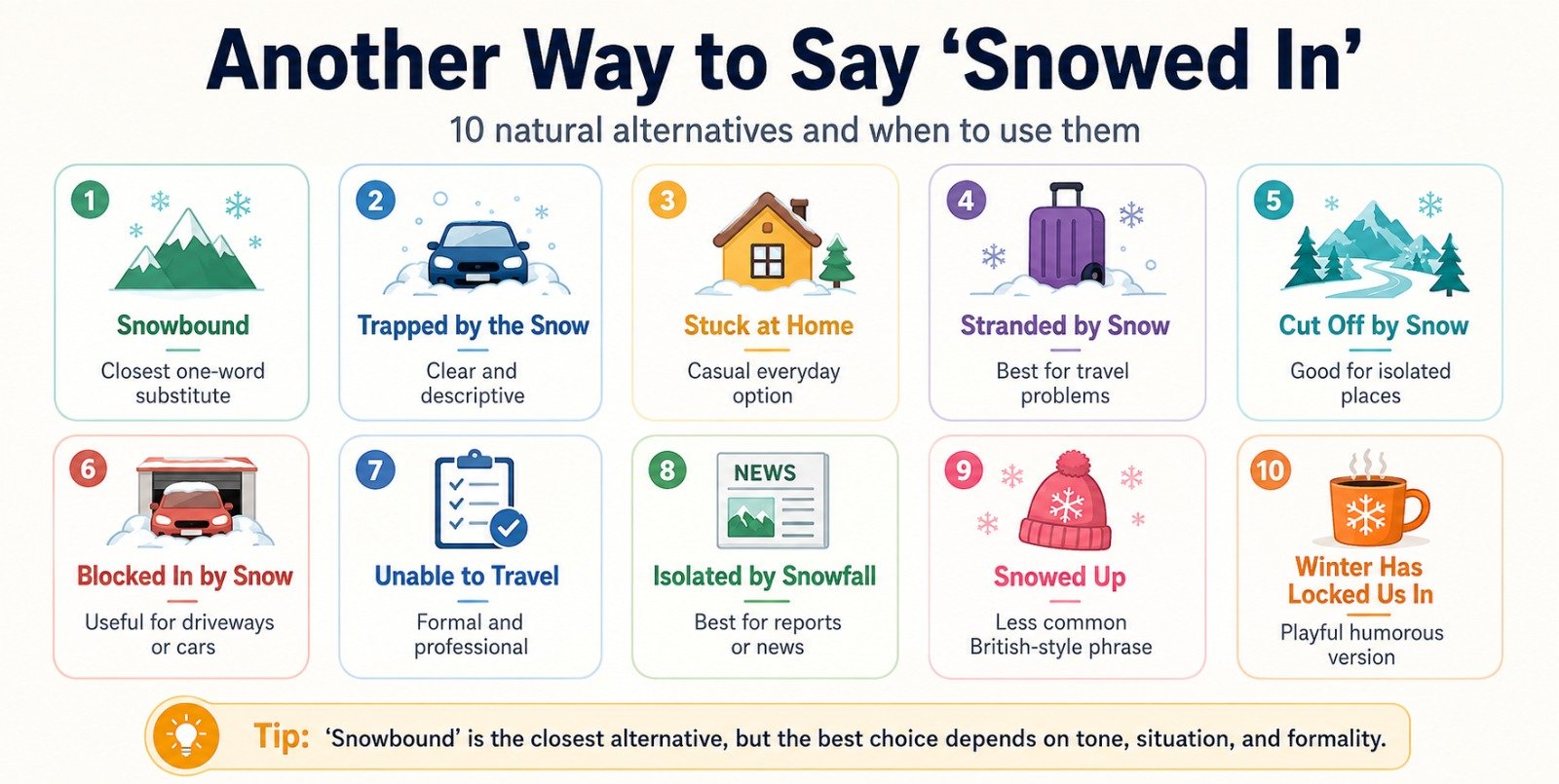
Some of the strongest alternatives are snowbound, trapped by the snow, stranded because of the snow, cut off by heavy snowfall, stuck at home because of the snow, and unable to travel due to severe winter weather. They share a similar idea, but they are not interchangeable in every situation.
What Does “Snowed In” Mean?
To be snowed in means that someone cannot leave a place because a large amount of snow has fallen or is continuing to fall.
Merriam-Webster gives two closely related uses: a person can be unable to leave because of snow, or something such as a road can be blocked by snow.
For example:
“We planned to leave the cabin this morning, but we’re snowed in.”
In this sentence, the snowfall has made leaving difficult or impossible.
The phrase can describe people at home, travelers in a hotel, residents of a remote community, or anyone temporarily unable to travel because of winter conditions.
Best Alternatives to “Snowed In” at a Glance
| Alternative | Tone | Best Used For |
|---|---|---|
| Snowbound | Neutral/descriptive | Closest one-word alternative |
| Trapped by the snow | Neutral | Emphasizing inability to leave |
| Stuck because of the snow | Casual | Everyday conversation |
| Stranded by the snow | Serious | Travelers and disrupted journeys |
| Cut off by snow | Neutral/formal | Villages, homes and remote areas |
| Blocked in by snow | Conversational | Driveways, cars and entrances |
| Trapped indoors by the snow | Casual | Staying inside |
| Isolated by heavy snowfall | Formal | Reports and news-style writing |
| Unable to travel due to snow | Formal | Workplace or professional messages |
| Snowed up | Regional/less common | Mainly British-style usage |
| Marooned by the snow | Dramatic | Creative or descriptive writing |
| Housebound by the weather | Neutral | Being unable to leave home |
The important difference is emphasis. Snowbound describes the overall condition, stranded emphasizes being unable to continue a journey, and cut off often describes a place that has lost normal access to the outside world.
Natural Alternatives for “Snowed In”
Other Ways to Say “Snowed In” in Everyday English
For normal conversation, simple wording usually sounds best.
Stuck because of the snow
This is one of the most natural casual alternatives.
“We were supposed to visit my parents, but we’re stuck here because of the snow.”
It sounds less idiomatic than “snowed in,” which can make it useful for English learners.
Stuck at home because of the snow
Use this when the location matters.
“I’m stuck at home because of the snow, so I’ll be working remotely today.”
It is clear and conversational without sounding dramatic.
Trapped by the snow
This places more emphasis on the snow preventing someone from leaving.
“We were trapped by the snow for most of the weekend.”
Depending on the situation, trapped may sound stronger than simply saying “snowed in.”
Blocked in by the snow
This works especially well when snow physically blocks a car, driveway, door, or road.
“The plow hasn’t reached our street, so we’re completely blocked in by the snow.”
It is less suitable when you simply mean that driving conditions are unsafe.
Other Ways to Say “Snowed In” With One Word
There are fewer natural one-word replacements than phrase-based alternatives.
Snowbound
Snowbound is the strongest direct one-word alternative. Wiktionary lists it among the synonyms for “snowed in.”
“The snowbound family spent three days in the cabin.”
It can refer to either people or places:
“A snowbound village”
“A group of snowbound travelers”
The word often sounds slightly more descriptive or literary than “snowed in.”
Stranded
Stranded can work in some contexts, but it is broader in meaning.
“The passengers were stranded overnight.”
The sentence does not tell us why they were stranded. They could have been affected by snow, a canceled train, a mechanical problem, or another disruption.
If snow is important, add it:
“The passengers were stranded by the snowstorm.”
Isolated
Isolated is another context-dependent alternative rather than a direct synonym.
“The mountain community was isolated by heavy snowfall.”
It works particularly well for towns, villages, homes, and remote areas whose routes have been blocked.
Other Ways to Say “Snowed In” When Traveling
Travel-related situations often need different wording because the important point is not necessarily being indoors; it is being unable to continue the journey.
Useful expressions include:
Stranded by the snow
“Our flight was canceled, and we were stranded by the snow overnight.”
Unable to continue because of the snow
“The drivers were unable to continue because of the snow.”
Stuck because of the snowstorm
“We’re stuck at the hotel because of the snowstorm.”
Unable to get through
“The road is covered in snow, so we can’t get through.”
Stranded in a snowstorm
“The motorists were stranded in a snowstorm for several hours.”
Here, stranded often communicates the situation better than snowbound because it highlights interrupted travel.
Other Ways to Say “Snowed In” Formally
“Snowed in” is perfectly understandable, but formal communication may benefit from wording that explains the practical problem more precisely.
You could say:
Unable to travel due to heavy snowfall
“I am unable to travel to the office due to heavy snowfall in my area.”
Unable to leave due to severe weather conditions
“We are currently unable to leave due to severe winter weather conditions.”
Road access is blocked by snow
“Road access to the property is currently blocked by snow.”
Travel is unsafe because of heavy snow
“I will be working remotely today because travel is unsafe due to heavy snow.”
Temporarily cut off by snowfall
“The community has been temporarily cut off by heavy snowfall.”
These expressions work better in workplace messages, official notices, reports, school announcements, and news writing because they tell the reader what has actually happened.
Other Ways to Say “Snowed In” Casually
When talking with friends or family, there is no need to sound formal.
Natural choices include:
“We’re stuck inside.”
“We can’t get out.”
“We’re stuck at home.”
“The snow has us trapped here.”
“We’re not going anywhere today.”
“The roads have us stuck at home.”
“We’re staying put until the snow clears.”
For example:
“Looks like we’re stuck inside all day. The driveway is completely buried.”
These alternatives sound relaxed, although some depend on the listener already knowing that snow is the reason.
Funny Other Ways to Say “Snowed In”
Humorous expressions are useful for texts, captions, and casual social posts, but they should not be treated as literal synonyms.
You might say:
“Winter has locked us in.”
“Mother Nature canceled our plans.”
“We’ve been taken hostage by the snow.”
“Our driveway has officially disappeared.”
“Apparently, we live in a snow globe now.”
“Winter says we’re staying home.”
“The snowstorm has grounded the whole house.”
“We’re prisoners of the weather today.”
These are deliberately playful. They would sound out of place in an official notice or serious report.
Not Every Alternative Means Exactly the Same Thing
One of the easiest mistakes is treating every winter-related expression as a direct replacement for snowed in.
Consider these sentences:
“We’re snowed in.”
“We’re stranded.”
“We’re snowbound.”
“We’re stuck in the snow.”
They are related, but they can describe different situations.
Snowed in usually means you are inside a place and cannot easily leave because of accumulated or falling snow.
Snowbound is very close in meaning but can sound more descriptive and can easily modify a noun, as in “a snowbound village.”
Stranded means you cannot continue or leave, but snow does not have to be the cause.
Stuck in the snow often means a person or vehicle is physically stuck while already outside.
For example:
“Our car is stuck in the snow.”
This does not necessarily mean:
“We are snowed in at home.”
The first describes a vehicle caught in snow. The second describes being unable to leave a location.
“Snowed In” vs. “Snowed Under”
These expressions look similar but normally mean very different things.
Snowed in: prevented from leaving because of actual snow.
“We were snowed in at the cabin.”
Snowed under: overwhelmed with work, tasks, or responsibilities.
“I’m snowed under with paperwork this week.”
Merriam-Webster’s entry for snow recognizes the literal sense of being shut in by snow and separately illustrates “snowed under” with papers, showing why the expressions should not be treated as interchangeable.
So if your boss says, “I’m snowed under,” you probably should not send a snow shovel.
Describing a Snowed-In Place More Creatively
Sometimes a writer does not need a synonym at all. A short description can create a stronger image.
Instead of:
“The cabin was snowed in.”
You could write:
“Deep snow surrounded the cabin and buried the road.”
“The overnight storm left the house cut off from the main road.”
“Snowdrifts had swallowed the driveway by morning.”
“The village woke to roads buried beneath fresh snow.”
“No one could leave until the plows cleared a route through the snow.”
These versions are especially useful in stories, travel writing, weather descriptions, and personal narratives because they show the situation instead of simply naming it.
How to Describe Beautiful Snow in Different Ways
The related question of how to describe beautiful snow is slightly different from finding another way to say snowed in. Here, the goal is imagery rather than describing blocked travel.
Other Ways to Say “Beautiful Snow”
Instead of repeatedly using beautiful snow, try:
Freshly fallen snow
Good for describing new, untouched snowfall.
“Freshly fallen snow covered the garden.”
Pristine snow
Suggests clean and undisturbed snow.
“Pristine snow stretched across the valley.”
Glistening snow
Focuses on the way light reflects from the surface.
“The morning sun shone across the glistening snow.”
Sparkling snow
A warm, visual choice for bright winter scenes.
“Sparkling snow covered the rooftops.”
Powdery snow
Describes light, dry snow and is especially natural in skiing contexts.
“Powdery snow covered the mountain trails.”
A blanket of white
“By sunrise, the entire field was hidden beneath a blanket of white.”
A winter wonderland
“The overnight snowfall transformed the village into a winter wonderland.”
A snow-covered landscape
“The photographer captured the quiet beauty of the snow-covered landscape.”
For a photo caption, phrases such as winter wonderland, snowy serenity, freshly fallen snow, frozen beauty, and a world in white can sound more expressive than simply writing “beautiful snow picture.”
421 Ways to Say Snow in Scotland: Is That Really True?
The famous claim about 421 ways to say snow in Scotland has a genuine research source, although “421 synonyms for snow” would be an oversimplification.
Researchers working on the University of Glasgow’s Historical Thesaurus of Scots reported cataloguing 421 Scots words and expressions related to snow. The university highlighted examples including snaw for snow, sneesl for beginning to rain or snow, and skelf for a large snowflake.
The Historical Thesaurus project began at the University of Glasgow and organized Scots vocabulary into semantic categories, including weather. Its later project history describes the launch publicity as highlighting over 400 terms related to snow.
That distinction matters.
The 421 items are not 421 interchangeable ways of replacing the English noun snow in the same sentence. They include vocabulary for different kinds of snow, snowflakes, snowfall, actions, conditions, and other snow-related ideas.
Some recorded examples include:
Snaw — snow
Skelf — a large snowflake
Flindrikin — a slight snow shower
Spitters — small drops or flakes of wind-driven precipitation
Reports on the University of Glasgow research described the collection as 421 words relating to snow rather than 421 perfect synonyms for a single English word.
Different Ways to Say “Snow” in Other Languages
Languages around the world naturally have their own ordinary words for snow.
| Language | Word for Snow |
| French | neige |
| Spanish | nieve |
| German | Schnee |
| Italian | neve |
| Swedish | snö |
| Finnish | lumi |
| Russian | снег (sneg) |
| Japanese | 雪 (yuki) |
| Korean | 눈 (nun) |
| Mandarin Chinese | 雪 (xuě) |
| Turkish | kar |
These are translations of the general noun snow, not necessarily translations of snowed in.
That distinction is important because an expression that is idiomatic in English may need a different grammatical construction in another language.
For example, Wiktionary records equivalents for the state of being “snowed in,” including German eingeschneit, Dutch ingesneeuwd, and Swedish insnöad.
If you are writing for native speakers of another language, it is usually better to use a natural local expression rather than translate the English phrase word for word.
How Many Ways Are There to Say Snow in “Eskimo”?
Claims about the number of “Eskimo words for snow” need more context than a simple number can provide.
First, there is no single language called Eskimo. Discussions of the famous claim generally involve languages in the Inuit and Yupik groups.
Second, these languages can build complex words by attaching meaningful elements to a root. That makes counting “words” across languages difficult because what English expresses with several words may be expressed as one longer word in a polysynthetic language.
The history of the claim goes back to discussions associated with anthropologist Franz Boas, and later writers expanded the number considerably. Linguists have since debated what should count as an independent snow word, a root, or a derived form.
Research summarized in linguistic discussions has nevertheless found rich snow and ice vocabulary in particular Inuit and Yupik varieties. The key point is that there is no single universally correct number that applies to every Inuit or Yupik language.
So a more accurate statement is:
Different Inuit and Yupik languages contain numerous terms for particular kinds and conditions of snow and ice, but claims about one exact number depend heavily on the language and on what researchers count as a separate word.
How to Choose the Best Alternative to “Snowed In”
The best phrase depends on what you actually want to emphasize.
Use snowbound when you want a close and compact substitute.
Use stuck at home because of the snow in casual conversation.
Use stranded by the snow when a journey has been interrupted.
Use cut off by snow for villages, homes, or areas that have become inaccessible.
Use blocked in by snow when a driveway, vehicle, or exit is physically obstructed.
Use unable to travel due to heavy snowfall in professional or formal communication.
Use a descriptive sentence such as “the roads were buried beneath deep snow” when you want stronger imagery in creative writing.
Choosing according to meaning is more useful than simply replacing “snowed in” with the first synonym you find.
Frequently Asked Questions
What is another way to say “snowed in”?
The closest one-word alternative is snowbound. Other natural choices include trapped by the snow, stuck because of the snow, stranded by the snow, cut off by snow, and unable to travel due to heavy snowfall.
Is “snowbound” the same as “snowed in”?
They are very close. Snowed in is extremely natural in everyday conversation, while snowbound can sound slightly more descriptive or literary. Snowbound also works naturally before a noun, as in “a snowbound village.”
Can I say “stuck in the snow” instead of “snowed in”?
Not always. Stuck in the snow often describes someone or a vehicle physically caught in snow. Snowed in usually means someone cannot leave a house or another location because snow has blocked access.
What is a professional way to say “I’m snowed in”?
You could say, “I’m unable to travel due to heavy snowfall,” “Road conditions prevent me from traveling safely,” or “I’m unable to reach the office because local roads are blocked by snow.”
What is a funny way to say “snowed in”?
For a playful message, try “Winter has locked us in,” “Mother Nature canceled my plans,” or “Apparently, we live in a snow globe now.” These are humorous expressions rather than direct dictionary synonyms.
Does Scotland really have 421 words for snow?
University of Glasgow researchers working on the Historical Thesaurus of Scots reported 421 Scots terms related to snow. However, they are not 421 completely interchangeable synonyms for the noun “snow”; they cover different forms, conditions, actions, and features associated with snowy weather.
How many Inuit words are there for snow?
There is no single reliable number for all Inuit and Yupik languages. Different varieties have their own snow and ice vocabulary, and their grammatical structure makes direct word-count comparisons with English difficult.
What are some poetic ways to describe snow?
Natural descriptive options include glistening snow, pristine snow, freshly fallen snow, a blanket of white, sparkling snow, powdery snow, and a snow-covered landscape. The best choice depends on the particular appearance or mood you want to describe.
Conclusion
Finding another way to say snowed in is mainly about deciding which part of the situation matters most. Snowbound is a close substitute, while stranded works better for interrupted travel, cut off emphasizes lost access, and straightforward phrases such as unable to travel due to heavy snowfall suit formal communication. Casual and creative alternatives can be more expressive, but they should still match the audience, tone, context, and level of formality. Clarifyra focuses on those small differences so you can choose wording that communicates not just the basic meaning, but the exact situation you have in mind.
You May Also Read | 25 Other Ways to Say “Safe Travels”: Thoughtful Phrases for Any Trip