Other Ways to Say “Firstly, Secondly, Thirdly”: 30+ Better Alternatives for Writing
“Firstly, secondly, thirdly” is a perfectly understandable way to organize ideas, but it isn’t always the smoothest choice. In essays, reports, presentations, emails, and everyday explanations, repeating the same numbered transitions can make your writing feel rigid. The best other ways to say “firstly, secondly, thirdly” depend on what you are doing: listing arguments, explaining steps, adding supporting points, or moving toward a final idea.
Instead of replacing these words with random synonyms, it helps to choose transitions that show the actual relationship between your ideas. Sometimes first, second, third is all you need. In other situations, phrases such as to begin with, in addition, and finally create a more natural flow.
What Do “Firstly, Secondly, Thirdly” Mean?
“Firstly,” “secondly,” and “thirdly” are sequencing words. They help readers understand that ideas are being presented in a specific order.
For example:
Firstly, we need to understand the problem.
Secondly, we should compare the possible solutions.
Thirdly, we need to choose the most practical option.
This structure is clear, but the numbered form can sometimes sound formal or mechanical, particularly when it appears several times in a short piece of writing.
A simpler version would be:
First, we need to understand the problem.
Second, we should compare the possible solutions.
Third, we need to choose the most practical option.
Both approaches communicate the sequence. The better choice depends on the style and tone you want.
Quick Comparison of Alternatives
| Alternative Sequence | Tone | Best Used For |
|---|---|---|
| First, second, third | Neutral and direct | Essays, reports, presentations |
| To begin with, next, finally | Neutral and natural | General writing and explanations |
| First of all, then, lastly | Friendly | Emails, conversation, informal writing |
| One reason, another reason, a final reason | Analytical | Essays and persuasive writing |
| The first point, the next point, the final point | Professional | Reports and presentations |
| Initially, subsequently, ultimately | Formal | Processes and developments over time |
| To start with, moving on, to finish | Conversational | Speeches and presentations |
| First and foremost, furthermore, finally | Emphatic/formal | Arguments and professional writing |
The alternatives in this table are not automatically interchangeable. For example, initially usually refers to something happening at an early stage, while first can simply introduce the first item in a list.
Better Alternatives to “Firstly, Secondly, Thirdly”
The most effective replacement is often a complete sequence rather than three unrelated synonyms.
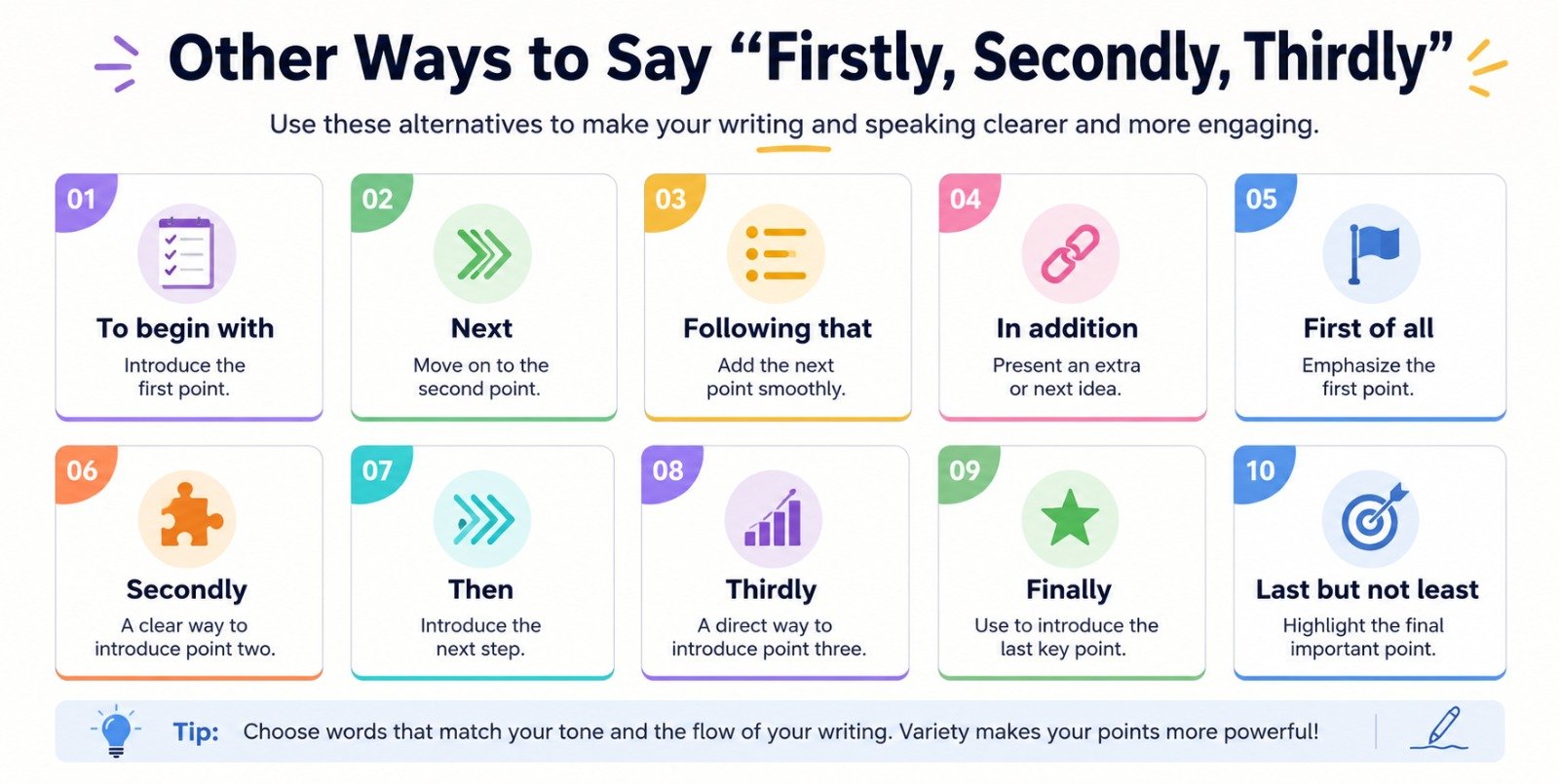
Other Ways to Say “Firstly, Secondly, Thirdly” Simply
If clarity is your main goal, these combinations work particularly well:
- First, second, third
- First, next, finally
- To begin with, next, lastly
- First of all, then, finally
- To start with, after that, to finish
- The first point, the next point, the final point
Example:
Instead of:
“Firstly, we will review the application. Secondly, we will contact suitable candidates. Thirdly, we will arrange interviews.”
You could write:
“First, we will review the application. Next, we will contact suitable candidates. Finally, we will arrange interviews.”
The second version sounds less numbered while keeping the sequence obvious.
Alternatives for Each Word
Sometimes you don’t need to replace the whole sequence. You may simply want a more suitable way to introduce one particular point.
Other Ways to Say “Firstly”
Useful alternatives include:
- First
- First of all
- To begin with
- To start with
- In the first place
- At the outset
- Initially
- First and foremost
- For starters
- The first point is
- One reason is
These phrases don’t all carry exactly the same meaning.
First is the safest general replacement.
Example:
“First, we should identify the cause of the delay.”
To begin with introduces an opening point naturally.
Example:
“To begin with, let’s review what happened last week.”
First and foremost gives the first point extra importance.
Example:
“First and foremost, we need to protect customer data.”
It would be unnecessary if you merely meant “item number one.”
Initially usually refers to the beginning of a process, situation, or period.
Example:
“Initially, the team expected the project to take three months.”
Here, “initially” means “at first,” not simply “my first argument.”
At the outset has a more formal tone and refers to the beginning of an activity or process.
Example:
“At the outset of the project, clear responsibilities were assigned.”
Other Ways to Say “Secondly”
Once you’ve introduced your opening point, several expressions can help move the reader forward:
- Second
- Next
- Then
- Another point is
- Another reason is
- In addition
- Furthermore
- Following this
- After that
- Subsequently
- The next consideration is
- Moving on to
The choice depends heavily on meaning.
Second is useful when numerical order matters.
Example:
“Second, we need to determine whether the plan is affordable.”
Next works naturally for both ideas and steps.
Example:
“Next, compare the results from both groups.”
Another reason is works especially well in argumentative writing.
Example:
“Another reason is that public transport reduces the need for parking.”
Furthermore and in addition add information, but they do not specifically mean “second.”
Example:
“Furthermore, the updated system requires less maintenance.”
Use them when the important relationship is addition rather than numerical order.
Subsequently normally means something happened later.
Example:
“The proposal was revised and subsequently approved.”
It is therefore most suitable for chronology, not for introducing an unrelated second argument.
Other Ways to Say “Thirdly”
Natural alternatives for a third or later point include:
- Third
- Finally
- Lastly
- A third point is
- Another consideration is
- A further point is
- The final reason is
- The last point is
- To finish
- Ultimately
- Last but not least
Again, context matters.
Third is the direct numerical alternative.
Example:
“Third, the company needs to improve staff training.”
Finally is appropriate when the third point is also the last one.
Example:
“Finally, decide who will be responsible for implementing the changes.”
If you have a fourth and fifth point coming, “finally” would be misleading.
Lastly also signals the final item.
Example:
“Lastly, remember to attach the completed form.”
A further point is works when the exact number isn’t important.
Example:
“A further point is that the new policy could reduce administrative work.”
Last but not least is warmer and more conversational.
Example:
“Last but not least, I’d like to thank our volunteers.”
It’s often better for speeches and presentations than formal academic arguments.
Other Ways to Say “Firstly, Secondly, Thirdly” in an Essay
Essay writing doesn’t always require numbered transitions. In many cases, transitions based on meaning create stronger connections between sentences and paragraphs.
Consider this version:
“Firstly, online learning offers greater flexibility. Secondly, it can make education accessible to people living far from universities. Thirdly, it can reduce some of the costs associated with attending classes.”
You could make the paragraph flow more naturally:
“To begin with, online learning offers greater flexibility. In addition, it can make education accessible to people living far from universities. A further advantage is that it can reduce some of the costs associated with attending classes.”
Notice that these transitions aren’t simply decorative synonyms. Each one tells the reader something about how the new idea relates to the previous one.
Other Ways to Say “Firstly” in an Essay
For an opening argument, consider:
- To begin with
- The first consideration is
- One important reason is
- In the first place
- A key starting point is
- First
Example:
“To begin with, the policy could reduce unnecessary spending.”
Other Ways to Say “Secondly” in an Essay
When developing an argument, useful options include:
- In addition
- Furthermore
- Another important point is
- A second consideration is
- The next issue to consider is
- Moreover
- Second
Example:
“Another important point is that the policy could improve access to essential services.”
Other Ways to Say “Thirdly” in an Essay
If you’re introducing a third argument, try:
- A further consideration is
- Third
- Another factor is
- The third point concerns
- Finally
- The final consideration is
Example:
“A further consideration is the long-term cost of maintaining the system.”
Formal and Professional Alternatives
Professional writing usually benefits from direct transitions rather than unnecessarily elaborate language.
You might use:
The first consideration is → A second consideration is → The final consideration is
Or:
To begin with → In addition → Finally
For example:
“The first consideration is the project’s cost. A second consideration is the time required for implementation. The final consideration is whether existing staff can manage the additional workload.”
This structure works well in proposals, reports, business emails, and presentations because each transition tells the reader what role the point plays.
Other Ways to Say “Firstly” Professionally
- The first consideration is
- To begin with
- Our first priority is
- The first point to address is
- At the outset
Example:
“The first point to address is the proposed implementation schedule.”
Other Ways to Say “Secondly” Professionally
- The next consideration is
- In addition
- A second point is
- Furthermore
- Another factor to consider is
Example:
“Another factor to consider is the effect on existing customers.”
Other Ways to Say “Thirdly” Professionally
- The final consideration is
- A further point is
- Third
- Finally
- The last issue to address is
Example:
“The final consideration is whether additional training will be required.”
Casual and Conversational Alternatives
In conversation, “firstly, secondly, thirdly” can sound unusually structured. Shorter transitions often feel more natural.
Try combinations such as:
First off → Next → Finally
For starters → Then → Last of all
To start with → Another thing → And finally
For example:
“First off, we need somewhere to stay. Then, we need to book the train. And finally, we can decide what we want to do once we get there.”
Other Ways to Say “Firstly” Casually
- First off
- For starters
- To start with
- First
- The first thing is
Example:
“For starters, we don’t even know how much the tickets cost.”
Other Ways to Say “Secondly” Casually
- Next
- Then
- Another thing
- On top of that
- After that
Example:
“Another thing, we should probably reserve a table before we go.”
Other Ways to Say “Thirdly” Casually
- Finally
- Last thing
- And lastly
- To finish
- Last but not least
Example:
“And finally, don’t forget to bring your ID.”
Alternatives for Listing Reasons
If you’re explaining why something is true, numbered transitions aren’t always the most informative choice.
Instead of:
“Firstly … Secondly … Thirdly …”
try:
One reason is → Another reason is → A final reason is
For example:
“One reason remote work appeals to employees is the flexibility it provides. Another reason is that commuting time is reduced. A final reason is that employees may have more control over their working environment.”
This structure immediately tells the reader that each new point is a reason rather than merely another item.
Other useful expressions include:
- One factor is
- Another factor is
- An additional factor is
- One advantage is
- Another advantage is
- A further benefit is
- One concern is
- Another concern is
- A final concern is
Alternatives for Explaining Steps
When giving instructions, chronological transitions are usually more useful than “firstly, secondly, thirdly.”
Try:
First → Next → Then → Finally
For example:
“First, create an account. Next, verify your email address. Then, complete your profile. Finally, submit the application.”
You can also use:
- First
- To start
- Next
- Then
- After that
- Following this
- Once that’s done
- Finally
These phrases show actual progression through a process.
Not Every Alternative Is Interchangeable
This distinction matters because a word can be related to “firstly,” “secondly,” or “thirdly” without being a direct substitute.
“Initially” Does Not Always Mean “Firstly”
“Initially” means something like “at the beginning” or “at first.”
Natural:
“Initially, I wasn’t convinced by the proposal.”
Less natural if you simply want to introduce argument number one:
“Initially, public transport is affordable.”
If you’re listing reasons, “First” would be clearer.
“Furthermore” Does Not Literally Mean “Secondly”
“Furthermore” adds another supporting idea.
It doesn’t tell the reader that the idea is specifically number two.
Compare:
“Second, the solution is inexpensive.”
“Furthermore, the solution is inexpensive.”
The first sentence marks position. The second emphasizes addition.
“Finally” Does Not Always Mean “Thirdly”
“Finally” normally signals the last point, no matter whether it is the third, fourth, or tenth.
If you’re writing five points, don’t use “finally” for point three.
“Ultimately” Is Not Simply Another Word for “Thirdly”
“Ultimately” points toward an eventual result, final judgment, or most important conclusion.
Example:
“Ultimately, the board must decide whether the benefits justify the cost.”
It would be misleading to use it simply because you’re introducing the third item.
“First and Foremost” Adds Emphasis
“First and foremost” means that something deserves priority.
Compare:
“First, we should discuss security.”
“First and foremost, we must protect customer data.”
The second sentence makes security sound especially important, not merely first in order.
Should You Use “First” or “Firstly”?
Both forms can be used to introduce the first point in a sequence. In modern everyday and professional writing, first is often the cleaner and shorter choice.
For example:
“First, let’s review the figures.”
is more concise than:
“Firstly, let’s review the figures.”
If you choose the shorter form, keeping the sequence parallel usually sounds best:
First → Second → Third
rather than:
First → Secondly → Third
Consistency makes the structure easier to follow.
Can You Mix Different Transition Words?
Yes, provided the transitions accurately describe the relationship between your ideas.
You do not have to write:
“First, second, third.”
You could write:
“To begin with, the system is inexpensive. In addition, it requires little maintenance. Finally, it can be installed quickly.”
Here, the writer is not emphasizing numerical order. Instead, the transitions introduce the opening argument, add another benefit, and signal the final one.
Mixing transitions becomes a problem only when they send conflicting signals.
For example:
“Finally, let’s discuss our third point. Next, let’s move to point four.”
The word “finally” incorrectly suggests that there won’t be another point.
How to Choose the Right Sequence
Before selecting an alternative, ask what you’re actually trying to show.
If you’re numbering independent points, use:
First → Second → Third
If you’re explaining instructions, use:
First → Next → Then → Finally
If you’re building an argument, try:
To begin with → Furthermore → A further consideration → Finally
If you’re listing reasons, use:
One reason → Another reason → A final reason
If you’re describing events over time, expressions such as:
Initially → Subsequently → Eventually
may make more sense.
If you’re giving a presentation, a spoken structure such as:
First, let’s look at… → Moving on to… → Finally, let’s consider…
usually sounds more natural than repeatedly saying “firstly,” “secondly,” and “thirdly.”
Common Mistakes to Avoid
Using “Finally” Too Early
If there are more points coming, choose next, another point, third, or a further consideration instead.
Using Chronological Words for Unrelated Arguments
“Subsequently” suggests something happened afterward. Don’t use it simply because an idea is second on your list.
Choosing Complicated Words Just to Sound Formal
“First” is often stronger than an unnecessarily elaborate expression. Good writing is about clarity, not making simple transitions sound difficult.
Repeating the Same Transition Pattern in Every Paragraph
Not every paragraph needs an obvious numbered connector. Sometimes the relationship between ideas is clear without one.
Forgetting Parallel Structure
If numerical order matters, a consistent pattern generally reads better:
First, second, third
rather than:
Firstly, second, thirdly
Examples in Different Contexts
Essay
“To begin with, regular exercise can improve cardiovascular health. In addition, it can support better sleep. A further benefit is its positive effect on daily energy levels.”
Business Report
“The first consideration is cost. The next issue is implementation time. Finally, we need to assess the effect on current operations.”
Presentation
“First, let’s look at last year’s results. Next, I’ll explain what changed this year. Finally, we’ll discuss our goals for the next quarter.”
Instructions
“First, open the settings menu. Next, select your account. Then, update the required information. Finally, save your changes.”
Casual Conversation
“First off, I’m tired. Another thing, I haven’t eaten all day. And finally, I really don’t feel like going out tonight.”
Each example uses transitions suited to its purpose rather than changing words simply for variety.
Frequently Asked Questions
What is another word for “firstly”?
First is the most straightforward alternative. Depending on context, you can also use to begin with, first of all, to start with, initially, in the first place, or first and foremost. Remember that “initially” refers more specifically to an early stage, while “first and foremost” adds emphasis.
What is another word for “secondly”?
Common alternatives include second, next, then, another point, another reason, in addition, and furthermore. “Second” marks numerical order, while “in addition” and “furthermore” simply introduce extra information.
What is another word for “thirdly”?
You can use third, another point, a further consideration, finally, lastly, or the third point. Use “finally” or “lastly” only if you are actually introducing the last point.
What can I use instead of “firstly, secondly, thirdly” in an essay?
For simple enumeration, first, second, third is clear and concise. For an argument, you might prefer to begin with, furthermore, a further consideration, and finally. The best transitions depend on how the ideas relate to one another.
Is it correct to say “firstly, secondly, thirdly”?
Yes. The sequence is understandable and grammatically acceptable. However, it can sound more formal or structured than alternatives such as first, second, third, particularly in everyday writing.
Is “first, secondly, thirdly” correct?
Readers will understand it, but the sequence lacks parallel structure. First, second, third or firstly, secondly, thirdly generally creates a more consistent pattern.
What should I say instead of “thirdly” if I have more points afterward?
Use third, another point, a further consideration, or the third issue. Avoid “finally” and “lastly” because those expressions normally indicate that you are reaching the end of the list.
Can “moreover” replace “secondly”?
Sometimes, but not as a direct synonym. Moreover adds another supporting idea and strengthens the sense of addition. It does not specifically identify that idea as the second point.
Conclusion
There isn’t one replacement for “firstly, secondly, thirdly” that works everywhere. First, second, third is best when numerical order matters; first, next, then, finally works naturally for steps; and transitions such as to begin with, in addition, and a further consideration can make arguments flow more smoothly. Choose wording according to the relationship between your ideas, the audience you’re addressing, the tone you want, and the level of formality the situation requires.
The small differences between transitions can change how organized, formal, conversational, or persuasive a piece of writing feels. Clarifyra focuses on those practical distinctions so you can choose wording that doesn’t just sound different, but genuinely fits what you mean.
You May Also Read | 55 Beautiful Ways to Say Rest in Peace with Meaningful Examples