Squawk Meaning: Definition, Pronunciation & Examples
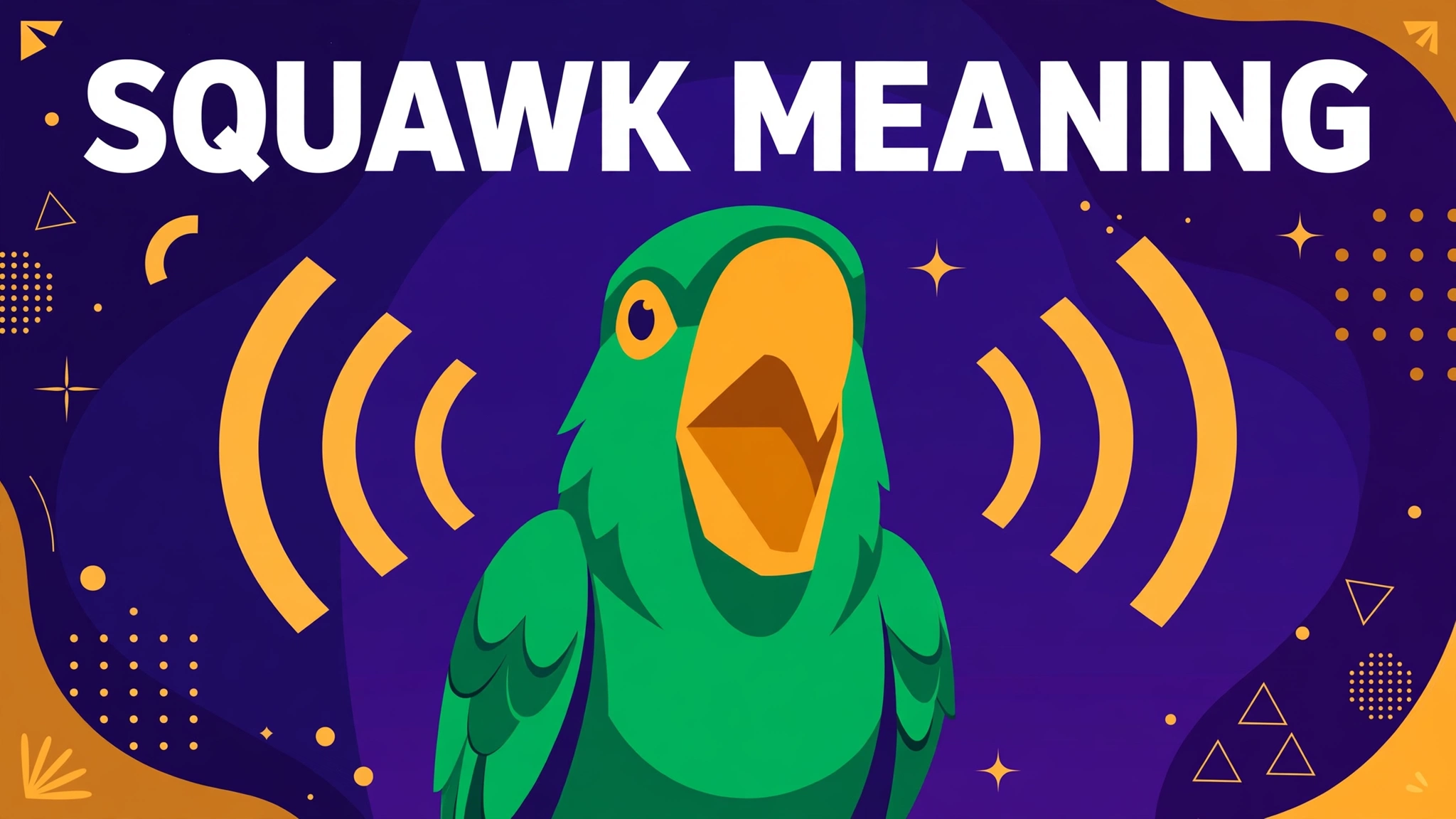
To squawk is to make a loud, harsh cry — the kind of sound a startled parrot makes, or a person makes when a bill arrives that is twice what they expected. It is a word that sounds like what it describes: say it out loud and you can hear the harsh, abrupt noise inside it. That sound quality is no accident. Squawk is an imitative word, built to mimic the cry of a bird, and it has carried that noise with it into every sense it has gained since — including the figurative one, where a person who squawks is complaining loudly and at length.
The word does two jobs in English. As a verb it names the act of making that noise, whether the noisemaker is a bird or a human being. As a noun it names the noise itself, or the complaint. Both uses are standard, both are in every major dictionary, and the difference between them is simply whether the sentence needs an action or a thing: the parrot squawked against the parrot let out a squawk.
What Does Squawk Mean?
Merriam-Webster gives the verb two senses. The first is literal: “to utter a harsh abrupt scream”. The second is figurative: “to complain or protest loudly or vehemently”. The noun follows the same split: “a harsh abrupt scream” and “a noisy complaint”. Collins and Oxford Learner’s Dictionaries agree on this shape, with Oxford putting the bird sense first — “(of birds) to make a loud sharp sound” — and then the human one: “to speak or make a noise in a loud, sharp voice because you are angry, surprised, etc.”
The literal sense is the older and more basic one. A squawk is a particular kind of animal noise: loud, harsh, sudden, and usually expressing alarm, anger, or protest. Ducks squawk when frightened; parrots squawk when startled or excited; geese squawk at intruders.
The figurative sense takes that edge and applies it to people. When customers squawk about high prices, or opponents of a project have been squawking for weeks, the word does more than report that they complained. It colours the complaint: loud, persistent, a little undignified, and probably ineffective. That colouring is the reason the word is so useful, and also the reason it is slightly rude. To say someone squawked is to say they made a noise about something rather than making a reasoned objection.
How to Pronounce Squawk
Cambridge and Oxford agree on the pronunciation, with the usual transatlantic difference in the vowel. In British English it is /skwɔːk/ — SKWAWK, with the long “aw” of law and saw. In American English it is /skwɔk/, the same vowel but shorter, and in accents with the cot–caught merger it becomes /skwɑk/, rhyming with sock. The spelling is a good guide to the sound: squ- as in square, then -awk as in hawk — which is fitting, since the word is probably related to hawk in its history.
The commonest pronunciation mistake is to drop the w and say something like skawk. The w is pronounced: the word begins with the cluster skw-, the same sound that opens squad, square, and squash. Keep the w audible and the vowel broad, and the pronunciation takes care of itself.
Squawk as a Verb: The Forms
Squawk is a regular verb. Its forms are squawks (third person singular), squawking (present participle), and squawked (past tense and past participle). There are no irregularities to memorise, and the spelling never changes: the w stays put in every form, so it is squawking, never “squaking”.
The verb is used both intransitively and transitively. Intransitively, it simply reports the noise: “The parrot squawked and flew away.” Transitively, it can take a quotation or a cry as its object, in the manner of verbs of speaking: “‘You did what?!’ she squawked.” Oxford records both patterns.
Real examples of the verb in its two senses:
- Bird noise: “The hens squawked and scattered when the dog ran into the yard.” “A gull squawked overhead as we walked along the pier.”
- Human complaint: “Customers squawked about the high prices.” “Opponents of the project have been squawking since the plans were published.” (Both examples are Merriam-Webster’s.)
- Sharp speech: “‘You did what?!’ she squawked.” (Oxford Learner’s Dictionaries.)
Squawk as a Noun
The noun is equally straightforward. A squawk is the cry itself: “The bird gave a startled squawk.” “She awoke to the squawk of chickens.” In the figurative sense it is a loud complaint: “If we don’t receive any squawks, we can assume the change was acceptable” — Merriam-Webster’s example, which captures the word’s dry, slightly dismissive tone. A complaint described as a squawk is being treated as noise, not argument.
The Aviation Sense: Squawk Codes
Squawk has a specialist life in aviation, where it means something quite different and very precise. A squawk code is a four-digit number a pilot sets on the aircraft’s transponder so that air traffic control can identify the flight on radar. To “squawk” in this sense is to set or transmit that code: a controller might tell a pilot to “squawk 1200”, the standard code for a flight operating under visual flight rules.
Three codes are reserved for emergencies and are worth knowing because they appear in news reports: 7500 for hijacking, 7600 for radio failure, and 7700 for a general emergency. Both uses come from the same idea as the ordinary word: a squawk is a signal that demands attention, loudly.
Where the Word Comes From
Squawk is a young word by English standards. Merriam-Webster dates the first known use of the verb to 1821, and the noun to 1850. Collins says it is of imitative origin — a word formed to sound like the noise it names — and dates it to the nineteenth century.
On the finer question of what it is a blend of, the dictionaries disagree, and the disagreement is worth recording honestly. Merriam-Webster says it is probably a blend of squall and squeak. Dictionary.com’s etymology gives it as a blend of squall and hawk, dated 1815–25. The safest statement is the one Collins makes: squawk is of imitative origin, first recorded in the nineteenth century. That is certain; the exact blend is a matter of scholarly judgement.
Squawk vs Screech, Squeak, and Squall
Squawk has several noisy neighbours, and the differences between them are a matter of pitch, duration, and who is making the noise.
| Word | The sound | Who makes it | Typical use |
|---|---|---|---|
| Squawk | Loud, harsh, abrupt | Birds; people complaining | A parrot’s cry; a loud complaint |
| Screech | High, piercing, prolonged | Birds of prey; brakes; people | An owl’s screech; tyres screeching |
| Squeak | Short, high, thin | Mice; hinges; shoes | A mouse squeaks; a door squeaks |
| Squall | Loud, harsh cry; also a storm | Babies; wind and sea | A baby squalls; a squall at sea |
There is one more near-neighbour worth separating: peal, the loud ringing of bells. A squawk is harsh and ugly; a peal is musical and sustained. The two words belong to different families of sound, and confusing them would be like confusing a car horn with a church bell. If you want the full story of peal and its homophone peel, see Clarifyra’s guide to peel or peal.
Common Mistakes to Avoid
Using “squawk” for any bird noise
Not every bird sound is a squawk. Songbirds sing, owls hoot and screech, doves coo, and only the loud, harsh cries of birds like parrots, ducks, geese, and gulls are naturally called squawks. Using the word for a nightingale’s song would be a category error, not a poetic stretch.
Forgetting the figurative sense is dismissive
To say that someone “squawked” about something is not neutral. It implies the complaint was loud, emotional, and probably not very effective. In formal writing, or when you want to report a complaint respectfully, objected, protested, or complained are safer choices. Squawked belongs in informal writing, dialogue, and journalism with a point of view.
Spelling it “squak” or “squawk” with one w too few
The spelling is s-q-u-a-w-k. The aw in the middle is the same spelling as in hawk and squall, and dropping the w produces a word no dictionary recognises. The related forms keep the same spelling throughout: squawked, squawking, squawker.
Confusing the aviation sense with the ordinary one
In a sentence about flying, “squawk” is a technical term with a precise meaning — a transponder code. It is not a complaint and not a bird noise. Readers meeting the word in an aviation context should not import the barnyard sense, and writers should not use the aviation sense as a joke without signalling it.
FAQs
What does squawk mean?
As a verb, to make a loud, harsh cry, like a parrot or a frightened duck; figuratively, to complain loudly. As a noun, the cry itself, or a loud complaint. In aviation, it also means to set a transponder code.
Is squawk a noun or a verb?
Both. It is a verb (“The parrot squawked”) and a noun (“a startled squawk”). The verb is the older use — first recorded in 1821 — and the noun followed around 1850.
What is a squawk code?
A four-digit code a pilot sets on an aircraft’s transponder so air traffic control can identify the flight. The best-known codes are 1200 for normal visual flight, 7500 for hijacking, 7600 for radio failure, and 7700 for a general emergency.
What is the difference between squawk and screech?
A squawk is loud, harsh, and abrupt — the cry of a parrot or a complaining person. A screech is higher, more piercing, and more prolonged — the cry of an owl, or tyres on tarmac. Both are harsh sounds, but a screech sits higher in pitch.
What is a squawk box?
An informal term, dating to around 1945, for a loudspeaker or intercom system — a box that broadcasts sound, often abruptly and at volume. It is still used for speaker systems in offices, cockpits, and trading floors.
The Takeaway
Squawk is a loud, harsh, abrupt cry — made by birds, and, by extension, by people complaining loudly. Pronounced SKWAWK, UK /skwɔːk/ and US /skwɔk/, it works as both a verb (the parrot squawked) and a noun (a startled squawk), with regular forms throughout. It is an imitative nineteenth-century word that still does exactly what it was built to do: put a harsh noise into a sentence. Remember that the figurative sense carries a dismissive edge, and that in aviation the word has a precise technical meaning of its own.