Shrank or Shrunk: Which Is Correct?
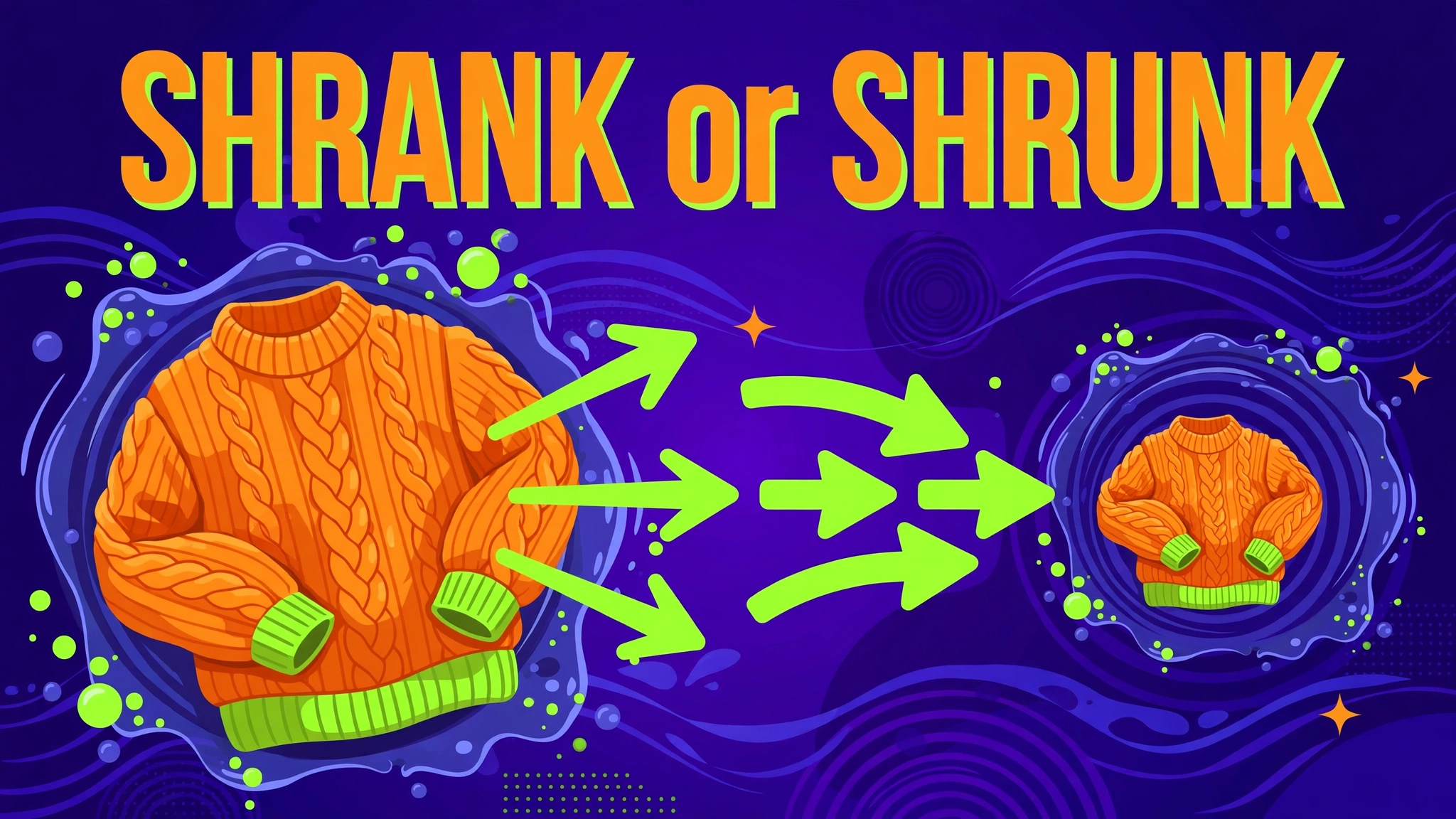
Shrank is the past tense of shrink — the sweater shrank in the wash — and shrunk is the past participle — the sweater has shrunk. They are not interchangeable, though English speakers swap them constantly: shrank goes with a finished action in the past (“it shrank yesterday”), while shrunk follows have/has/had (“it has shrunk”). The pattern is the same one you already know from sing–sang–sung and drink–drank–drunk.
Quick Answer
Use shrank for the simple past: The jeans shrank after one wash; the market shrank by 5%. Use shrunk for the past participle: The jeans have shrunk; the market had shrunk for two quarters. Think shrink–shrank–shrunk, exactly like sing–sang–sung. Writing “have shrank” or “it shrunk yesterday” in formal prose will be flagged — swap in the matching form.
The three forms of “shrink”
Shrink is an irregular verb meaning to become smaller or to cause something to become smaller — clothes in hot water, economies in recessions, violets in the figurative sense of shrinking from attention. Its principal parts are:
- Base form: shrink — “Cotton will shrink in hot water.”
- Past tense: shrank — “The sweater shrank when it was washed” (Merriam-Webster’s own example). Collins’s COBUILD entry lists the past tense as shrank.
- Past participle: shrunk — “All my jumpers have shrunk” (Collins’s example). Used after have/has/had: “The deficit has shrunk.”
The family resemblance is the memory aid: shrink–shrank–shrunk follows the same i–a–u vowel shift as sing–sang–sung, drink–drank–drunk, and sink–sank–sunk. If you can say “he sang yesterday” and “he has sung,” you already know how shrink works.
Where the confusion comes from
The honest complication is that shrunk as a simple past is extremely common in speech: “The sweater shrunk in the dryer” sounds natural to millions of native speakers, and some dictionaries record it. Collins’s British English entry lists the past tense as “shrank or shrunk,” and Webster’s New World (American) gives “shrank or shrunk” for the past tense too, with “shrunk or shrunken” as the past participle. So “it shrunk yesterday” is not an invention — it is a documented variant.
But there is a clear hierarchy, and Collins’s own main line states it: past tense shrank, past participle shrunk. Usage guides consistently prefer shrank for the simple past, and the famous cautionary tale is Christopher Darden’s “The gloves appear to have shrank somewhat” during the O. J. Simpson trial — the error being the mirror image: shrank used where the participle shrunk belonged. In formal writing, keep the two forms in their lanes: shrank for “yesterday,” shrunk for “has/have/had.”
There is one more form worth knowing: shrunken, the older participial adjective, still alive in set phrases — “a shrunken head,” “a shrunken sweater,” “shrunken hopes.” It works as an adjective before a noun, not as a verb form: “the shrunken economy” (fine), “the economy has shrunken” (not standard — use “has shrunk”).
Pronunciation
All three forms are pronounced the same way in British and American English, with the stress on the single syllable: shrink /ʃrɪŋk/, shrank /ʃræŋk/, shrunk /ʃrʌŋk/. Collins gives /ʃrɪŋk/ for the headword in both varieties. The vowel shift i → a → u is the whole audible difference: shrINK (like ink), shrANK (like tank), shrUNK (like drunk). Rhyming each form with its sing–sang–sung cousin locks in both the sound and the spelling.
Correct and incorrect, in sentences
| Sentence | Verdict | Why |
|---|---|---|
| The sweater shrank in the wash. | ✓ Correct | Simple past of a finished action — shrank. |
| The sweater has shrunk twice now. | ✓ Correct | Past participle after has — shrunk. |
| He shrank from the challenge. | ✓ Correct | Figurative sense (recoiled); simple past — shrank (MW’s example). |
| All my jumpers have shrunk. | ✓ Correct | Past participle after have — shrunk (Collins’s example). |
| The shrunken sweater no longer fits. | ✓ Correct | Shrunken as an adjective before a noun. |
| The sweater has shrank twice now. | ✗ Wrong | After has you need the participle: “has shrunk.” |
| The sweater shrunk in the wash. | ⚠ Avoid in formal writing | Common in speech and recorded as a variant, but shrank is the preferred past tense. |
| The gloves appear to have shrank. | ✗ Wrong | After have the participle is required: “have shrunk.” |
| The economy has shrunken for two years. | ✗ Wrong | Shrunken is an adjective, not a verb form: “has shrunk.” |
Common mistakes
“Have shrank” / “has shrank.” The single most common error with this verb: pairing the past tense with a helping verb. “The budget has shrank” should be “the budget has shrunk.” The test: if have, has, or had comes before it, the form is shrunk — every time, no exceptions.
Using “shrunk” as the simple past in formal writing. “The shirt shrunk” will pass unnoticed in conversation and even in some edited prose, but style guides and the dictionary’s preferred forms say shrank. In anything formal — reports, exams, applications — write “the shirt shrank.”
Treating “shrunken” as a verb. “The market had shrunken” is not standard. Shrunken survives only as an attributive adjective: “the shrunken market,” “shrunken heads,” “his shrunken sweater.”
Forgetting the figurative sense. Shrink also means to recoil or hold back: “she shrank from the spotlight,” “he didn’t shrink from the fight.” The verb forms are identical in this sense — shrank past, shrunk participle (“he has never shrunk from a challenge”).
Over-regularizing to “shrinked.” Learners sometimes produce shrinked by analogy with regular verbs. It is not a word in standard English — the past is shrank, full stop.
FAQs
Which is correct: “shrank” or “shrunk”?
Both are correct — in different jobs. Shrank is the simple past tense (“it shrank yesterday”); shrunk is the past participle (“it has shrunk”). Collins lists the pair as past tense shrank, past participle shrunk. Use shrunk as a simple past (“it shrunk yesterday”) only in informal speech; prefer shrank in writing.
Is “have shrunk” or “have shrank” correct?
“Have shrunk.” After have/has/had, English requires the past participle, and the participle of shrink is shrunk. “Have shrank” is always wrong in standard English.
What about “shrunken”?
Shrunken is an older participial form that survives as an adjective: “a shrunken sweater,” “shrunken heads.” Don’t use it as a verb form — “has shrunken” is not standard; write “has shrunk.”
How do you pronounce “shrank” and “shrunk”?
Shrank is /ʃræŋk/ (rhymes with tank), shrunk is /ʃrʌŋk/ (rhymes with drunk), identical in British and American English. The base verb shrink is /ʃrɪŋk/.
Why is it “shrink–shrank–shrunk” and not “shrinked”?
Shrink is a Germanic strong verb, like sing, drink, sink, and swim — it marks tense with a vowel change (i–a–u) rather than adding -ed. Collins traces it to Old English scrincan; a thousand years of vowel-shifting is why the pattern feels irregular but is actually ancient and regular within its family.
Takeaway
Shrink–shrank–shrunk: past tense shrank for finished actions (“the sweater shrank”), past participle shrunk after have/has/had (“the sweater has shrunk”), and the adjective shrunken for the thing itself (“the shrunken sweater”). The sing–sang–sung parallel is your permanent memory hook. Keep the helping-verb test in your pocket — have before it means shrunk, always — and this verb will never trip you again. It is a classic test item in exams and copy-editing exercises, so knowing it cold pays off.
Sources: Collins gives the word forms as past tense shrank, past participle shrunk (with “shrank or shrunk” listed as past-tense variants in the British and American entries, and “shrunk or shrunken” as the participle), pronounced (ˈʃrɪŋk); Merriam-Webster’s examples use “The sweater shrank when it was washed” and “shrank from the challenge.” Further reading: Collins — shrink; Merriam-Webster — shrink.