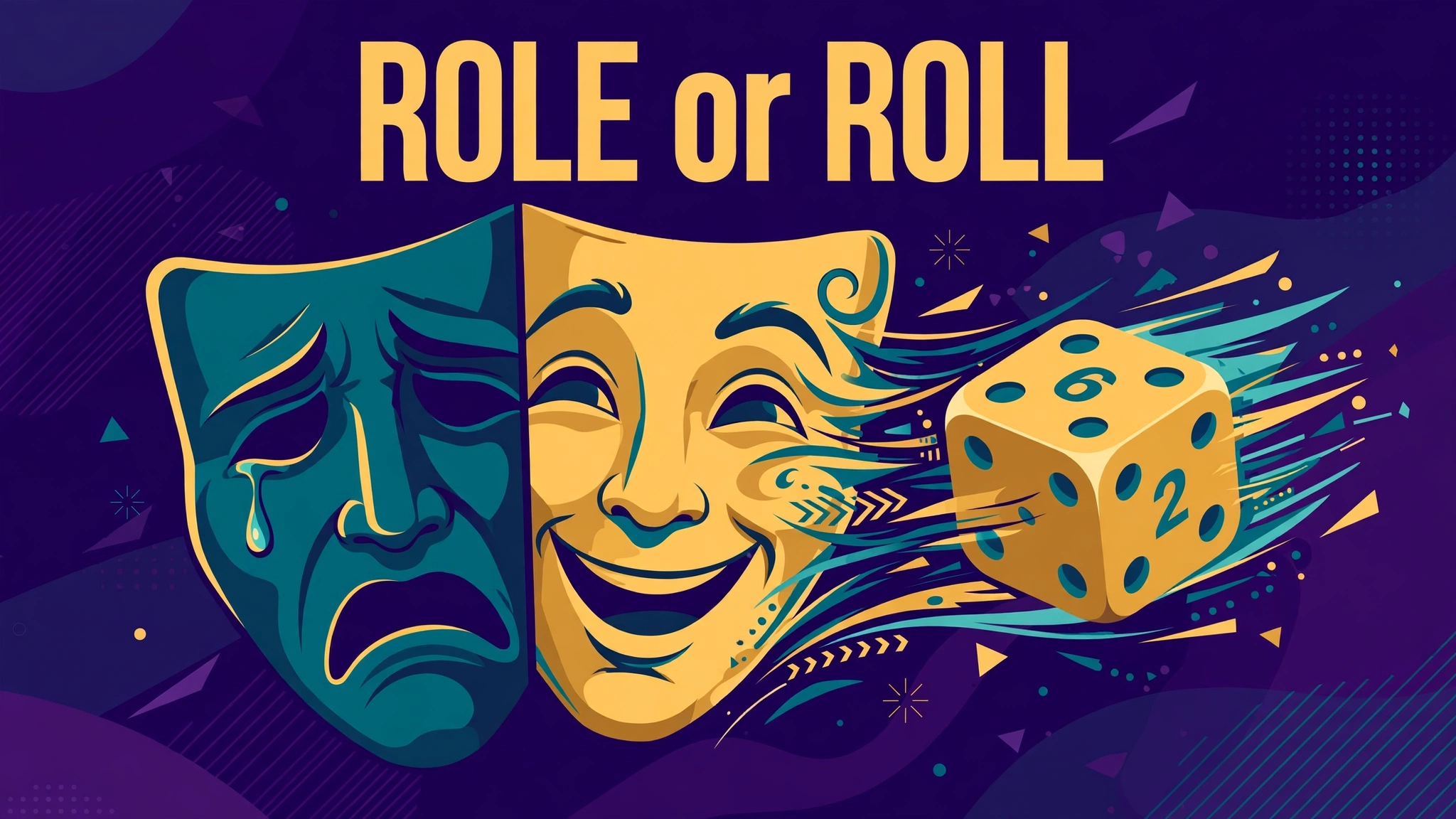
Role or Roll: What’s the Difference?
Role is a noun meaning a part you play or a function you perform — her role in the project, the role of a parent. Roll is a verb meaning to turn over and over — the ball rolled down the hill — or a noun for something rolled up or a list of names — a bread roll, a roll of tape, the class roll. The two words are homophones (both pronounced /rōl/), which is why they get mixed up, but they belong to different parts of speech, mean entirely different things, and even have different histories — though, delightfully, those histories turn out to be related.
Quick Answer
Use role (with one l) for a part played or a job performed: She played the leading role; his role is to keep the accounts. Use roll (two l‘s) for turning motion or a coiled thing: The dice rolled across the table; a roll of paper towels. They sound identical, so spell by meaning: a role is something you play; a roll is something that turns.
What “role” means
Role is always a noun. Merriam-Webster’s synonyms — purpose, task, job, function, part — map its territory neatly: it names the part someone or something plays in a larger performance or undertaking. “Her role in the merger was to handle the legal filings.” “Parents have a crucial role in a child’s education.” “What role does sleep play in memory?” In each case, role answers the question what part does X play?
The word entered English in 1605 from French rôle — literally, “roll,” from Old French rolle. The connection is not coincidence: Merriam-Webster’s etymology notes that an actor’s part was once written on a scroll, so the “part played by an actor” took its name from the physical roll of paper it was written on. Role is, etymologically speaking, a roll that got a part in the theatre. (This is also why the spelling keeps a single l with a silent e — it is a French borrowing, dressed for the stage.)
Two usage notes. First, role has no verb form: “he roles the dough” and “she roled with laughter” are both wrong — those are roll jobs. Second, the set phrase is role model (a person whose behavior is imitated), never “roll model.”
What “roll” means
Roll is the busy one: a verb and a noun with a long list of senses, all circling the idea of turning over and over. As a verb, Merriam-Webster’s core senses are “to impel forward by causing to turn over and over on a surface” (“rolled the ball down the hill”), “to move along a surface by rotation without sliding” (“the ball rolled slowly to a stop”), and “to wrap round on itself” (“rolled up the newspaper”). Extended senses cover everything from roll out the dough to roll the cameras to rolling in money.
As a noun, roll names three main things: (1) something coiled or cylindrical — a roll of film, a dinner roll, a sausage roll; (2) a list of names — the class roll, the electoral roll, to call the roll (this is the scroll sense again: a list was literally a roll of parchment); and (3) the act or sound of rolling — a roll of thunder, a forward roll. The verb goes back to Middle English, from Anglo-French rouler, first recorded in the 14th century — and its root is the Latin rota, wheel, which it shares with rotation, rotary, and roulette.
So the twist: role and roll are not just sound-alikes that drifted together. Role was borrowed from a French word that itself meant “roll.” They are etymological cousins who happen to have landed in English with different spellings and different jobs.
Pronunciation
Identical: /rōl/ — rhyming with hole, soul, and coal. Merriam-Webster gives /ˈrōl/ for role, and roll matches it exactly in both British and American English. This is a true homophone pair — no accent distinguishes them — which is why the confusion is a spelling problem only. The mnemonic that works: role has one l, like the single part it names; roll has two l‘s, like the two ends of a rolling cylinder. Better still, spell by meaning: if you can substitute “part” or “function,” write role; if you can substitute “turn” or “spin,” write roll.
Correct and incorrect, in sentences
| Sentence | Verdict | Why |
|---|---|---|
| She played the leading role in the play. | ✓ Correct | A part performed — role (one l). |
| His role is to manage the budget. | ✓ Correct | A function performed — role. |
| The ball rolled under the sofa. | ✓ Correct | Turning motion — roll (two l‘s). |
| She bought a roll of paper towels. | ✓ Correct | A coiled cylinder — roll. |
| The teacher called the roll. | ✓ Correct | A list of names — roll (the scroll sense). |
| She played the leading roll in the play. | ✗ Wrong | A part performed is a role; a roll is something that turns. |
| He has an important roll in the company. | ✗ Wrong | A function is a role, not a roll. |
| He roles the dough flat before baking. | ✗ Wrong | Role has no verb form; the verb is roll: “he rolls the dough.” |
| She is his roll model. | ✗ Wrong | The set phrase is role model — the person, not the pastry. |
Common mistakes
Writing “roll” for a part played. The signature error: “an important roll in the negotiations,” “starring roll,” “roll model.” Because the two words sound identical, the wrong one slips past spellcheckers (both are real words) and sometimes past proofreaders. If you mean part, function, or job, it is role — one l.
Writing “role” for turning motion. The mirror error, less common but real: “the car roled down the hill,” “role over and go back to sleep.” Role is noun-only; motion always takes roll.
“Roll call” confusion. Roll call (reading the list of names) is spelled with two l‘s — it is the scroll/list sense of roll, not a role anyone is playing. A useful test: roll call is a thing done to people; a role is a thing a person does.
Mixing “roll” with bread. A dinner roll and a sausage roll are bread products named for their rolled shape — two l‘s. Writing “dinner role” turns supper into theatre.
Assuming they are unrelated words. Not a mistake that affects spelling, but a missed pleasure: role comes from French rôle, literally “roll” — the actor’s part written on a scroll. Knowing the shared root makes the pair easier to remember, not harder.
FAQs
What is the difference between “role” and “roll”?
Role (one l) is a noun meaning a part played or function performed: “her role in the film.” Roll (two l‘s) is a verb meaning to turn over and over (“the ball rolled”) or a noun for a coiled thing or a list (“a roll of tape,” “the class roll”). They are pronounced identically.
Is it “role model” or “roll model”?
Role model — one l. It means a person whose behavior serves as a pattern for others; the “role” is the part they play in someone’s life. “Roll model” would be a model of a bread roll.
Are “role” and “roll” homophones?
Yes — a true homophone pair, pronounced /rōl/ in both British and American English with no distinction. Context is the only guide to which one a speaker means, which is why writers have to get the spelling right.
Is “role” ever a verb?
No. Role is noun-only in standard English. If the sentence needs a verb — rolling dough, rolling dice, rolling out of bed — the word is roll.
Why do they sound the same?
Partly coincidence, partly history. Roll comes from Latin rota (wheel) via French; role comes from French rôle, which itself meant “roll” — an actor’s lines written on a scroll. The two words are distant cousins wearing different spelling.
Takeaway
One l for the part you play, two l‘s for the thing that turns: role is the actor’s part, the job, the function; roll is the motion, the coil, the list. They sound the same because they partly share a root — the actor’s role was once literally a roll of paper. Spellcheck won’t save you here, since both are real words; only meaning will. Substitute “part” — if it fits, write role. Substitute “turn” — if it fits, write roll.
Sources: Merriam-Webster lists role (/ˈrōl/) with the synonyms purpose, task, job, function, part, and traces it to French rôle, literally “roll,” from Old French rolle — the actor’s part written on a scroll; its entry for roll gives the core verb senses “to impel forward by causing to turn over and over on a surface” and “to move along a surface by rotation without sliding,” tracing the word to Latin rota, wheel. Further reading: Merriam-Webster — role; Merriam-Webster — roll.