Motley Meaning: Definition, Origin and Examples
Motley is a word with a costume drama for a past. Today it means a mixed, varied, oddly-assorted bunch — a motley crew, a motley collection. But the word began as cloth: parti-coloured woollen fabric, the patchwork uniform of the medieval jester. The journey from fabric to fool to “a strange mixture” is one of the most satisfying etymologies in English, and it explains why motley still carries a faint whiff of the circus.
What the Dictionaries Say About “Motley”
| Dictionary | Definition of motley |
|---|---|
| Collins COBUILD | Adjective: “You can describe a group of things as a motley collection if you think they seem strange together because they are all very different.” Examples: “a motley collection of vans, old buses, cattle-trucks, and even a fire engine”; “The volunteers seem a motley crew.” |
| Collins British English | Adjective /ˈmɒtlɪ/: “made up of elements of varying type, quality, etc“. Noun: the particoloured attire of a jester; obsolete: a jester. Word origin, 14th century: perhaps from mot, “speck, mote”. |
| Collins American English | Adjective /ˈmɑːtli/: 1. “a motley group” (varied); 2. “being of different colors combined; parti-colored” (“a motley flower border”); 3. “wearing a parti-colored garment” (“a motley fool”). Noun: 4. “a combination of different colors”; 5. “a parti-colored effect”; 6. “the parti-colored garment of a jester“. Synonyms: varied, mixed, incongruous. |
The table reveals the word’s double life. As an adjective, it does two jobs: mixed/various (the modern, common one) and multicoloured (the older, literal one). As a noun, it is the jester’s coat — and, in the obsolete sense, the jester wearing it. Keep both adjective senses in mind; the “multicoloured” one is the bridge to the origin story.
How to Pronounce “Motley”
MOT-lee — two syllables, stress on the first. British English: /ˈmɒtlɪ/ (with the short rounded o of hot); American English: /ˈmɑːtli/ (with the broader ah of father). The second syllable is a quick, unstressed -lee. Two common slips: stressing the second syllable (mot-LEE), and pronouncing it to rhyme with mottled — the words are unrelated neighbours, not rhymes.
From Cloth to Clown: Where “Motley” Comes From
This is the part worth telling in full, because the history explains the modern meaning.
Stage one: the fabric (1300s). Since at least the 14th century, motley — spelled a dozen ways — named a woollen cloth woven from threads of two or more colours. Etymologists derive the adjective from Anglo-French motteley, “parti-coloured, variegated in colour”, originally of fabric; the noun, “cloth of contrasting mixed colour”, is dated to the same period. The Oxford English Dictionary calls it a cognate of medley (a mixture) — the two words are old cousins. Chaucer’s Canterbury Tales dresses its Merchant in it: “In motlee, and hye on hors he sat” — and the Merchant is no fool, which shows the cloth was ordinary wear before it became a costume.
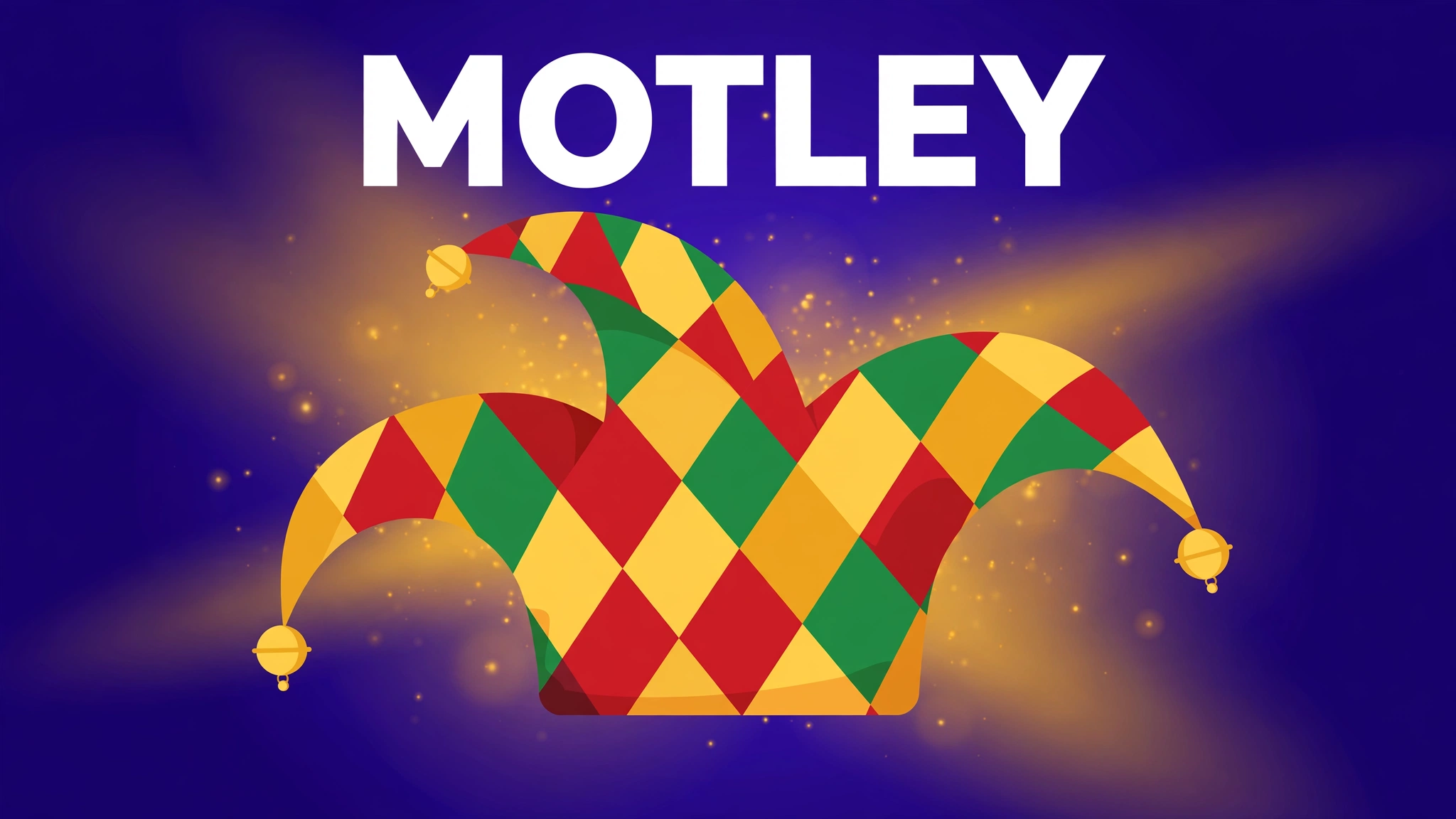
Stage two: the fool’s uniform. The professional jester — the court fool, the harlequin of commedia dell’arte — adopted patchwork motley as his livery: diamonds of red, green and blue that announced, at a glance, this person stands outside the normal order. In Elizabethan England this had a real legal function. Sumptuary laws dictated who could wear what; the fool, dressed in motley, was placed outside the class system — and therefore outside its punishments. That is why the fool could say things to the king that would cost anyone else their head: the costume was a licence.
Stage three: the fool himself. By around 1600, motley standing alone could mean the jester — the garment naming the wearer. Shakespeare, who loved the word, gives us the two most famous lines. In As You Like It (Act 2, Scene 7), Jaques meets a fool in the forest and envies his freedom: “Motley’s the only wear” — the fool’s coat is the only honest uniform — and begs the Duke, “I am ambitious for a motley coat.” It is the same scene that gives us “All the world’s a stage”.
Stage four: the modern adjective. From “wearing mixed colours” the word slid to “mixed in itself”: a motley group is one whose members look as oddly assorted as the patches on the fool’s coat. The colour sense survives too (“a motley flower border”), but the “strange mixture” sense now does most of the work.
“A Motley Crew”: The Phrase That Carries the Word
Most people meet motley inside “a motley crew”, and it is worth understanding exactly what the phrase claims. It means a diverse, oddly-assorted and usually slightly disorganised group — think of a pirate ship’s company, a volunteer clean-up team of strangers, or the famously mismatched Fellowship of the Ring. Vocabulary.com glosses it as “a diverse and poorly organized group”.
Note the flavour: motley is mildly disparaging as an adjective. A “motley collection” is, as one encyclopedia entry puts it, “an uninspiring pile of stuff” — the word implies the mixture is accidental rather than curated. COBUILD’s definition bakes this in: “if you think they seem strange together“. Compare: a diverse team is a compliment; a motley team is a description with a raised eyebrow. Use diverse or varied when you mean it warmly; use motley when the oddness of the mixture is the point.
One modern footnote: the heavy-metal band Mötley Crüe spells the same two words with umlauts. The dots are pure decoration — a rock-band affectation with no linguistic function — but they testify to how evocative the word remains: motley still sounds like trouble in a good costume.
“Motley” in Real Sentences
The “mixed bunch” sense:
- The volunteers were a motley crew — students, retirees, one off-duty chef and a dog.
- Her bookshelves held a motley collection of paperbacks, textbooks and ancient magazines.
- The festival drew a motley crowd of locals, tourists and lost-looking backpackers.
The “multicoloured” sense:
- The garden was at its best in June, all motley borders of poppies and cornflowers.
- He wore a motley scarf knitted from a dozen leftover balls of wool.
The noun (jester’s garment):
- The actor entered in full motley, bells jingling, and the court fell silent.
- “On with the motley” — the old theatrical cry for the clown to take the stage.
Motley vs Its Neighbours
Motley vs diverse / varied. All three mean “made of different kinds”, but diverse and varied are neutral-to-positive, while motley adds oddness and a hint of disorder. A diverse workforce (good); a motley assortment of leftovers (accurate, slightly rueful).
Motley vs assorted. Assorted is the shopkeeper’s word — “assorted biscuits” — neutral and commercial. Motley is the storyteller’s word: it implies the assortment wasn’t planned and looks it.
Motley vs ragtag. Ragtag (“a ragtag army”) is motley‘s rougher cousin — it adds shabbiness to the mixture. A motley crew might just be eccentric; a ragtag crew is falling apart.
Motley vs incongruous. Collins lists incongruous as a synonym, and it captures the “strange together” element precisely. But incongruous is formal and analytical; motley is vivid and slightly comic. Use incongruous in an essay, motley in a story.
FAQs About “Motley”
What does “motley” mean?
As an adjective: made up of very different, oddly-assorted elements (“a motley crew”), and multicoloured/parti-coloured (“a motley flower border”). As a noun: the jester’s patchwork garment — and, in older use, the jester himself.
How do you pronounce “motley”?
MOT-lee — stress on the first syllable: UK /ˈmɒtlɪ/, US /ˈmɑːtli/. Not mot-LEE, and not rhymed with mottled.
What does “a motley crew” mean?
A diverse, oddly-assorted, usually slightly disorganised group — like a pirate ship’s company or a random team of volunteers. The phrase carries a mildly comic, slightly disparaging flavour: the mixture looks accidental.
Is “motley” negative?
Mildly. It is not an insult, but it implies oddness and lack of organisation rather than harmonious variety. If you want the compliment, say diverse; if the ragtag oddness is the point, motley is perfect.
Why is a jester’s costume called “motley”?
Because it was made from motley cloth — 14th-century woollen fabric woven from mixed-colour threads. The patchwork costume marked the fool as outside the normal class order, which in Elizabethan England effectively licensed him to speak freely, even to royalty. Shakespeare’s Jaques envied exactly that freedom: “Motley’s the only wear.”
What is the origin of the word “motley”?
Late 14th century, from Anglo-French motteley (“parti-coloured”), perhaps from mot (“speck, mote”); the OED calls it a cognate of medley. It went from fabric, to fool’s uniform, to fool, to “strange mixture” — all in about 600 years.
The Takeaway
Motley — MOT-lee — means a strange, mixed assortment (and, literally, multicoloured), with a noun sense naming the jester’s patchwork coat. The word travelled from 14th-century cloth to the fool’s licensed uniform to Shakespeare’s forest (“Motley’s the only wear”) to today’s “motley crew” — always carrying the idea that the mixture is odd, accidental and a little bit wonderful. Use it when diverse is too polite and ragtag too rough. For the full dictionary entry with British and American senses, see Collins’s entry for motley.