Macaron or Macaroon: What’s the Difference?
If you have ever stood in a bakery wondering whether the pastel sandwich cookies are macarons and the coconut haystacks are macaroons — or whether you have it backwards — you are not alone. Here is the short version: a macaron is the French almond meringue cookie made of two halves with a filling between them; a macaroon is the soft, chewy coconut or almond biscuit. They are two different treats, with two different spellings, two different pronunciations, and one very tangled shared history.
The confusion is understandable, because for a long time English barely distinguished them. As the Oxford Advanced Learner’s Dictionary records, macaroon entered English in the late 16th century from the French macaron — one word gave birth to the other, and only later did the two settle into meaning different things. So this is not a case of one spelling being right and the other wrong. It is a case of two correct words that grew apart.
Two Cookies, Two Spellings
The Oxford Advanced Learner’s Dictionary defines each word with a picture-worthy precision. A macaron is “a small round cake, made with egg white, sugar and almonds, usually consisting of two halves with a cream filling in between”. The word is marked as French in origin — and the dictionary itself adds “see also macaroon“, acknowledging that readers of one entry need the other. A macaroon is “a soft, round, sweet biscuit made with almonds or coconut”. Notice the adjectives: the macaron is a “cake” of two halves; the macaroon is a single “biscuit”, soft and round.
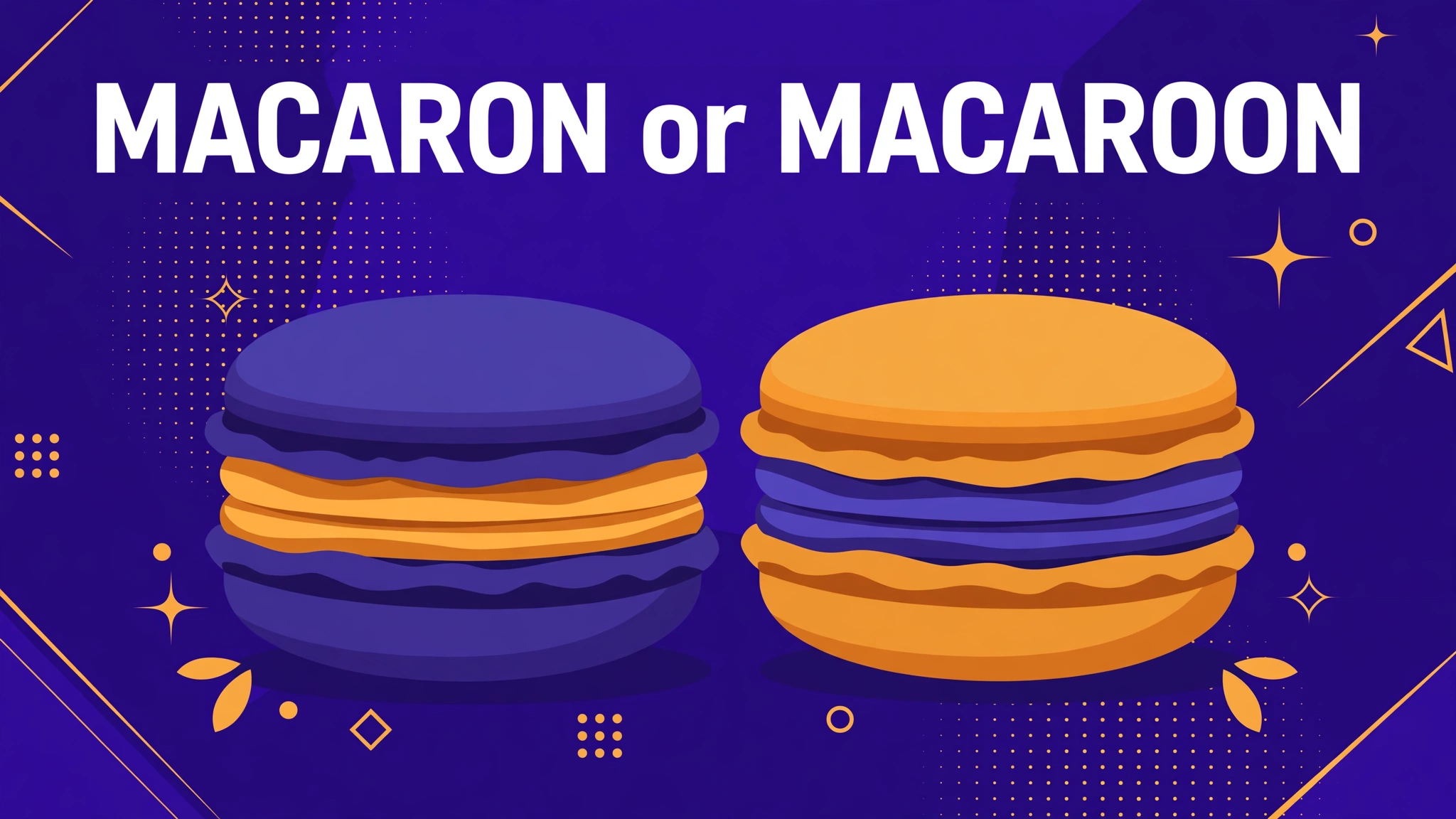
Put them side by side in a bakery and the difference is visual. The macaron is petite, smooth, brightly coloured, with a glossy shell and a visible band of ganache or buttercream. The macaroon is rustic — a rough golden mound, often studded with coconut, sometimes dipped in chocolate. If it looks like it was piped with architectural precision, it is a macaron. If it looks like a delicious lump, it is a macaroon.
| Macaron | Macaroon | |
|---|---|---|
| Spelling | one O | double O |
| Pronunciation | mac-ah-ROHN (UK /ˌmækəˈrɒn/, US /ˌmækəˈrɑːn/) | mac-ah-ROON (UK/US /ˌmækəˈruːn/) |
| Main ingredients | almond flour, egg white, sugar | coconut or almonds, egg white, sugar |
| Shape | two smooth halves sandwiched with filling | single rough, chewy mound |
| Origin of the word | French macaron | late 16th cent.: from French macaron, Italian maccarone, late Greek makaria |
| Use it when | ordering at a French pâtisserie | baking coconut biscuits at home |
Why the Words Collided
The etymology is the reason nobody can keep them straight. Oxford traces macaroon to “late 16th cent.: from French macaron, from Italian maccarone, from late Greek makaria ‘food made from barley'”. In other words, the English word macaroon began life as the French word macaron, anglicised. For centuries, English speakers used macaroon for anything in this almond-meringue family — including what the French called a macaron.
The two recipes then diverged geographically. In France, the macaron evolved into the filled sandwich cookie perfected by Parisian pâtissiers. In Britain and America, the coconut version took hold, and the English spelling macaroon stuck to it. When French-style macarons became fashionable in the English-speaking world in the 2000s, the original French spelling came back with them — and suddenly both spellings were in circulation again, attached to two different treats.
This history matters for writing, because it explains why you will sometimes see older American recipes call the French cookie a “macaroon”. It is not exactly wrong — it is the older English usage, from before the two words settled their modern division of labour. But in contemporary writing, the distinction is the standard: macaron for the French sandwich cookie, macaroon for the coconut or almond biscuit.
How to Say Each One
The pronunciation difference is entirely in the final syllable, and it mirrors the spelling:
- macaron: mac-ah-ROHN — UK /ˌmækəˈrɒn/, US /ˌmækəˈrɑːn/. The final vowel is the short “o” of on, with a French-nasal quality if you want to be authentic. Stress on the last syllable.
- macaroon: mac-ah-ROON — UK/US /ˌmækəˈruːn/. The double o gives the long “oo” of moon. Stress on the last syllable here too.
The shared mistake is to pronounce both like “mac-ah-ROON”, which erases the distinction the spelling works so hard to keep. If you remember that the single o in macaron keeps its French value (“rohn”, not “roon”), the spelling itself becomes the pronunciation guide.
Macaron and Macaroon in Real Sentences
- She bought a box of pastel macarons from the pâtisserie.
- Grandma’s coconut macaroons were always the first to disappear.
- The café serves pistachio macarons with salted caramel filling.
- He prefers chewy almond macaroons to the fancy French kind.
- Making macarons at home requires a steady hand and a scale.
- These chocolate-dipped macaroons are a holiday tradition.
Notice that in each sentence the word names the treat precisely. “A box of coconut macarons” would puzzle a baker; “a box of coconut macaroons” is exactly what it says. Precision here is not pedantry — it is how you get the dessert you actually wanted.
Correct vs. Incorrect
| Correct | Incorrect |
|---|---|
| The macaron shells were perfectly smooth. | The macaroon shells were perfectly smooth. |
| She baked coconut macaroons for the party. | She baked coconut macarons for the party. |
| He ordered a pistachio macaron at the café. | He ordered a pistachio macaroon at the café. |
| These almond macaroons are wonderfully chewy. | These almond macarons are wonderfully chewy. |
| The macarons were filled with raspberry ganache. | The macaroons were filled with raspberry ganache. |
Common Mistakes
Mistake 1: Using “macaroon” for the French sandwich cookie. This is the most common error in menus, food blogs, and everyday speech. The French almond sandwich cookie is spelled macaron, one o. Reserve macaroon for the coconut or almond biscuit.
Mistake 2: Pronouncing both as “mac-ah-ROON”. The single-o spelling of macaron signals a different vowel: “rohn”. Saying “mac-ah-ROON” for both collapses two words into one and betrays the spelling.
Mistake 3: Assuming they are the same recipe. They share a family history, but a macaron’s almond-flour shell and ganache filling are nothing like a macaroon’s chewy coconut mound. Writing about one while describing the other confuses readers who bake.
Mistake 4: Plurals with an apostrophe. The plurals are macarons and macaroons — no apostrophe. “Macaron’s” means “belonging to a macaron”, which is only useful if you are writing about a very possessive cookie.
Frequently Asked Questions
Is a macaroon the same as a macaron?
No — they are two different treats. A macaron is the French almond meringue sandwich cookie with a filling; a macaroon is the soft, chewy coconut or almond biscuit. The Oxford Advanced Learner’s Dictionary gives each its own entry and pronunciation, and cross-references them with “see also”.
Why are they spelled so similarly?
Because macaroon began as the English spelling of the French macaron. Oxford traces macaroon to the “late 16th cent.: from French macaron, from Italian maccarone, from late Greek makaria“. The two words only settled into meaning different things later.
How do you pronounce macaron?
Mac-ah-ROHN — UK /ˌmækəˈrɒn/, US /ˌmækəˈrɑːn/, stress on the last syllable, with the short “o” of on. Not “mac-ah-ROON” — that pronunciation belongs to macaroon (UK/US /ˌmækəˈruːn/).
Which spelling do I use in a bakery order?
If you want the pastel French sandwich cookies, write and say macaron. If you want the chewy coconut biscuits, write and say macaroon. The spelling is the order.
The Takeaway
Macaron (one o, “rohn”) is the French almond sandwich cookie. Macaroon (two o’s, “roon”) is the chewy coconut or almond biscuit. They share a 16th-century ancestor but have been different words — and different desserts — for a long time. Spell the one you mean, and pronounce the final syllable to match.
Sources: Oxford Learner’s — macaron; Oxford Learner’s — macaroon.