Sunburned or Sunburnt: Which Is Correct?
Sunburned or Sunburnt: Which Is Correct?
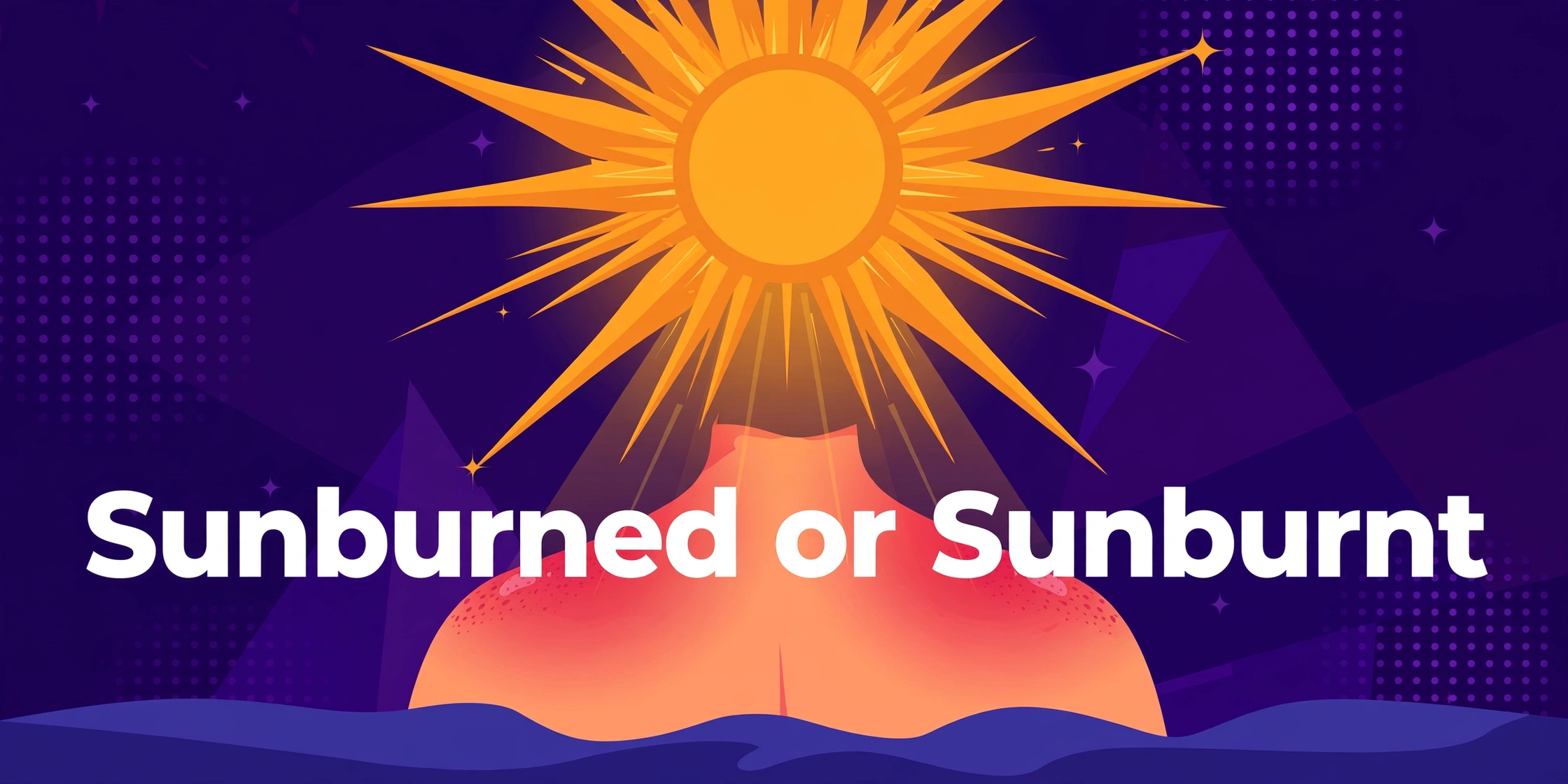
Sunburned and sunburnt are both correct. They are the two accepted past-tense and past-participle forms of the verb sunburn, and both work as adjectives meaning “red and sore from too much sun.” The difference is one of geography and habit, not correctness: sunburned is the usual form in American English, while sunburnt is the preferred form in British English. Collins lists both as standard adjectives, and Merriam-Webster’s entry for the verb reads “sunburned or sunburnt” — the dictionaries refuse to pick a winner.
What the Dictionaries Say
The reference works are refreshingly unanimous here. Collins gives sunburned a full entry as an adjective — “someone who is sunburned has sore bright pink skin because they have spent too much time in hot sunshine” — and its thesaurus treats sunburnt as a synonym alongside it. Merriam-Webster’s verb entry for sunburn gives the inflection line as “sunburned or sunburnt,” refusing to rank them.
The wider pattern explains why the pair exists at all. Merriam-Webster’s usage note on burned vs. burnt — the parent pair from which sunburned/sunburnt inherits its behaviour — says that “burned” is the usual past tense of “burn,” but “burnt” is common in many contexts when the past participle is used as an adjective (“burnt toast”), and that both are acceptable forms. In British English, the -t form is the more common choice in most roles; in American English, the -ed form dominates, and burnt survives mainly in fixed expressions like “burnt toast” or “burnt offering.” Sunburned/sunburnt follows the same split: one form, two national preferences.
The Verb Forms at a Glance
| Form | American preference | British preference | Example |
|---|---|---|---|
| Infinitive | sunburn | “She sunburns easily.” | |
| Present participle | sunburning | “He was sunburning his shoulders.” | |
| Past simple | sunburned | sunburnt | “We sunburned on the first day.” / “We sunburnt on the first day.” |
| Past participle | sunburned | sunburnt | “They had sunburned badly.” / “They had sunburnt badly.” |
| Adjective | sunburned | sunburnt | “his sunburned nose” / “his sunburnt nose” |
One practical note: in real life, sunburn is used as a verb far less often than as a noun or adjective. Most writers reach for the adjective — “a sunburned face” — or the noun — “a bad sunburn.” The verb forms appear mostly in reflective or narrative sentences: “I sunburned in twenty minutes.” All forms above are standard.
Pronunciation
The pronunciation follows the spelling, with the usual UK/US vowel difference in the stressed syllable:
- Sunburned — American English: sʌnbɜrnd (Collins’ transcription), “SUN-burnd.” British speakers who use the form say /ˈsʌn.bɜːnd/.
- Sunburnt — UK /ˈsʌn.bɜːnt/ (“SUN-burnt”), US /ˈsʌn.bɝːnt/. The ending is a crisp -t, exactly like burnt.
Neither form is difficult to say; the only thing to avoid is reading the -ed ending as a separate syllable. “Sunburned” rhymes with “burned,” not with “sunburn-ed.”
Which Should You Use?
Let your reader decide. If you write for an American audience, sunburned will look natural and sunburnt will look faintly British. If you write for a British, Australian, or Canadian audience, sunburnt will look at home and sunburned will look faintly American. Neither will be marked wrong by any dictionary or spellchecker in either country.
What does matter is consistency. Switching between “sunburned shoulders” in paragraph one and “sunburnt shoulders” in paragraph three looks careless, in the same way that mixing “burned” and “burnt” in a single document does. Pick the form that suits your audience and keep it all the way through.
There is one narrow exception. In fixed idiomatic phrases, the -t form is entrenched across varieties: nobody writes “burned to a crisp” for the joke about overcooked meat, and by the same logic “sunburnt to a crisp” is the natural phrasing for a lobster-red beach disaster. When the phrase is already fixed, follow the phrase.
Correct vs. Incorrect
- ✓ “After the hike, my neck was badly sunburned.” (AmE)
- ✓ “After the hike, my neck was badly sunburnt.” (BrE)
- ✓ “She sunburned easily as a child.” / ✓ “She sunburnt easily as a child.”
- ✓ “The sunburnt tourists queued for aloe vera.” (BrE adjective)
- ✗ “He got sunburneded at the beach.” — there is no double past-tense form; sunburned already contains the ending.
- ✗ “My sunburned was terrible.” — sunburned is the adjective/past form; the noun is sunburn: “my sunburn was terrible.”
- ⚠ “She had sunburned her back, and her brother had sunburnt his.” — grammatically both forms are correct, but mixing them in one sentence looks sloppy. Choose one.
Common Mistakes
1. Assuming one form is a misspelling. This is the most common confusion, and it runs in both directions. American writers see “sunburnt” and assume a typo; British writers see “sunburned” and assume an Americanism has leaked in. Both are dictionary-standard. If your spellchecker flags one of them, your spellchecker’s dictionary is set to the other variety — change the language setting, not the word.
2. Confusing “sunburn” the noun with “sunburned/sunburnt” the adjective. “Sunburn” names the condition: “a nasty sunburn.” “Sunburned” and “sunburnt” describe the person or skin: “nasty sunburned shoulders.” Writing “his sunburn was red” is fine; writing “his sunburned was red” is not.
3. Overusing the verb where the noun or adjective would be simpler. “The sun sunburned him” is correct but clumsy. “He got sunburned” or “he got a sunburn” says the same thing in fewer, more natural words.
4. Carrying the split into unrelated -burn words. The burned/burnt pattern generalises to sunburn, but not every compound behaves the same way. “Windburned” has no standard “windburnt” form in current dictionaries — don’t invent parallel forms for other compounds.
5. Writing “sunburnt-looking” as one closed word. Compound adjectives built on participles take hyphens before a noun: “a sunburnt-looking tourist,” “a sunburned-looking tourist.” After the noun, the hyphen usually drops: “the tourist looked sunburnt.” The hyphen rule follows whichever participle spelling you’ve chosen — it doesn’t change the underlying form.
Frequently Asked Questions
Is “sunburnt” more correct than “sunburned”?
No. Both are listed as standard by the major dictionaries. “Sunburnt” is the more common choice in British English and “sunburned” in American English, but correctness doesn’t favour either one.
Can I use “sunburnt” in American writing?
You can — no American dictionary or style guide calls it wrong — but it will read as British-flavoured. If your audience is American, “sunburned” is the frictionless choice.
Is “sunburned” the past tense of “sunburn”?
Yes, and so is “sunburnt.” The verb sunburn takes both forms for the past simple and past participle: “we sunburned/sunburnt,” “we have sunburned/sunburnt.” Choose by variety and stay consistent.
Why do the two forms exist?
English has never fully regularised the past tense of “burn.” The older -t ending survived in Britain (“burnt”) while America largely adopted the regular -ed (“burned”), and compounds like sunburn inherited the split. Both endings remain productive and standard today.
Does it matter in the adjective position?
The same preference applies: “a sunburned face” (AmE), “a sunburnt face” (BrE). Merriam-Webster notes that the -t form is especially common when the participle is used as an adjective, which is why “sunburnt” feels particularly natural before a noun.
What about “sunburning”?
Sunburning is the present participle and gerund — identical in both varieties, since the regional split only affects the -ed/-t ending: “he was sunburning within minutes.” It doubles as a noun for the process (“sunburning is cumulative”), though most writers prefer “getting sunburned” in everyday prose.
The Takeaway
Sunburned and sunburnt are the same word wearing two national spellings — both standard, both dictionary-listed, both correct as past tense, past participle, and adjective. Match the form to your audience (America: -ed; Britain: -t), use it consistently, and spend your proofreading energy on the sunscreen instead.