Make or Break: Meaning, Examples and How to Use It
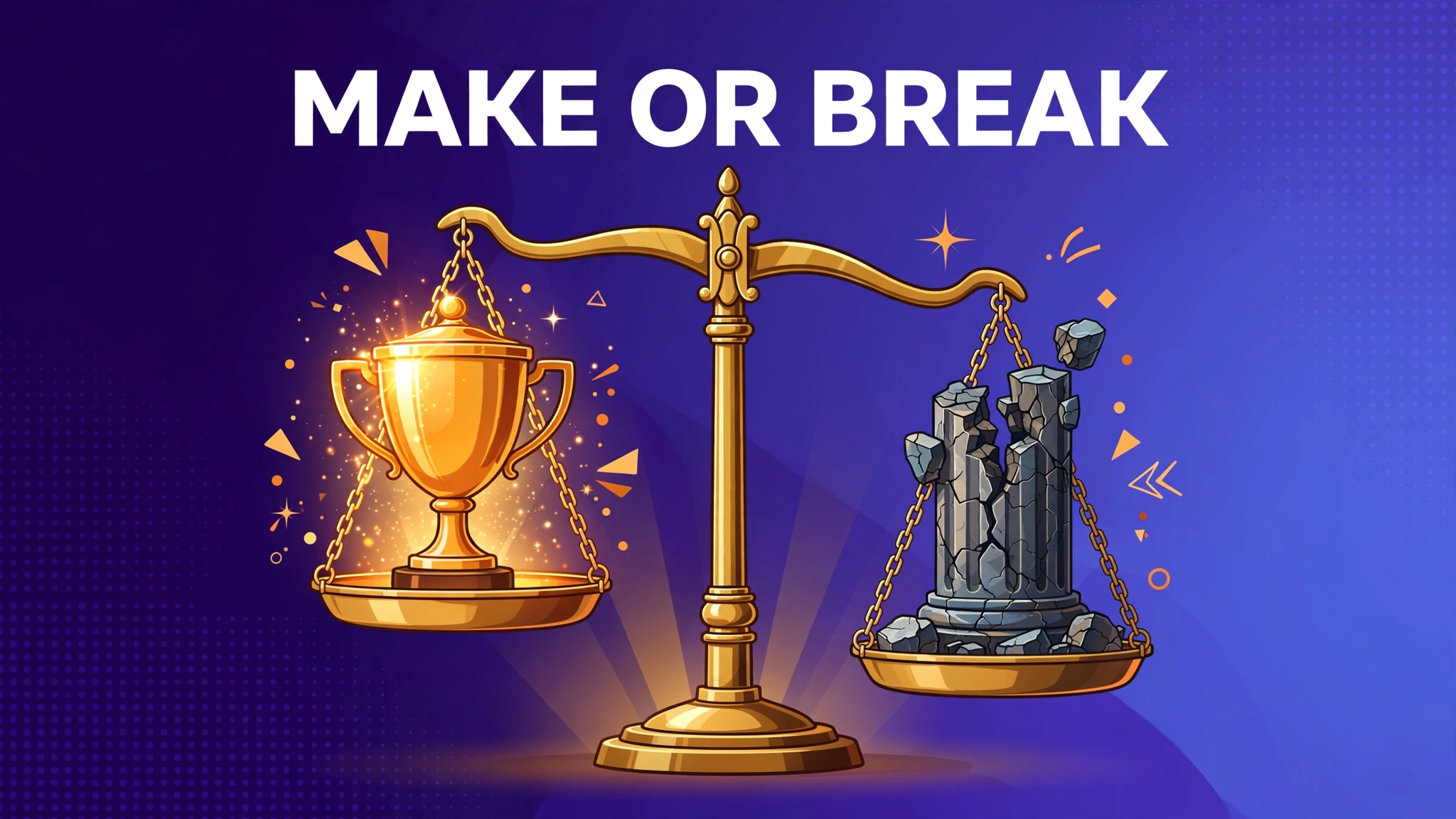
“Make or break” means to decide whether something succeeds or fails completely — and when it sits before a noun, it becomes the hyphenated adjective “make-or-break,” describing a moment, decision, or event that could go either way. Collins lists the adjective make-or-break — pronounced (ˌmeɪkəˈbreɪk) in British English and (ˈmeikərˈbreik) in American English — as “resulting in either complete success or total failure,” with the word’s origin dated to 1915–20. The verb form make or break means “to cause the success or failure of.” So a make-or-break decision is a decision that will either work brilliantly or fail badly — nothing in between.
Quick Answer
Make or break (/ˌmeɪkəˈbreɪk/ UK, /ˈmeɪkərˈbreɪk/ US) means to be the deciding factor between success and failure: The first year of trading can make or break a new business. As an adjective, use the hyphenated make-or-break before a noun: a make-or-break decision, make-or-break time. Hyphenation matters — the hyphens tell readers the three words are acting as one unit describing the noun.
What “make or break” means
At its simplest, make or break is about extremes. When something “makes or breaks” you, it pushes you toward one of two opposite outcomes: complete success or total failure. There is no middle ground in the phrase. The debut album will make or break the band. The new contract will make or break the company. The meaning carries a built-in sense of high stakes — you would not say a trip to the shops will “make or break” your afternoon, because the phrase demands consequences worth the drama.
Collins records the adjective make-or-break in both its British and American entries with the definition “resulting in either complete success or total failure,” and gives as examples “make-or-break decisions,” “a make-or-break situation,” and “It’s make-or-break time.” Merriam-Webster’s thesaurus files the adjective under crucial — “resulting in either definite success or definite failure” — alongside synonyms like critical, pivotal, decisive, fateful, momentous, and watershed. The verb form make or break is listed in Collins’s American English entry simply as “to cause the success or failure of.”
The word’s origin is dated by Collins to 1915–20 — early twentieth century, American in flavor, from the blunt pairing of two plain verbs that already stood as opposites in English.
The two jobs: verb phrase and adjective
This phrase does two different grammatical jobs, and keeping them apart answers most usage questions. As a verb phrase, it takes a subject and object: The exam will make or break her university hopes. Your opening paragraph can make or break the essay. The quality of the lighting is a make or break factor in the 24-hour race. (That last example is how the phrase often appears in business writing — note the unhyphenated form after “a.”)
As an adjective, it goes before a noun and describes it: a make-or-break decision, make-or-break negotiations, a make-or-break moment. It is almost always hyphenated in this position — make-or-break — because the hyphens glue the three words into a single modifier. This is the standard compound-modifier rule in English: when several words act as one adjective before a noun, hyphenate them so readers see one unit. Without hyphens, “make or break moment” reads as a verb phrase awkwardly parked in front of a noun.
The adjective can also stand after the verb be: These next few weeks will be make or break for many businesses. In predicate position, dictionaries and style guides generally leave it unhyphenated (Collins’s own example reads “It’s make-or-break time,” hyphenated before the noun time, while predicative uses tend to drop the hyphens). Both forms appear in real writing, but the cleanest pattern is: hyphens before the noun, no hyphens after the verb.
Hyphenation at a glance
| Position | Form | Example |
|---|---|---|
| Before a noun (adjective) | make-or-break (hyphenated) | It was a make-or-break meeting. |
| After the verb “be” | make or break (usually open) | July will be make or break for the team. |
| As a verb phrase | make or break (open, never hyphenated) | This launch could make or break us. |
A simple test: if you could replace the phrase with the adjective decisive, hyphenate. If you could replace it with the verb phrase determine the outcome, leave it open.
Examples in real sentences
- ✓ The next election will be make or break for the party’s future. — verb phrase, open form.
- ✓ She described the interview as a make-or-break moment in her career. — adjective before a noun, hyphenated.
- ✓ The first year of trading can make or break a new business. — classic verb-phrase usage, echoing Collins’s financial-terms example.
- ✓ The soundtrack can make or break a film. — a widely used pattern; small details with outsized effects.
- ✓ We are entering a make-or-break phase of the negotiations. — attributive adjective, hyphenated.
- ✗ It was a make or break decision. — missing hyphens in front of the noun; write make-or-break decision.
- ✗ This will make-or-break the company. — hyphens in the verb phrase are never used; write This will make or break the company.
Why it works as an adjective
English loves turning whole clauses into modifiers — think of do-or-die, make-or-buy, or life-or-death. The trick is the same each time: take two opposing outcomes, join them with or, hyphenate the lot, and you have an adjective that says “this involves both possibilities.” Make-or-break is the most productive of the family. Where do-or-die suggests desperation, make-or-break suggests calculation — a decision point where the stakes are known and the two outcomes are named.
Notice how the phrase resists softening. You cannot really have a “make-or-break sandwich” or a “make-or-break commute.” The adjective refuses trivial nouns because its meaning — complete success or total failure — demands subjects that can actually succeed or fail: decisions, moments, matches, launches, elections, interviews.
Common mistakes
Hyphenating the verb phrase. “This will make-or-break us” is the most frequent error, likely caused by seeing the hyphenated adjective so often. Verbs never take the hyphens: make or break as a verb is always open.
Leaving the hyphens out before a noun. “A make or break decision” is common in informal writing and will pass unnoticed by many readers, but it breaks the compound-modifier rule and can look sloppy in edited prose. Hyphenate: a make-or-break decision.
Using it for low-stakes situations. Because the phrase is fashionable in business writing, it gets stretched onto minor choices — “make-or-break lunch meetings” and the like. Reserve it for moments where real success or real failure hangs in the balance; overuse drains its force.
Confusing it with “break the bank” or “break a record.” These share the verb break but nothing else. Make or break is always about the two opposite outcomes of success and failure, never about cost or achievement in isolation.
FAQs
Is “make-or-break” one word, two words, or hyphenated?
It depends on the job it is doing. As an adjective before a noun, it is hyphenated: a make-or-break decision. As a verb phrase, it is two open words: This could make or break the company. Collins lists the headword adjective with hyphens and the verb entry without.
What part of speech is “make-or-break”?
Both Collins and Merriam-Webster treat the hyphenated form as an adjective (“resulting in either complete success or total failure”). The open form make or break is a verb phrase meaning “to cause the success or failure of.”
Can I say “make or break” about small everyday things?
You can, but it loses its power. The phrase’s meaning commits you to two extreme outcomes, so it fits best when the stakes genuinely are success or failure — an exam, a launch, a negotiation, an election. Using it for trivial choices sounds inflated.
Is it “make-or-break” or “make or breaks”?
Always make or break — the two verbs stay in their base forms, make and break, even after a third-person singular subject: The exam makes or breaks her chances becomes “makes or breaks” only because the whole verb phrase conjugates normally. The fixed noun-modifier form is make-or-break, never make-or-breaks.
Where does the phrase come from?
Collins dates the word’s origin to 1915–20, built from the plain English opposition of make (cause to succeed) and break (cause to fail). No single inventor is recorded; it is the kind of crisp business-age coinage that emerged from American commercial writing in the early twentieth century.
Takeaway
Make or break the verb decides outcomes — This will make or break the company. Make-or-break the adjective describes the deciding thing — a make-or-break decision. Hyphenate before the noun, leave open everywhere else, and keep it for stakes that genuinely deserve it. Dated by Collins to 1915–20 and defined as “resulting in either complete success or total failure,” it remains one of English’s most economical ways to say: this is the moment that decides everything.