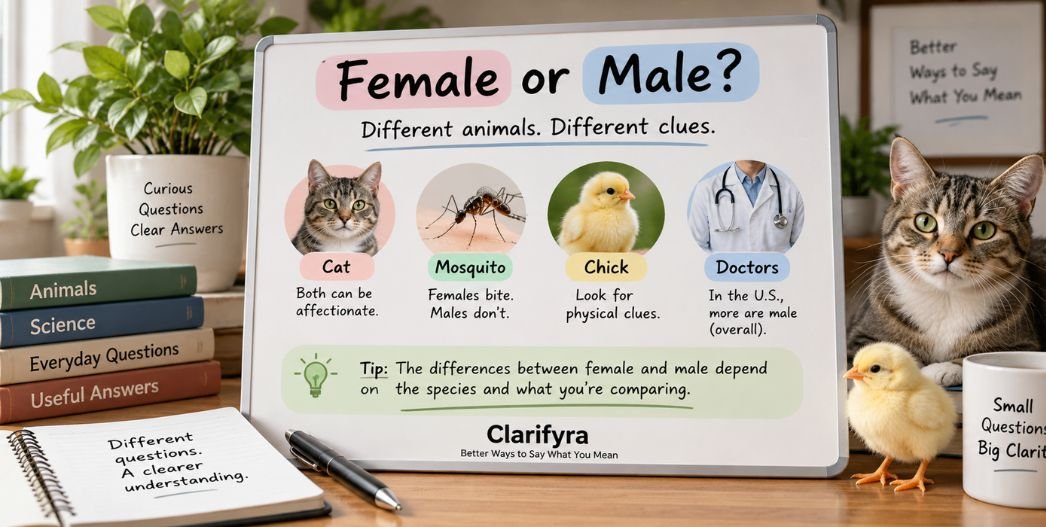
Female or Male? Key Differences in Cats, Mosquitoes, Chicks, and More
The difference between female or male is not always as simple as it sounds. With animals, biological sex may affect anatomy, reproduction, and certain behaviors, but it does not automatically determine personality. In other cases, such as mosquitoes, sex creates a very clear behavioral difference: females take blood meals, while males do not. Even the way you identify sex varies between cats, kittens, chicks, and insects.
This guide explains the most useful differences, including how to identify male and female cats and chicks, which mosquitoes bite, and whether there are more female or male doctors.
Whether female or male makes a meaningful difference depends on what you are comparing. In cats, sex affects anatomy and some reproductive behaviors but does not reliably determine affection. Female mosquitoes take blood meals, while males do not, and identifying the sex of kittens or chicks requires looking at specific physical characteristics.
Female vs. Male: A Quick Comparison
There is no single characteristic that separates females and males in every context. The relevant differences depend on the species—or, when discussing people, on exactly what information is being compared.
| Topic | Female | Male |
|---|---|---|
| Cats | Can be affectionate and can spray | Can be affectionate; intact males commonly spray |
| Kittens | Genital opening is closer to the anus | Greater distance between openings |
| Mosquitoes | Females of blood-feeding species take blood meals | Do not take blood meals |
| Chicks | Identification depends on method and breed | Identification depends on method and breed |
| U.S. doctors | 38.7% of active physicians in 2024 | Larger share of active physicians in 2024 |
The important point is that biological sex may be highly relevant to one characteristic while telling you very little about another.
Are Female or Male Cats More Affectionate?
You may hear that male cats are friendlier or more affectionate, while female cats are more independent. That is too broad to be treated as a rule.
Cats have individual personalities, and their behavior toward people can be influenced by socialization, environment, previous experiences, reproductive status, and the relationship they develop with their caregivers. Cats also express affection in different ways, including following a person, slow blinking, head rubbing, and seeking physical contact.
Female cats can be extremely affectionate. In fact, an unspayed female may temporarily become particularly affectionate and attention-seeking while she is in heat.
The better approach when choosing a female or male cat is therefore to consider the individual animal’s temperament instead of assuming its sex will predict how loving it will be.
Does spaying or neutering affect behavior?
It can affect behaviors driven by reproductive hormones. An intact male, for example, may be more inclined to roam, spray urine, or seek females. Neutering commonly reduces hormone-driven behaviors such as roaming and marking.
That does not mean neutering completely changes a cat’s basic personality. A friendly cat does not automatically become unfriendly after being neutered, nor does the procedure guarantee that a reserved cat will become affectionate.
How to Tell If a Cat Is Female or Male
The most useful way to identify a cat’s sex is to examine the anatomy beneath the tail. Behavior, body size, and personality are not reliable substitutes.
Gently lift the tail when the cat is relaxed and look at the anus and genital opening.
In a female cat, the genital opening is relatively close to the anus and looks more like a vertical slit.
In a male cat, there is usually a noticeably greater distance between the anus and genital opening. The genital opening tends to appear more rounded, and the scrotum may be visible in an unneutered male.
A simplified way to remember the difference is:
Female: openings closer together
Male: more space between the openings
Never force a frightened or struggling cat into position simply to check. A veterinarian can quickly confirm the sex if you are uncertain.
How to Tell a Female or Male Kitten
Identifying a female or male kitten uses the same basic anatomical clues, but it can be more difficult because the structures are tiny and still developing.
For a female kitten, the anus and vulvar opening are close together, with the lower opening resembling a vertical line. In a male kitten, the distance is greater and the lower opening appears rounder.
Testicles are not always a useful clue in a very young kitten. They can be difficult to see or feel, and a male that has already been neutered will not have them.
Can coat color reveal a kitten’s sex?
Sometimes coat color provides a clue, but it is not a general method for determining sex.
Calico and tortoiseshell cats are overwhelmingly female because the genetics responsible for their characteristic orange-and-black coloration are linked to the X chromosome. Male calico and tortoiseshell cats can occur, but they are unusual.
For an individual kitten, checking its anatomy—or asking a veterinarian—is more reliable than guessing from color.
Do Female or Male Cats Spray?
Both male and female cats can spray urine.
Spraying is particularly common in intact males, but treating it as an exclusively male behavior is a mistake. Female cats can spray as well, including during heat.
Spraying is a form of scent communication. A cat may use urine marking because of reproductive behavior, territorial concerns, social conflict, stress, or changes in its environment.
A typical spraying cat backs toward a vertical object, raises its tail, and releases a relatively small quantity of urine. This differs from ordinary urination, which usually involves squatting and emptying a larger quantity onto a horizontal surface.
Spaying or neutering often reduces marking associated with reproductive hormones, although sterilized cats can still spray.
Persistent changes in urination should not automatically be dismissed as behavioral. Urinary problems can have medical causes, so a cat that suddenly starts urinating or marking unusually should be assessed by a veterinarian.
Do Female or Male Mosquitoes Bite?
This comparison has a much clearer answer: female mosquitoes take blood meals; males do not bite people or animals for blood.
Female mosquitoes of blood-feeding species have mouthparts capable of piercing skin. The blood provides nutrients needed for egg production. The Centers for Disease Control and Prevention notes that most female mosquitoes cannot produce eggs without obtaining a blood meal.
Male mosquitoes do not have a proboscis capable of piercing human skin. Instead, they feed on plant-derived sources such as nectar. Females also consume nectar and other plant sugars when they are not taking blood meals.
So, if a mosquito is feeding on your blood, it is female.
The itching that follows a mosquito bite results from the body’s reaction to saliva introduced while the mosquito feeds.
How Can You Tell Male and Female Mosquitoes Apart?
You are unlikely to inspect a mosquito closely enough to determine its sex while it is flying around your room, but there are physical differences.
Male mosquitoes generally have noticeably bushier, feathery antennae than females. These antennae are important for detecting females during mating.
The mouthparts also differ functionally. Females of blood-feeding species possess mouthparts capable of piercing skin and taking blood. A male mosquito’s proboscis cannot pierce human skin for a blood meal.
For everyday purposes, behavior offers the simplest clue: the mosquito actively taking your blood is female.
How to Tell Female or Male Chicks
Determining the sex of a newly hatched chick is much more difficult than identifying an adult rooster or hen.
Professional hatcheries may use vent sexing, which involves examining subtle anatomical differences around the chick’s vent. This technique requires considerable training and is not something an inexperienced owner should rely on.
Another possibility is sex-linked characteristics. Certain specifically bred crosses produce male and female chicks with different colors or feather-growth patterns at hatching, allowing them to be distinguished much more easily.
These methods do not apply equally to every chicken.
As chickens mature, secondary sex characteristics become more noticeable. Males commonly develop larger combs and wattles and, depending on the breed, distinctive hackle and saddle feathers. Crowing can eventually provide another clue.
Can you tell a chick’s sex from the shape of its egg?
No. Claims that pointed or differently shaped eggs reliably produce one sex are not supported. Egg shape is not a dependable method of predicting whether a chick will be female or male.
Are There More Female or Male Doctors?
There is no universal answer without specifying the country and year.
In the United States, Association of American Medical Colleges data show that 38.7% of the active physician workforce was female in 2024. That means male physicians still accounted for the larger share overall in that dataset.
The proportions differ substantially by medical specialty. In 2024, women represented 66.7% of pediatricians, 64.1% of physicians in obstetrics and gynecology, and 63.1% in hospice and palliative medicine. Their representation was considerably lower in some surgical specialties.
Therefore, the accurate answer depends on whether you mean all physicians in a particular country or doctors working in a particular specialty.
Mae Martin: Female or Male?
Mae Martin is a Canadian comedian, actor, and writer. Describing Martin simply as either female or male does not reflect their publicly stated identity.
Martin is non-binary and uses they/them pronouns. Current profiles and interviews likewise refer to Martin using those pronouns.
When referring to a person’s gender identity, it is more accurate and respectful to use the identity and pronouns that the person publicly uses rather than forcing the person into a binary category that does not describe them.
Common Mistakes to Avoid
A recurring problem with female-versus-male comparisons is assuming that sex predicts characteristics that actually vary greatly among individuals.
For cats, do not assume every male will be affectionate or every female independent. Likewise, do not assume only male cats spray; females can urine-mark too.
With kittens and chicks, avoid relying on myths or a single superficial characteristic. Anatomical examination is useful for kittens, while determining the sex of day-old chicks may require specialist techniques or breed-specific sex-linked characteristics.
Mosquitoes are different because there is a clear distinction relevant to biting: males do not take blood meals, whereas females of blood-feeding species do.
FAQ
Can you tell whether a cat is male or female by its face?
Not reliably. Adult intact males may develop physical features associated with testosterone, but facial appearance alone is not a dependable way to determine a cat’s sex. Examining the genital area or asking a veterinarian is more accurate.
Are female cats less friendly than males?
No general rule says female cats are less friendly. Individual temperament, socialization, environment, reproductive status, and past experiences can all affect how a cat interacts with people.
Can a female cat spray after being spayed?
Yes. Spaying can reduce hormone-related urine marking, but a spayed female can still spray because of factors such as stress, territorial concerns, or conflict with other cats.
Why don’t male mosquitoes bite?
Male mosquitoes do not take blood meals and lack mouthparts capable of piercing human skin in the way blood-feeding females do. They obtain food from sources such as flower nectar and plant sugars.
Is vent sexing safe for chicks?
Vent sexing is a specialized technique requiring training and practice. Inexperienced owners should not assume they can accurately perform it simply by looking at the chick. Certain sex-linked crosses are much easier to identify at hatching.
Does male or female always refer to gender?
No. “Male” and “female” can describe biological sex in many contexts, particularly when discussing animals. When discussing a person’s gender identity, however, terms such as man, woman, or non-binary may be more appropriate depending on how the individual identifies.
The Bottom Line
The importance of being female or male depends entirely on the context. Both male and female cats can be loving companions and both can spray, while anatomical differences provide the most useful way to sex a kitten. With mosquitoes, females take blood meals and males do not. Sexing young chicks can be considerably more complicated and may require specialized knowledge.
For people, questions about sex, gender identity, and workforce demographics should also be handled precisely rather than reduced to assumptions. Understanding what is actually being compared is the simplest way to reach a clear answer—the same practical approach Clarifyra uses to help readers make sense of easily confused terms and questions.