Pergola or Gazebo: What’s the Difference and Which Is Better?
Choosing between a pergola and a gazebo can be confusing because both create a dedicated outdoor space for relaxing, dining, entertaining, or enjoying your garden. However, they are designed differently and provide different levels of shade and weather protection.
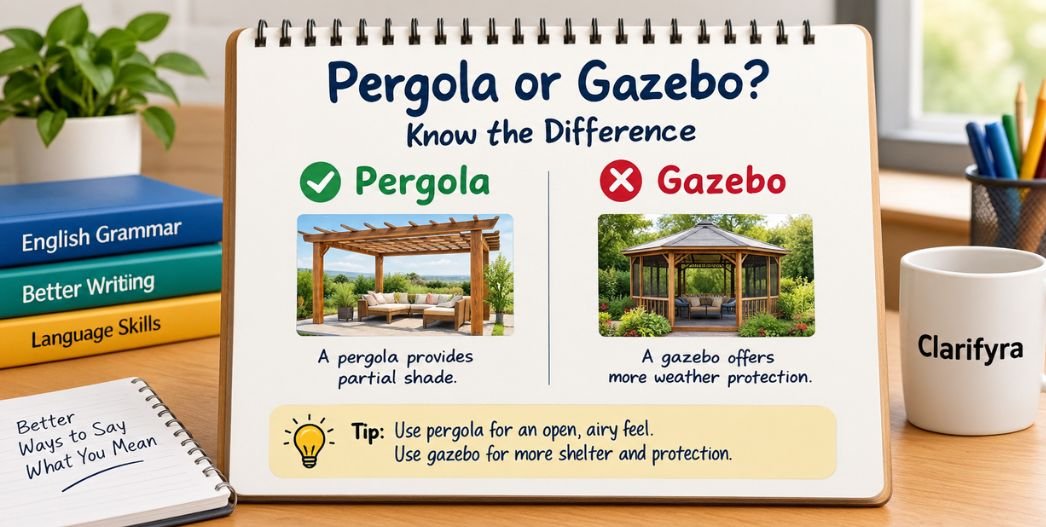
The simplest distinction is the roof. A traditional pergola has an open or slatted roof, while a gazebo normally has a solid roof. That difference affects everything from shade and rain protection to ventilation, appearance, placement, and cost. The right choice depends less on which structure is universally “better” and more on how you plan to use your outdoor space.
A pergola is an open-air structure with beams or slats that provides partial shade and excellent airflow. A gazebo usually has a solid roof and offers more protection from sun and rain. Choose a pergola for an open, shaded outdoor area; choose a gazebo when shelter and weather protection are higher priorities.
Pergola vs. Gazebo: Quick Comparison
| Feature | Pergola | Gazebo |
|---|---|---|
| Roof | Open or slatted | Usually solid and covered |
| Shade | Partial or filtered | More complete |
| Rain protection | Limited | Better |
| Airflow | Excellent | Depends on design |
| Structure | Posts, beams and rafters | Roof supported by posts/walls |
| Typical location | Deck, patio, garden | Garden, patio, lawn or pool area |
| Can be attached to a house? | Yes | Usually freestanding |
| Privacy | Usually more open | Can be screened or enclosed |
| Outdoor atmosphere | Open and airy | Sheltered and room-like |
| Best suited to | Shade and outdoor living | Shelter and weather protection |
Both structures can be customized, so there are exceptions to these general characteristics. For example, a pergola can have a retractable or louvered covering, while a gazebo can have open sides or screens.
What Is a Pergola?
A pergola is an outdoor framework consisting primarily of vertical posts supporting horizontal beams and rafters. Its traditional roof is open, allowing some sunlight to pass through.
Because of this design, a pergola creates shade without completely separating the occupants from the surrounding garden or sky. It can also be decorated with climbing plants, outdoor curtains, lighting, or a fabric canopy.
A pergola is commonly used over:
- Patio seating
- Outdoor dining areas
- Decks
- Garden paths
- Outdoor kitchens
- Lounge areas
- Hot tubs
Pergola examples
We added a wooden pergola over the patio to create a comfortable sitting area.
The climbing roses have grown across the pergola.
A freestanding pergola now provides shade over the deck.
One important point is that a basic pergola is not the same as a fully covered roof. Rain can still pass through the open sections.
What Is a Gazebo?
A gazebo is a freestanding outdoor structure with a roof that provides a more sheltered space. Traditional gazebos are often associated with octagonal or other polygonal shapes, but modern versions can also be square or rectangular.
The roof is the major practical difference. A solid roof provides significantly more protection from direct sunlight and rain than a traditional open pergola.
Gazebos can also be fitted with:
- Screens
- Curtains
- Railings
- Built-in seating
- Lighting
- Weather-resistant flooring
Gazebo examples
We sat in the gazebo while a light rain passed through the garden.
The family uses the gazebo for outdoor meals during the summer.
Screens were added to the gazebo to create a more private sitting area.
The Main Difference Between the Two
The easiest way to remember the distinction is to think about openness versus shelter.
A pergola is primarily an open framework. It defines an outdoor area and provides partial shade while preserving airflow and visibility.
A gazebo is more like a roofed outdoor room. It creates a stronger barrier against weather and can feel more enclosed.
This doesn’t mean a pergola cannot provide substantial shade. Modern pergolas can have adjustable louvers, retractable covers, or other additions. Likewise, a gazebo does not necessarily have to be completely enclosed.
The basic design, however, remains different.
Pergola or Gazebo for a Deck?
Both options can work on a deck, but the choice depends on how you use the space.
A pergola can be particularly suitable for a deck when you want shade while keeping the area open. Its framework can create a visual extension of the home without making the deck feel enclosed.
For example, a pergola can sit above:
- Outdoor sofas
- A dining table
- A barbecue area
- Lounge chairs
- A small outdoor kitchen
A gazebo can also be installed over or alongside a deck, but its greater roof and structural components can introduce additional considerations.
Before installing a substantial structure on an existing deck, check the deck’s load capacity, anchoring requirements, dimensions, and the manufacturer’s installation instructions. A deck designed for normal furniture is not automatically suitable for every large outdoor structure.
Pergola or Gazebo for a Patio?
For a patio, either structure can work well.
A pergola is useful when you want to define a patio as an outdoor living room without closing it in. The open roof allows daylight and air to remain part of the space.
A gazebo is more appropriate when the patio needs a dedicated sheltered area. Its roof can make outdoor dining or seating more comfortable during strong sun or light rain.
Consider your main purpose:
- Want filtered shade and openness? A pergola may fit better.
- Want more dependable rain protection? A gazebo may be more practical.
- Want a framework for plants and lighting? A pergola is particularly suitable.
- Want a sheltered entertaining area? A gazebo may be preferable.
What About a Pergola or Gazebo Over a Hot Tub?
Both structures can be used around a hot tub, but they create different environments.
A pergola can provide overhead shade while retaining an open-air feel. This can be attractive if you want plenty of airflow around the spa and don’t want the area to feel enclosed.
A gazebo can provide a stronger sense of shelter. Its roof can protect the hot tub area from direct sun and some weather, making the space feel more like a dedicated outdoor spa room.
However, ventilation matters. A heavily enclosed structure around a hot tub needs adequate airflow because hot water produces heat and steam.
You should also consider:
- Electrical safety
- Proper drainage
- Structural strength
- Clearance around the tub
- Wind conditions
- The hot tub manufacturer’s requirements
- Local building and electrical regulations
The structure should complement a properly planned hot-tub installation rather than being treated as a substitute for one.
Which Is Better: A Pergola or Gazebo?
There is no universal winner because the two structures solve slightly different problems.
A pergola may be the better fit if you want:
An open atmosphere: You can enjoy the garden and sky without feeling enclosed.
Partial shade: The rafters filter sunlight while retaining some natural light.
Good airflow: The open construction allows air to move freely.
A flexible outdoor design: Curtains, plants, lighting, canopies, and other accessories can be added.
A deck or patio feature: It can define a particular outdoor area without creating a completely separate room.
A gazebo may be the better fit if you want:
More weather protection: A solid roof provides better protection from sun and rain.
A sheltered sitting area: The structure can feel like a dedicated outdoor room.
Greater privacy: Screens, curtains, or enclosed sides can be incorporated.
A standalone garden feature: A gazebo can serve as a focal point in a lawn or garden.
So, instead of asking which structure is inherently better, ask what you want the structure to do.
Cost, Materials, and Maintenance
The price of either option can vary considerably.
A simple pergola kit may cost considerably less than a large custom-built gazebo, but size, materials, roofing systems, labor, foundations, and accessories can change the final price substantially.
Common materials include:
- Pressure-treated wood
- Cedar
- Vinyl
- Aluminum
- Steel
- Composite materials
Material selection affects maintenance as well as price.
Wood can provide a traditional appearance but may require periodic cleaning, staining, sealing, or other maintenance. Aluminum and vinyl can reduce some maintenance requirements, although individual products vary.
Gazebos can have additional maintenance requirements because their roofs need to be kept clear of leaves and debris and checked for damage, drainage problems, or deterioration.
When comparing prices, don’t look only at the structure itself. Consider delivery, foundation work, anchoring, assembly, permits where applicable, and installation.
How to Choose One When Buying Online
If you’re looking for the best place to buy a pergola or gazebo online, it is more useful to compare the product and seller carefully than to rely on a single retailer being “best” for everyone.
Before purchasing, check:
- Exact dimensions – Make sure the structure fits your available space.
- Materials – Look at the frame, roof, hardware, and finishes.
- Roof design – Determine whether it is open, fixed, retractable, or adjustable.
- Wind and weather specifications – Check the manufacturer’s stated limits where available.
- Anchoring requirements – Find out what type of foundation or anchors are required.
- Assembly – A large structure may require several people or professional installation.
- Warranty – Read what components and finishes are actually covered.
- Replacement parts – This can matter years after installation.
- Delivery – Large outdoor structures may have different shipping arrangements from ordinary household products.
- Return policy – Check the conditions before ordering something large and difficult to return.
It’s also worth checking whether the structure is designed specifically for a deck, patio, lawn, or another surface.
Common Mistakes to Avoid
Assuming a pergola is fully waterproof
A traditional open pergola does not automatically protect you from rain. A separate canopy, retractable roof, or louvered system may be needed.
Choosing based only on appearance
A structure may look perfect in a photograph but be unsuitable for your climate, available space, or intended use.
Ignoring anchoring
Outdoor structures experience wind loads. Proper anchoring is an important part of installation.
Forgetting the surrounding space
Don’t measure only the structure. Allow enough room for furniture, walkways, doors, drainage, and maintenance access.
Assuming every gazebo can go on a deck
The deck and structure need to be compatible. Check structural capacity and installation requirements before proceeding.
Should I Get a Pergola or Gazebo?
Start with your biggest priority.
If you mainly want shade, airflow, an open design, and a defined outdoor living area, a pergola is worth considering.
If your priority is rain protection, stronger overhead shelter, privacy, and a more enclosed outdoor room, a gazebo may make more sense.
Your location also matters. A structure that works well in a mild, dry climate may require different features in an area with heavy rain, snow, or strong winds.
Budget and maintenance should be considered alongside appearance. A smaller, well-installed structure that suits your space is generally more useful than a larger one that overwhelms the patio or deck.
FAQs
Is a pergola or gazebo better for rain?
A gazebo generally provides better rain protection because it normally has a solid roof. A traditional pergola has an open roof, although additional coverings can make some pergolas more weather-resistant.
Can you put a pergola on a deck?
Yes, pergolas can be installed on decks, but the deck must be suitable for the structure. Check its load capacity, anchoring requirements, and the pergola manufacturer’s installation instructions before installation.
Can you put a gazebo on a patio?
Yes. A gazebo can work well on a patio when there is sufficient space and an appropriate surface or foundation. Check the manufacturer’s requirements for anchoring and installation.
Which is better over a hot tub?
Either can work. A pergola offers an open and well-ventilated environment, while a gazebo generally provides more overhead shelter. Ventilation, drainage, structural strength, and electrical safety should all be considered.
Is a pergola cheaper than a gazebo?
A basic pergola is often less expensive than a comparable gazebo, but there is no fixed price difference. Materials, size, roof design, customization, foundation work, and installation can significantly affect the total cost.
Should I choose a pergola or gazebo for a patio?
Choose based on the type of protection you need. A pergola is suited to an open patio with partial shade, while a gazebo is better suited to a more sheltered space with greater protection from sun and rain.
The Bottom Line
A pergola and gazebo are both useful ways to improve an outdoor space, but they offer different experiences. Pergolas emphasize openness, shade, airflow, and visual connection with the outdoors, while gazebos emphasize shelter and weather protection. For a deck or patio, consider how much shade and protection you actually need, and for a hot tub, pay particular attention to ventilation and safety. For practical comparisons like this, Clarifyra helps you better understand the choices behind everyday terms and products.