Fedora Meaning: Definition, Pronunciation & History
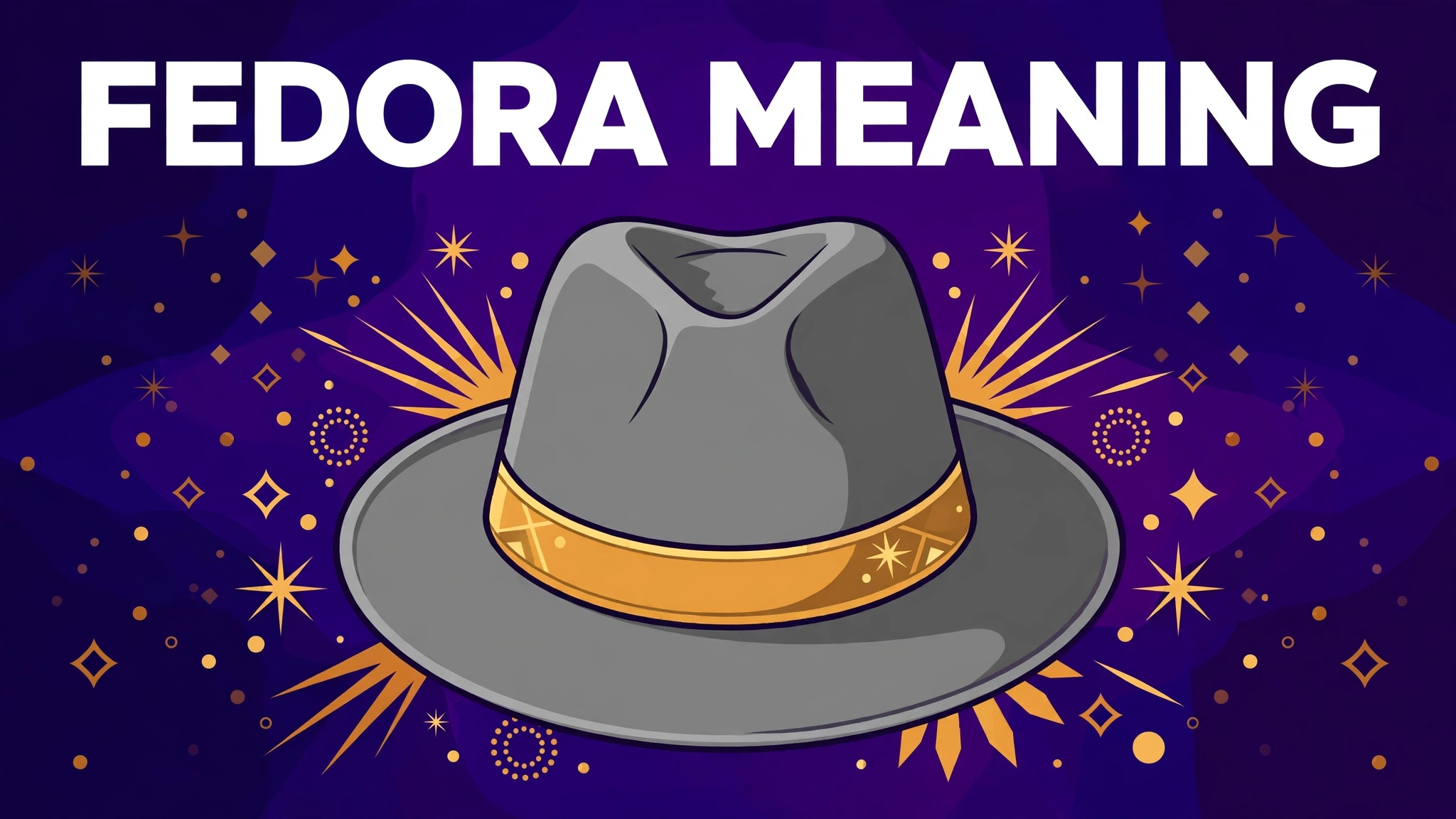
A fedora is a soft felt hat with a wide brim and a creased crown — the hat of film noir detectives, of 1940s gangsters and newspapermen, of Indiana Jones, and of Frank Sinatra. It is one of the few items of clothing that has become a piece of visual shorthand: put a fedora on a character in a film and the audience knows, before a word is spoken, what kind of person they are dealing with. That shorthand is the product of a century of cultural history, and it begins, oddly enough, with a French play.
The word itself is a name. It comes from Fédora, an 1882 drama by the French playwright Victorien Sardou, written as a vehicle for the actress Sarah Bernhardt. In the play, the heroine wore a soft felt hat of this kind, and the hat took the character’s name — the way, in other languages, a garment can take the name of the person who made it famous.
What Does Fedora Mean?
Merriam-Webster defines a fedora as “a low soft felt hat with the crown creased lengthwise”. Oxford Learner’s Dictionaries gives the same picture in slightly different words: “a low soft hat with a wide brim”. Cambridge Dictionary lists it as a noun with the pronunciation UK /fəˈdɔː.rə/ and US /fəˈdɔːr.ə/.
Three features define the hat, and all three appear in every dictionary definition. First, it is soft: unlike a bowler or a top hat, a fedora has no rigid structure, and it can be shaped by the wearer. Second, it is made of felt — usually wool felt, or, in better hats, rabbit or beaver felt. Third, the crown is creased lengthwise: pressed down the middle to form a long dent running from front to back, and usually pinched at the front on both sides. That crease is the fedora’s signature. Take it away and the hat becomes a shapeless dome; put it in and the hat has its character.
The word is a noun, and only a noun. There is no verb “to fedora”, and the word has no other part of speech. Its plural is regular: fedoras. It is countable — you can own a fedora, buy a fedora, or lose a fedora — and it is usually used with the indefinite article when it stands for the kind of hat, and the definite article when it stands for a particular one: “a fedora” against “his fedora”.
How to Pronounce Fedora
There is a small but genuine disagreement between the dictionaries on the first vowel, and it is worth stating plainly rather than smoothing over. Cambridge gives UK /fəˈdɔː.rə/ and US /fəˈdɔːr.ə/ — fuh-DOR-uh, with the first syllable a neutral schwa, the sound of the a in about. Oxford Learner’s Dictionaries gives /fɪˈdɔːrə/ — fih-DOR-uh, with a short i in the first syllable, the sound of the i in sit. Both pronunciations are in standard use, and both will be understood everywhere. The stress, on which all the dictionaries agree, falls on the second syllable: fe-DOR-a, never FED-or-a or fe-dor-A.
The Anatomy of a Fedora
A fedora has four parts, and knowing them is the difference between describing the hat accurately and gesturing vaguely at it. The crown is the top of the hat, the part that covers the head; on a fedora it is typically around four and a half inches high, creased lengthwise down the centre and pinched at the front. The brim is the flat edge that sticks out around the crown; on a fedora it is usually around two and a half inches wide, and it can be worn flat, turned up at the back, or snapped down at the front. The pinch is the pair of dents pressed into the front of the crown, one on each side, which gives the hat its familiar shape. And the band is the ribbon that runs around the base of the crown, usually in a darker colour than the felt, often finished with a small bow.
Where the Word Comes From
The fedora is named after a character in a play. Fédora, written by Victorien Sardou in 1882 for the French actress Sarah Bernhardt, was a melodrama about a Russian princess seeking revenge for her husband’s murder. Bernhardt wore a soft felt hat of this kind in the role, and the hat became associated with her — and then with the character’s name. Merriam-Webster dates the first known use of fedora in English to 1883, the year after the play opened, and records the etymology simply as “Fédora (1882), drama by V. Sardou”.
Oxford Learner’s Dictionaries agrees on the origin and adds the detail that the word was originally American: “late 19th cent. (originally US): from Fédora, the title of a drama (1882) written by the French dramatist Victorien Sardou (1831–1908)”. The hat’s adoption in the United States was rapid. By the 1920s it was the standard hat of the American businessman, and by the 1940s and 1950s it was so common that a man without a hat was the exception rather than the rule. Photographs of crowds from that period show a sea of fedoras, in grey, brown, and black, worn by almost every adult man.
Fedora vs Trilby: The Most Common Confusion
The fedora is most often confused with the trilby, and the confusion is understandable: both are soft felt hats with creased crowns and pinched fronts, and both come from the same period. But they are different hats, and the difference is in the proportions.
| Fedora | Trilby | |
|---|---|---|
| Brim | Wide, usually around 2.5 inches | Narrow, usually around 1.5 inches or less |
| Crown | Taller, around 4.5 inches | Shorter and more tapered |
| Brim position | Often worn flat or snapped down | Usually turned up at the back, down at the front |
| Feel | Broad and substantial | Slimmer and more angled |
Fedora vs Homburg and Bowler
Two other hats are worth separating from the fedora, because they appear in the same photographs and the same period dramas. The homburg is also a soft felt hat with a creased crown, but its crown has a single centre dent rather than a lengthwise crease, its brim is turned up all the way round and bound with a ribbon edge, and it is never pinched at the front. It is the more formal of the two — the hat of Winston Churchill and of Central European statesmen — and it does not have the fedora’s casual versatility.
Fedora in Everyday Use
In modern English, fedora appears in a handful of contexts, and they cover most of what the word does:
- Describing the hat itself: “He wore a grey fedora with a black band.” “She found her grandfather’s old fedora in the attic.”
- As a style reference: “The costume designer gave the detective a fedora and a trench coat.” “The band’s look was all fedoras and waistcoats.”
- As a cultural shorthand: “A fedora and a cigarette — that was the whole character.” The hat stands for an era, a genre, or a type of person.
- As a colour or material word: “fedora grey” is occasionally used for the dark grey of a classic fedora, though it is not a standard colour term.
One More Fedora: The Computer
There is one more Fedora that readers will meet, and it has nothing to do with hats. Fedora is also the name of a Linux operating system, developed by the community-supported Fedora Project and sponsored by Red Hat.
Common Mistakes to Avoid
Calling any soft hat a fedora
A trilby is not a fedora, and neither is a homburg, a bowler, or a flat cap. The fedora has a specific shape — wide brim, tall crown, lengthwise crease, pinched front — and using the word for any hat with a brim empties it of meaning. If the brim is narrow, check whether it is a trilby before calling it a fedora.
Getting the pronunciation wrong
The stress is on the second syllable: fe-DOR-a. The first vowel is either a schwa (Cambridge) or a short i (Oxford); both are standard. What is not standard is stressing the first syllable — FED-or-a — which no dictionary records.
Spelling it “fedora” with a capital F when you mean the hat
The hat is a common noun and takes a lowercase f: “a fedora”. The capital F belongs to the Linux distribution and to the play’s title, Fédora. In ordinary writing about hats, lowercase is correct.
FAQs
What is a fedora?
A low, soft felt hat with a wide brim and a crown creased lengthwise, usually pinched at the front. It is typically made of wool, rabbit, or beaver felt, and it was the standard men’s hat in the English-speaking world from the 1920s to the 1950s.
What is the difference between a fedora and a trilby?
A fedora has a wide brim (around 2.5 inches) and a taller crown; a trilby has a narrow brim (around 1.5 inches or less) and a shorter, more tapered crown. The fedora is the broader, more substantial hat; the trilby is the slimmer one.
Where does the word fedora come from?
From Fédora, an 1882 play by the French dramatist Victorien Sardou, written for Sarah Bernhardt. The heroine wore a hat of this kind, and the hat took her name. Merriam-Webster dates the first known use of the word in English to 1883.
How do you pronounce fedora?
With the stress on the second syllable: fe-DOR-a. Cambridge gives UK /fəˈdɔː.rə/ and US /fəˈdɔːr.ə/; Oxford gives /fɪˈdɔːrə/. Both first vowels — schwa and short i — are in standard use.
The Takeaway
A fedora is a low, soft felt hat with a wide brim and a crown creased lengthwise — pronounced fe-DOR-a, with the stress on the second syllable, from Fédora, an 1882 play by Victorien Sardou. It was the standard men’s hat of the 1920s to the 1950s, it survives as the visual shorthand of film noir and adventure, and it is not a trilby: the brim is the test. Wide brim, tall crown, lengthwise crease — that is a fedora.