Masticate Meaning: Definition, Examples and How to Use It
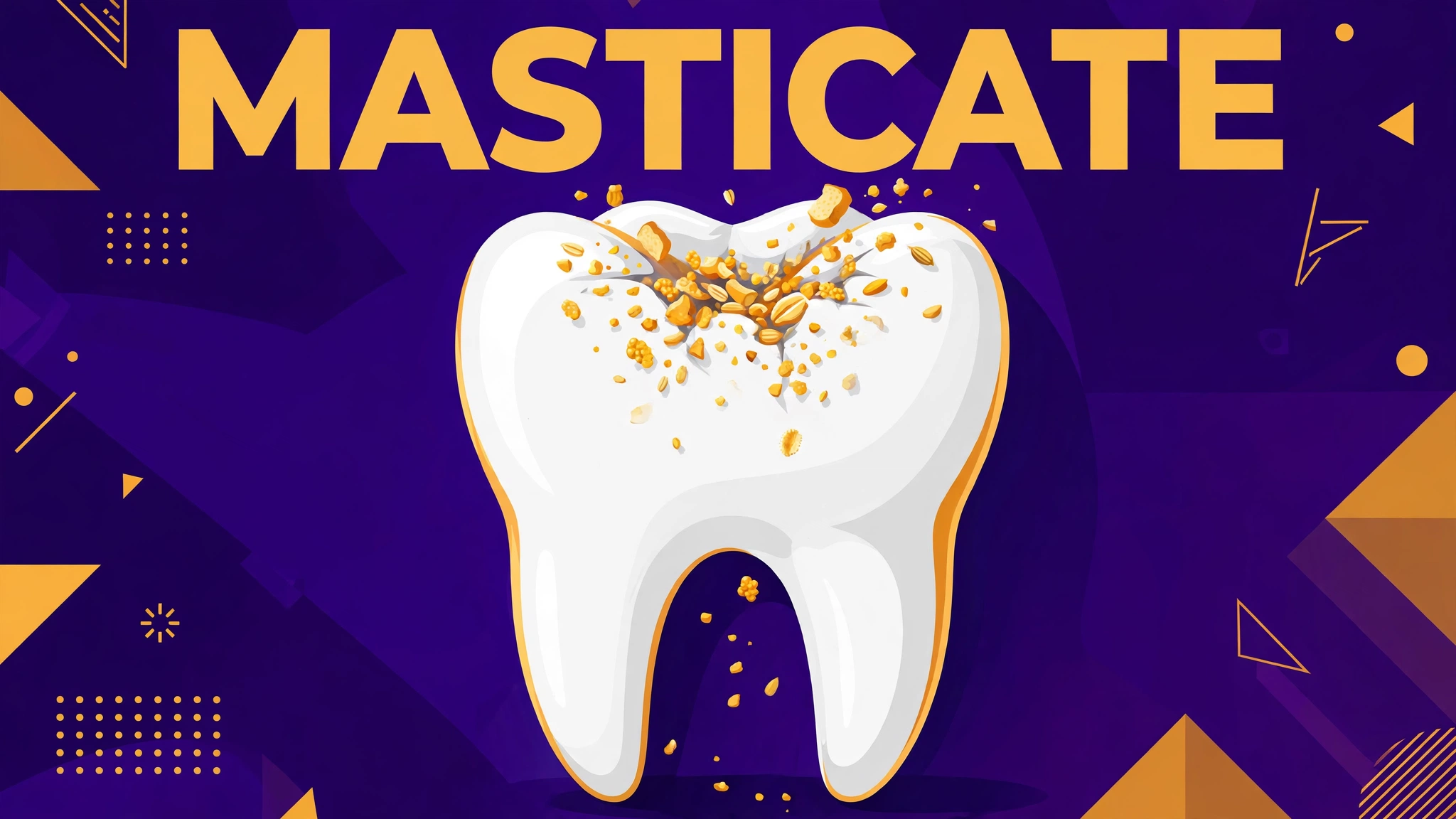
Masticate is the formal, precise word for chewing. When a dictionary, a dentist, or a biology textbook says that an animal masticates its food, it means exactly what happens when you chew — the teeth grind food down so it can be swallowed. The word is rarely heard in everyday conversation, where chew does all the work, but it survives because it does jobs chew cannot: it is the technical term in anatomy and dentistry, the root of mastication, and the source of a whole family of related words.
What the Dictionaries Say About “Masticate”
| Dictionary | Definition of masticate |
|---|---|
| Cambridge Dictionary | Verb [I or T], medical, specialized — “to chew (= crush with the teeth) food“. UK /ˈmæs.tɪ.keɪt/, US /ˈmæs.tə.keɪt/. |
| Collins COBUILD | “When you masticate food, you chew it.” Labelled FORMAL. Word forms: masticates, masticating, masticated. |
| Merriam-Webster | “To grind or crush (food) with or as if with the teeth.” First recorded 1562. Etymology: Late Latin masticatus, from Greek mastichan, “to gnash the teeth”. |
| Wiktionary | Transitive verb: “To chew (usually food)”; second sense: “To grind or knead something into a pulp“. Derived terms: mastication, masticatory, masticator. |
The dictionaries agree on two labels that shape how the word is used: formal and technical. Masticate is what you write in an exam, a medical report or a biology essay — never what you say at the dinner table. (“Pass the peas, and please masticate thoroughly” would get a laugh, not compliance.) It is always transitive in practice: you masticate food, the cud, each mouthful.
How to Pronounce “Masticate” (UK vs US)
Both varieties stress the first syllable. The difference lies in the middle vowel:
- UK: /ˈmæs.tɪ.keɪt/ — MAS-tih-kayt, with a clear short i in the middle, as in sit.
- US: /ˈmæs.tə.keɪt/ — MAS-tuh-kayt, where the middle vowel relaxes into a schwa, the neutral uh sound.
The ending is always -kayt, like date or late — it is never -kit or -kut. The noun built from it, mastication, is stressed differently: mas-tih-KAY-shun, with the stress landing on the -kay- syllable. The adjective masticatory (“relating to chewing”, as in “the masticatory muscles of the jaw”) is stressed MAS-tih-kuh-tor-ee.
Where “Masticate” Comes From
The word carries its own little family tree. Merriam-Webster traces masticate to Late Latin masticatus, the past participle of masticare, “to chew” — which itself comes from the Greek mastichan, “to gnash the teeth”, built on mastax, “mouth” or “morsel”. English has had it since 1562, and the Chambers dictionary of the early 20th century was already noting its relatives: masticable (able to be chewed), masticator (a chewing machine — or, in biology, the animal doing the chewing), and masticatory.
One of the prettiest branches of the family is mastic — the aromatic resin of the mastic tree, chewed like gum in the Mediterranean for thousands of years. The Latin word for the resin is the likely source of the Latin verb: people were literally “mastic-chewing” before English borrowed the verb for chewing in general. The same root gives dentistry its standard noun mastication, the technical name for the whole chewing process.
“Masticate” in Real Sentences
Technical and medical:
- The molars are shaped to masticate tough plant material.
- Proper mastication of food is the first stage of digestion.
- Patients with dental implants must learn to masticate on both sides of the mouth.
Biology and zoology:
- Cows masticate their cud slowly, sometimes for hours at a time.
- Rodents’ ever-growing incisors let them masticate bark and seeds without wearing their teeth down.
Literary and historical:
- Charles Dickens, in The Pickwick Papers (1832), wrote of a character swallowing “the huge piece of pie he had been in the act of masticating when he last fell asleep” — one of the word’s earliest literary appearances.
- Gandhi, in his autobiography, described vegetables “merely grated fine, if I could not masticate them.”
The extended sense (grind into a pulp):
- The machine masticates rubber before it is reformed into new products.
- Masticating juicers crush fruit slowly, imitating the chewing action of teeth.
That last example is worth a pause: the masticating juicer — a slow juicer that crushes rather than spins — takes its name directly from the second dictionary sense. It is probably the word’s most common appearance in modern advertising.
Common Mistakes and Confusions
Masticate vs chew. The meanings overlap almost completely, and the difference is register, not sense. Chew is the everyday word for every context; masticate is the formal or technical one. Use masticate in academic, medical or scientific writing and chew everywhere else. Dropping masticate into casual speech sounds affected — that is a feature, not a bug, of a formal word.
“Masticate” is not “medicate”. The two look and sound somewhat alike (MAS-tih-kayt vs MED-ih-kayt), and spellcheckers will not always save you. Medicate means to treat with medicine; masticate means to chew. Keep the mast- of masticate tied to the mast- of mastic, the chewed resin.
The grammar is simple: transitive verb, regular forms. It conjugates like any regular verb: masticate, masticates, masticating, masticated. It takes a direct object — “masticate your food”, not “masticate on your food”. (Cambridge lists it as [I or T], so an intransitive use like “chew and masticate slowly” exists, but the transitive use is far more common.)
Do not use it metaphorically for thinking. English has “chew over an idea” and “ruminate” for thinking things through, but “masticate a proposal” is not an established metaphor — it will read as a mistake. Keep masticate literal.
Use the right family member. The dictionaries record a whole word family, and each member has its job. Mastication is the process (“Mastication begins in the mouth”). Masticatory is the adjective, “relating to chewing” (as in “masticatory function”). Masticator can mean the chewer — or, in older industrial use, a machine for mincing meat, which Chambers’ dictionary defined as “a machine for cutting up meat for people unable to chew”. Keep masticate itself as the verb; reaching for mastication where the verb belongs (“the mastication of food is important” is fine as a noun phrase, but “you should mastication slowly” is simply wrong) is the classic family-mix-up error.
“Masticate” vs “manducate”. The thesaurus lists manducate as an even more formal synonym of chew. Both are Latinate and rare, but masticate is the one with real currency — in dentistry, biology and the kitchen appliance aisle. Unless you are writing deliberately archaic prose, masticate is always the safer choice.
FAQs About “Masticate”
Is masticate just a fancy word for chew?
Essentially yes — but “fancy” undersells it. It is the technical word: the one dentists, anatomists and biologists use when precision matters. In formal writing it is the correct choice; in conversation, chew is.
What does “mastication” mean?
Mastication is the noun for the act or process of chewing: “Proper mastication aids digestion.” It is standard in medicine and biology, and the reason most people meet the word family at all.
Why is a slow juicer called a “masticating juicer”?
Because it crushes fruit and vegetables slowly, the way teeth do, rather than shredding them at high speed — that is the dictionary’s second sense of masticate: to grind something into a pulp. The name is a literal description of the mechanism.
Can humans be described as masticating?
Yes — people masticate their food every day; the word just sounds clinical applied to humans. Writers use it for deliberate effect: it makes an ordinary meal sound scientific, comic, or (in the case of a villain “masticating her husband’s digits” in fiction) grotesque.
What is the opposite of masticate?
There is no single antonym, but gulp and bolt (as in “bolt your food”) describe the opposite behaviour — swallowing without chewing. Regurgitate is sometimes offered jokingly; it is not a real opposite.
The Takeaway
Masticate means to chew — to grind food with the teeth as the first step of digestion — and in its extended sense, to grind anything into a pulp. Pronounced MAS-tih-kayt (UK) or MAS-tuh-kayt (US), it descends from Latin masticare and Greek mastichan, “to gnash the teeth”, and has been in English since 1562. Keep it for formal, medical and scientific writing, keep chew for the dinner table, and remember that the word lives on in two everyday places: the dentist’s mastication and the kitchen’s masticating juicer.
Dictionary source: Cambridge Dictionary entry for “masticating”