Or Bust Meaning: Definition, Origin and Examples
You’ve seen it painted on the back of a road-tripping car, printed on a startup’s office wall, and muttered by sports fans every spring: “Championship or bust.” It’s one of the most economical phrases in American English — three syllables that pack in ambition, risk, and a shrug at failure. But what exactly does the “bust” half promise? And is the famous gold-rush origin story actually true?
What Does “Or Bust” Mean?
At its core, “or bust” sets up a stark bargain: success, or ruin. The speaker is saying there’s no middle ground and no fallback plan. “Hollywood or bust” doesn’t mean “I’ll try Hollywood and keep my options open” — it means Hollywood, or nothing worth having.
Merriam-Webster’s definition captures the flavor precisely: the phrase is informal and is “used to say that one will do everything possible to get somewhere.” That word informal matters — you wouldn’t write it in a grant proposal, but it’s perfectly at home in conversation, headlines, social media, and motivational slogans.
Typical uses fall into a few patterns:
- Journeys and quests: “New Orleans or bust!” painted on a car window. The phrase was practically born for road trips.
- Seasons and campaigns: “It’s championship or bust for this team.” Here it declares that anything short of the ultimate prize counts as failure.
- Personal resolve: “This launch is profitability or bust.” A founder signaling they’ll stake everything on one outcome.
- Humorous stakes: “I’m getting to that concert or bust.” The drama is the point — nobody’s life actually hangs in the balance.
What “Bust” Means Here
The “bust” in “or bust” is failure — specifically, the kind of failure where something breaks or goes under. Bust is an American variant of burst (the r dropped out in the 1700s), and its “sudden failure” sense dates to 1842. To go bust still means to go bankrupt — hundreds of restaurants went bust last year, as Collins’s examples put it.
So the phrase is really a compressed ultimatum: reach the goal, or burst. Either the boiler holds and you arrive, or it explodes and you’re done. Which brings us to the most interesting part: the boiler may be quite literal.
Where Did “Or Bust” Come From? The Honest Story
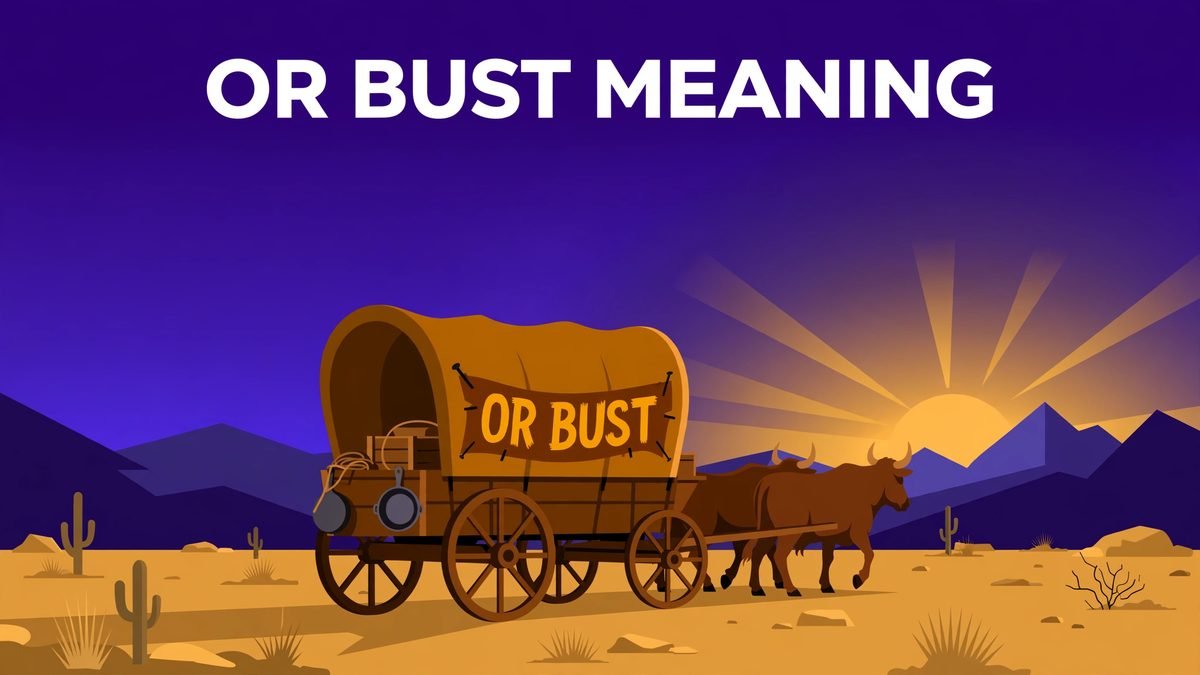
You’ve probably heard that “or bust” was coined by forty-niners heading to the California Gold Rush, with “California or bust!” painted on their covered wagons. It’s a great story — and it feels true, because the phrase’s spirit is pure gold-rush gamble. But the honest historical record is a little more careful than the legend.
Here’s what etymologists can actually verify. The Online Etymology Dictionary traces the pattern “______ or bust” as an emphatic expression to 1851, in British depictions of Western American dialect — squarely in the gold-rush era, but already a recognized turn of phrase rather than a brand-new coinage. Etymonline suggests it probably grew out of an earlier expression, “bust (one’s) boiler,” current by the late 1840s, referring to steamboat boilers exploding when driven too hard. The image is vivid: run the engine at full power and you either get there fast or blow up trying. That’s “or bust” in a nutshell.
As for “California or bust” specifically: the slogan that history documents most firmly isn’t from California at all — it’s “Pike’s Peak or Bust!”, the rallying cry of the Colorado gold rush of 1858–1861, when an estimated 100,000 prospectors headed for the Rockies. The phrase belonged to a whole generation of westward fortune-seekers, the same era that gave American English words like bonanza.
So the gold-rush association is real in spirit — the phrase is a child of mid-1800s American risk-taking — but if anyone tells you a specific forty-niner coined it on a specific wagon in 1849, they’re telling a legend, not history. The documented trail runs through 1851 Western dialect, steamboat boilers, and Pike’s Peak.
“Or Bust” vs. “Boom or Bust”
These two phrases get mixed up because they share two words and a gambling spirit, but they say different things:
| Phrase | What it expresses | Example |
|---|---|---|
| Or bust | Personal determination — my resolve to succeed or fail trying | “Promotion or bust this year.” |
| Boom or bust | An outcome pattern — a situation that will end either spectacularly well or terribly | “Oil towns are boom or bust.” |
“Or bust” is a vow you make. “Boom or bust” is a description of how things tend to go. A startup founder says “profitability or bust” (determination); an economist says “the crypto market is boom or bust” (observation).
Correct vs. Incorrect Usage
Correct:
- “We leave at dawn — Portland or bust!” (a journey with total commitment)
- “For the national team, it’s win or bust.” (anything less than victory = failure)
- “She moved to Nashville with her guitar and an ‘or bust’ attitude.” (as a modifier describing resolve)
Incorrect or awkward:
- “I need milk or bust from the store.” (The stakes are too low — the phrase needs a goal worth gambling on. This reads as a joke, which is fine if that’s the intent.)
- “The meeting is at 3 or bust.” (There’s no risk or grand ambition here; use “sharp” or “no excuses” instead.)
- Using it in formal writing: “The merger is completion or bust.” In a board report, say “the merger must be completed; there is no alternative.”
Common Mistakes
1. Treating it as a literal prediction
“Or bust” describes commitment, not probability. Saying “championship or bust” doesn’t mean the team will literally fold if it loses — it means the speaker counts anything less as failure. Don’t confuse the vow with a forecast.
2. Using it for small stakes
The phrase carries the weight of blown boilers and gold-rush wagers. Deploying it for grocery runs drains its power. Save it for goals that genuinely feel all-or-nothing.
3. Assuming the California story is documented fact
“California or bust!” is the version everyone remembers, but the paper trail points to 1851 Western dialect, steamboat boilers, and the Pike’s Peak slogan. The gold-rush era is the right neighborhood; the exact address is uncertain.
4. Confusing “bust” with the sculpture
A bust can also be a sculpture of someone’s head and shoulders (from French buste) — a completely different word with a completely different history. In “or bust,” it always means breakage, ruin, or failure, never the statue.
FAQs
What does “or bust” mean in simple terms?
It means “I will achieve this goal or fail completely trying — there is no backup plan.” It expresses total determination.
Where did “or bust” originate?
In the mid-1800s American West. The pattern “______ or bust” is attested by 1851 and probably comes from “bust (one’s) boiler,” referring to steamboat boilers exploding when pushed too hard. It’s often linked to the gold-rush era — most famously the “Pike’s Peak or Bust!” slogan of 1858–1861.
Is “or bust” formal or informal?
Informal. It works in conversation, headlines, slogans, and social media, but not in formal reports or academic writing.
Can “or bust” be used as an adjective?
Yes, informally — as in “an or-bust attitude” or “an or-bust season.” Hyphenate it when it modifies a noun.
What’s the difference between “or bust” and “do or die”?
They’re close cousins. “Do or die” is older (it goes back to at least the 1800s, with military overtones) and sounds more solemn; “or bust” is more American, more casual, and more associated with quests and journeys.
The Takeaway
“Or bust” is America’s three-syllable mission statement: pick the goal, burn the backup plans, and accept that failure is the only alternative to success. Born in the steamboat-and-gold-rush West of the 1850s and still going strong on car windows and locker-room walls, it survives because the feeling it names — the beautiful, terrifying clarity of having exactly one acceptable outcome — never goes out of style.